
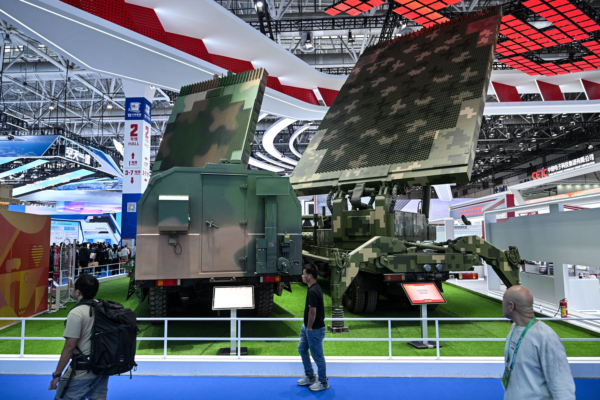
The Chinese Communist military industry system is facing “internal and external troubles”. On one hand, the air defense systems purchased by Venezuela and Iran have failed in real combat, leading to losses in the foreign market. On the other hand, the authorities’ internal purges are intensifying, dealing a heavy blow to the operation of the military industry. Analysts believe that this is a fundamental issue with the technological system, without competition and independent supervision, the Chinese Communist military industry is facing a vicious cycle.
Since the end of February, in the military actions against Iran by the United States, the Chinese air defense systems equipped by Iran have become a joke.
Currently, experts outside believe that Iran’s air defense consists of a combination of Russian (S-300/S-400), Chinese (Red Flag series/JY radar), and domestically equipped systems. Iran also has the Chinese-made YLC-8B air defense radar, claiming to counter invisible fighter jets. As a result, Israeli fighter jets easily penetrated Iranian airspace without opposition, resulting in the casualties of top Iranian officials including Ali Khamenei.
The YLC-8B is a long-range UHF band early warning radar developed by the China Electronics Technology Group Corporation (CETC).
In January, the US military carried out a surprise attack in Venezuela and captured President Maduro. Venezuela reportedly purchased the JY-27 “anti-stealth” radar from China, acquiring 9 sets, boasting the “most powerful air defense network in South America”. China claimed it could detect US F-22 and F-35 aircraft, yet within 3 hours, American special forces captured individuals without any of the 9 radars detecting a single US aircraft.
In June of last year, Israel launched the “Twelve-Day War” air raids. After the ceasefire, Iran urgently purchased the “Hongqi-9B” air defense system from China. In November of the same year, Iran also publicly displayed advanced radar systems, including the Chinese-made “JY-26 long-range anti-stealth radar” and the “JY-10 air defense command and control system”.
Both Venezuela and Iran are important export destinations for Chinese weapons, but those air defense facilities and strategic deployments crumbled before the US military, sparking discussions on social media.
Some netizens commented, “The air defense systems sold to Iran and Venezuela were completely useless. The whole world saw it. Where is the customer service? It’s a failure! Demand a refund and compensation for losses!” Another comment mentioned that a war in Iran might lead to losses for China in Middle Eastern arms trade, such as bad debts and interruptions in technology licenses, but the figures cannot be estimated.
Researcher Shen Mingshi from the Taiwan Institute for National Defense Security told Epoch Times that the facts prove that under US interference, both remote warning radars and air defense radars and missiles from China have lost their effectiveness, which will definitely affect China’s arms exports.
He analyzed that the dysfunction of China’s air defense system may be due to design or production issues, poor quality, or challenges from US weaponry owing to counterfeiting.
Deputy Researcher Xie Peixue from the Taiwan Institute for National Defense Security’s Network Security and Decision Simulation Research Institute told Epoch Times that the joint US and Israeli strikes on Iran showcased the real combat performance of Chinese-made weapon systems to the world, including Russian-made systems, which was a disgrace for China and Russia.
He said, “The military circles now have doubts about China’s (CCP) arms.
This negative effect is more direct than any external sanctions on the CCP.”
Since Xi Jinping’s crackdown on the military and military-industrial complex in 2023, the scope of impact has been expanding.
At least 12 state-owned military companies under the Chinese Communist Party include China Nuclear Industry Corporation, China Aerospace Science and Technology Corporation, China Aerospace Science and Industry Corporation, Aviation Industry Corporation of China, China Shipbuilding Industry Corporation, China State Shipbuilding Corporation, China Ordnance Industry Group, China Ordnance Equipment Group, China Electronics Technology Group Corporation, China Aero Engine Group Corporation, China Electronics Information Industry Group, and China Academy of Engineering Physics. From publicly available information, these state-owned military companies have seen almost no one spared in the anti-corruption efforts in recent years.
In February, former Chairman of the China Aviation Industry Corporation Zhou Xinmin, former Chief Engineer of China Nuclear Industry Corporation Luo Qi, and former director of China Academy of Engineering Physics Liu Cangli had their National People’s Congress positions revoked. Recently, those also confirmed to have their National Committee of the Chinese People’s Political Consultative Conference positions revoked include former Chairman of China Aero Engine Group Cao Jianguo, former Chairman of China Satellite Network Group Zhang Dongchen, former Chairman of China Electronics Information Industry Group Zeng Yi, former General Manager of China Electronics Technology Group Fan Youshan, and former Director of the National Defense Science and Technology Bureau Zhang Kejian.
Many fallen military background officials have not been publicly disclosed, and Ma Xingrui, a current Politburo member who has been missing for a long time, also served in the Aerospace Science and Technology Group.
In December 2025, the Stockholm International Peace Research Institute (SIPRI) reported that in 2024, the overall revenue of large Chinese military enterprises (such as AVIC, NORINCO, CASC) decreased by 10% (to approximately $88.3 billion), while the global arms industry generally saw growth.
The report listed that the largest land-based weapon system producer in China and the 11th-ranked on the 100 largest firms list, the China Ordnance Industry Group (NORINCO), saw the largest drop. The company’s arms revenue fell by 31% to $14 billion due to the dismissals of the chairman and military department heads on corruption charges in 2024, causing government reviews or delays in the company’s major contracts.
According to the report, the 17th-ranked China Aerospace and Missile Manufacturer China Aerospace Science and Technology Group (CASC) saw a 16% drop in arms revenue to $10.2 billion. This was mainly due to the dismissal of its president on corruption charges in late 2023, leading to delays in military satellite and carrier rocket projects.
The poor performance of Iranian use of Chinese military equipment has led some netizens to speculate that it may trigger a new round of cleansing in the military industry and equipment departments. Some netizens said, “Xi Jinping does not want to become the second Ali Khamenei. He has been thoroughly disappointed by Chinese military industry, and a larger clean-up of the military industrial system will follow.” “Due to industry monopolies and corruption, the military industry’s capabilities are weaker than enterprises under similar market competition.”
Shen Mingshi said that the corruption in the Chinese Communist military industry is essentially about the transfer of interests between the military industry and the army, or stealing foreign technology to produce assembled or counterfeit goods, causing performance issues.
He believes that Xi Jinping’s cleanup merely involves personnel changes, but does not address the fundamental issues, including the basic technological system problems, where changing people alone cannot solve the problems.
Xie Peixue said that the losses from export sales, coupled with internal purges, have put the Chinese Communist military industry in a rare dual crisis of internal and external tensions.
Xie Peixue also believes that Xi Jinping’s bring-down on military enterprises does not solve the problem because corruption is systemic, and removing high-ranking officials from a particular military enterprise cannot resolve it.
“State-owned enterprises monopolize all military orders, without a competitive mechanism, without independent supervision of contract reviews, and in a highly closed environment. No matter how many people are swapped, the problem remains. The Chinese Communist military industry is facing a vicious cycle.”