
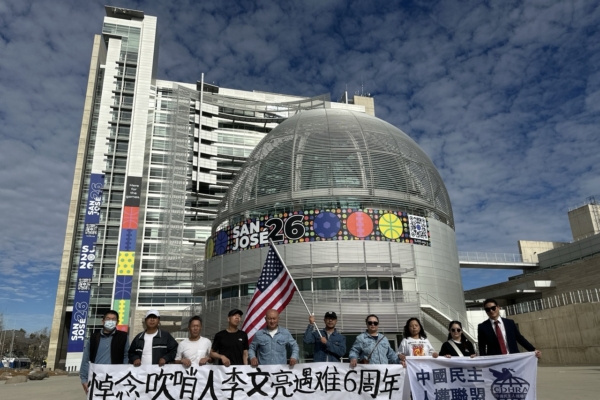
On the afternoon of March 1st, more than ten people gathered in front of San Jose City Hall to commemorate the sixth anniversary of the passing of Dr. Li Wenliang, the “whistleblower” of the COVID-19 pandemic.
This event was organized by the San Francisco branch of the Chinese Democracy and Human Rights Alliance. Participants recalled their experiences during the early days of the COVID-19 pandemic, calling on the international community to pay attention to issues such as freedom of speech, human rights, and the impact of public policies in China, and to hold the Chinese Communist Party accountable for the damage caused globally by the virus.
The organizer Li Haifeng stated during his speech that at the end of December 2019, Dr. Li Wenliang warned in a WeChat group of fellow doctors that the virus could be transmitted between humans. He was subsequently summoned and rebuked by the Chinese public security, forced to sign a guarantee letter. Li Haifeng pointed out that a sentence spoken by Li Wenliang before his death, “A healthy society should not have only one voice,” is still widely quoted today. He emphasized how the pandemic spread globally, affecting everyone’s lives and destinies. Li Wenliang’s Weibo account continues to receive messages of mourning from netizens, with readings reaching hundreds of millions over the years.
Vice Chairman of the Chinese Democracy and Human Rights Alliance, Shi Qingmei, rushed from Los Angeles to Northern California to participate in the event that day. She expressed that if relevant information at the end of 2019 had been disclosed promptly, the loss could have been mitigated. She emphasized the importance of “natural rights” and freedom of speech and stated that expressing opinions openly in the United States is a way to voice support for those still advocating for citizen actions in China. Shi Qingmei told reporters that if the truth of the pandemic had been revealed in a timely manner, greater disasters could have been avoided. She made this trip specifically to commemorate Li Wenliang and urged accountability for the Chinese Communist Party’s role in the pandemic.
Zhou Zhigang, from Xinyu, Jiangxi, who had worked for the state-owned enterprise New Steel Group, detailed his personal experience. He explained that during the pandemic, his workplace required vaccination, stating, “No vaccination, no work,” or they might face layoffs. After receiving three doses of the vaccine, about half a year later, a chest tumor the size of a fist was discovered during a check-up. He described the surgery in 2022 as occurring in a tense medical environment where the risks were high. Zhou also mentioned the sudden lifting of epidemic prevention policies at the end of 2023. During a self-driving trip, he passed through several rural areas where he saw many villages with white sails and coffins displayed.
Another organizer, Zhang Yong, mentioned that in his view, the Li Wenliang incident was “not an isolated case.” During the pandemic lockdown, the company he was in had over 60 employees, with his responsible projects gradually ceasing, after a year, leaving just over ten people. He also brought up the fire incident in Urumqi, Xinjiang, believing that under the high-pressure accountability system of the Chinese Communist Party, grassroots personnel, out of concern for responsibility issues, failed to open doors for evacuation promptly, leading to serious casualties.
Qiu Guanghui, from Wuhan, shared his experience of visiting the hospital where Li Wenliang worked. He recalled seeing reports of an unknown virus in Wuhan before the city was locked down while he was on a business trip. He believed that whether Li Wenliang was the “first whistleblower” was not the key issue; instead, it was about the transparency of information.
Yang Kun expressed during his speech that reminding of risks based on professional judgments was a normal behavior for doctors, but Li Wenliang was admonished for it, stating, “In some systems, there is no right or wrong, only positions.”
Li Shuqing recollected his life under the lockdown in China, describing how there was strict control where “if they say lock down, it’s locked down,” with residents unable to freely travel for extended periods, impacting even basic daily life. He also mentioned experiencing similar strict control measures during the SARS period in 2003.
During an interview, Peng Xuandong expressed that Li Wenliang, out of medical ethics, spoke the truth in the early stages of the pandemic but was suppressed by the Chinese authorities to maintain so-called social stability, ultimately losing his life. He believed that this reflected the Chinese Communist Party suppressing the truth for its own interests.
The event concluded with a group photo of participants. The organizers expressed their hopes that through annual commemorative events, relevant historical events and public discussions would continue to receive attention.