
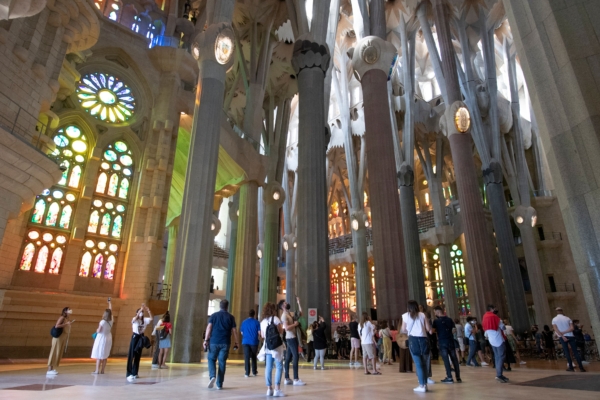
The Sagrada Familia is a large church located in Barcelona, Spain, designed by the renowned Spanish architect Antoni Gaudí, the most famous architect of the 19th century. Construction of the church began in 1882, but it was only one-quarter completed by the time of Gaudí’s death in 1926. The construction progress has been sporadic over time, earning it the nickname of the “never-ending construction” by the public.
On the morning of February 20th at 11:00 a.m., when construction workers used a crane to install the final piece of the cross on the top of the “Christ the Redeemer Tower,” the Sagrada Familia was finally declared topped out. With this, the overall height of this grand church reached 172.5 meters, finally realizing the height design envisioned by Gaudí. It has now become the “tallest church in the world.” In fact, as of October of last year, the Sagrada Familia was already the world’s tallest church.
Since the start of construction in 1882, the Sagrada Familia has endured two World Wars and faced periods of suspension due to insufficient funds. Additionally, the intricate and unconventional design caused technical challenges, leading to intermittent construction halts and restarts.
In 1926, Gaudí tragically passed away in a mysterious car accident, never witnessing the completion of this ambitious project. However, a century later, this extraordinary and unconventional architectural marvel is finally on track to completion.
The Sagrada Familia is divided into three facades – east, west, and south. The architect depicted various scenes from the Bible throughout the building, resembling a series of paintings, showcasing a unique architectural style. Today, it has become one of the most famous tourist attractions in Barcelona, as well as the only unfinished building listed as a UNESCO World Heritage Site.
It is understood that the construction funds for the Sagrada Familia mainly rely on ticket sales and donations. Currently, the interior of the “Christ the Redeemer Tower” is still under construction, while the exterior remains enveloped by cranes and scaffolding. The construction team anticipates that on June 10th of this year, the “Christ Tower” will be officially completed, coinciding with the 100th anniversary of Gaudí’s passing, when a grand inauguration and consecration ceremony will be held.
The construction team also mentioned that the full completion of the church is expected to take approximately another ten years.