
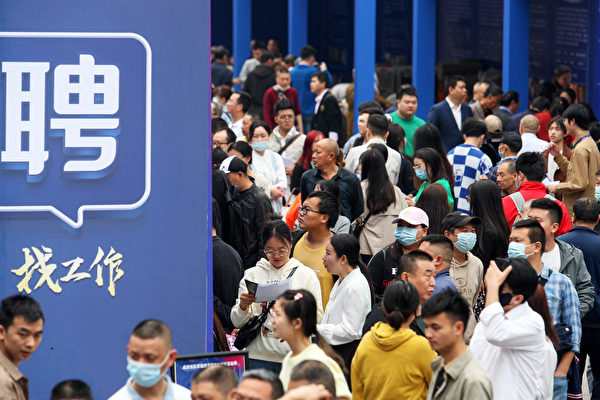
The Chinese authorities expect that the number of college graduates this year will reach 12.7 million, an increase of 480,000 compared to last year’s figures. The number of Chinese college graduates last year was expected to reach 12.22 million. The social crisis caused by youth unemployment has attracted attention.
Minister of Human Resources and Social Security of the Chinese Communist Party, Wang Xiaoping, announced on March 7th during the National People’s Congress that the number of college graduates this year is expected to reach 12.7 million, an increase of 480,000 compared to last year’s figures.
Wang Xiaoping admitted that uncertainties and difficulties in anticipation are increasing, and the issue of “ensuring employment” is facing new changes and challenges.
This data was officially announced by the Chinese Ministry of Education on November 20, 2025, and was reported by official media outlets.
Since 2022, the number of Chinese college graduates has surpassed 10 million annually. In 2022, there were 10.76 million, an increase of 1.67 million compared to the previous year; in 2023, there were 11.58 million, an increase of 820,000; in 2024, there were 11.79 million, an increase of 210,000; in 2025, there were 12.22 million college graduates, an increase of 430,000.
In recent years, Chinese youths have been facing the dilemma of “graduating into unemployment,” but the authorities have deliberately concealed this issue. Since 2022, the youth unemployment rate in China has risen significantly, reaching a peak of 21.3% in June 2023. Afterward, the authorities stopped publicizing the youth unemployment rate. It was not until January 17, 2024, that the “unemployment rate excluding students” was released after “adjustments”.
According to official data from the National Bureau of Statistics of the Chinese Communist Party, the latest youth unemployment rate (excluding students) published in December 2025 was 16.5%, showing a continuous decline for 4 months, reaching a six-month low.
However, industry experts believe that since Chinese university graduates actually start submitting resumes, internships, and job hunting one or two years before graduation, and even consider “job hunting” as their main activity, those who are still in school or have not found full-time employment are not counted in the unemployment statistics. This exclusion of the “quasi-unemployed” group leads to the official data not reflecting the true impact of a surge of graduates entering the job market.
According to Wang He, a China expert in the United States, the U.S. Bureau of Labor Statistics (BLS) includes individuals aged 16 and over who are capable of working and actively seeking employment in the past four weeks based on household surveys in its labor force calculations. If students are actively seeking work but cannot find it, they are considered unemployed; if they are not currently seeking work (such as full-time study), they are not included in the statistics.
As disclosed by the Chinese Ministry of Human Resources and Social Security in May 2021, the scale of so-called “part-time personal business and new employment forms such as flexible employment” amounted to 200 million people. “Flexible employment” has long been criticized as synonymous with semi-unemployment or unemployment, similar to past terms like “laid off” or “unemployed”.
China currently has a large number of flexible workers (defined as those who worked for one hour or more within the survey week to obtain labor compensation), including temporary workers and part-time employees. In the United States, working for at least 15 hours a week is considered employment, while in France, it is 20 hours.
The Chinese job market is rapidly shrinking, and more and more post-2000s youth are being forced to drop out of the competitive system, choosing to “lie flat” or even self-mockingly calling themselves “lying flat rats”. Many interviewees point out the challenges of finding work, sustaining income, lack of trust in the Chinese system, leading to a loss of expectations for marriage, childbirth, and life planning.
Xu Xin, a scholar at Renmin University of China, pointed out the emergence of a hidden population segment that is “not working, not employed, not consuming, and not appearing in statistics,” stating that the real social rupture is not rage but silent withdrawal.
Yuan Hongbing, a scholar in Australia, previously expressed that as the most knowledgeable group, being in long-term unemployment or semi-employment status directly undermines the youth’s confidence in the future.
Renowned Chinese economist Liu Yuanchun has warned earlier that if not handled properly, the continuously rising youth unemployment rate in China could trigger a political crisis.