
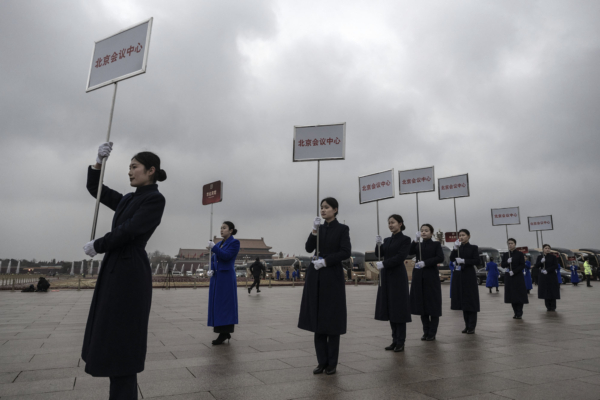
At the annual session of the National People’s Congress of the Communist Party of China, Premier Li Keqiang stated in the government work report that the main expected goal for China’s development in 2026 is an economic growth of 4.5% to 5%. This is the first time in decades that the CCP has set the GDP growth target below 5%, signaling significant implications and drawing high attention from global markets.
The adjustment of China’s GDP growth target to 4.5% to 5% is widely interpreted by international public opinion and experts as a reflection of the CCP government’s necessity in setting such a target amidst current internal and external challenges.
Bloomberg analysis points out the uncertainty in the global trade environment in 2026, suggesting that the role of mainland China’s exports in driving the economy may weaken, thus the 4.5% to 5% range reflects the CCP government’s cautious assessment of the pace of internal demand recovery.
The Economist comments that this targeted range aligns with the long-term trends of China’s population structure changes and declining labor supply.
J.P. Morgan believes the target meets market expectations, but the key lies in how to boost confidence in private enterprise investment, as relying solely on government expenditures may struggle to maintain the growth rate stability.
Financial Observers have put forward a sharper perspective. Financial blogger “Wei Hu” points out the significant internal pressures faced by the Chinese economy: four consecutive years of deflation, declining business profits, some companies running at a loss, and an increase in unemployment. Meanwhile, external pressures from Western trade partners led by the United States and geopolitical tensions in the Middle East (such as the conflict risk between Israel and Iran) have added to the global market uncertainties.
He states that the rising tensions in the Middle East, especially the conflict risk between Israel and Iran, further increase global market uncertainties. While facing external variables, China internally continues to grapple with issues like a sluggish real estate market and inadequate domestic demand, which to some extent weaken the economic growth momentum.
He also alleges that the CCP’s statistics bureau falsified data. In reality, in 2025, Chinese fiscal tax revenues not only did not increase but decreased by 1.7%, with over 50% of listed companies operating at a loss. He questions how China can achieve a growth target of up to 5% under these circumstances.
Li Keqiang set the annual consumer price index (CPI) inflation target at “around 2%” in the government work report.
U.S. business and financial media point out that this data appears more like a ceiling rather than the final target to be achieved.
“Wei Hu” notes that official CCP data show that the CPI barely increased throughout the year 2025, with the core CPI, excluding food and energy prices, growing only by 0.7%. This reflects the extremely weak domestic demand in China, also a core reason for deflation: insufficient purchasing power or confidence among residents leading to sluggish consumption growth.
“The growth in CPI is the lowest in over two decades, as well as the GDP growth target being the lowest in decades. It’s not an exaggeration to say that China’s economy is sending out the most dangerous signals ever.”
The 2026 government work report reveals plans to issue approximately 1.3 trillion yuan of super long-term special national bonds, with around 250 billion yuan allocated to stimulate domestic demand and consumption, including measures like trading in old for new consumer goods. Additionally, another 300 billion yuan of special national bonds is set to supplement the capital of large state-owned banks. Local government special bonds totaling 4.4 trillion yuan are also proposed for major project construction, replacing implicit debt, and clearing overdue accounts.
“Wei Hu” points out that these debt arrangements highlight the massive fiscal deficits of both central and local governments. Simultaneously, the downturn in the real estate sector poses significant pressure on the financial system, especially large commercial banks, requiring the government to respond like “firefighters” to sudden issues.
In Li Keqiang’s government work report, specific content regarding real estate mainly focuses on “efforts to stabilize the real estate market.”
According to “Wei Hu,” the real estate industry can “die,” but when it does, it must not cause trouble to society, increase unnecessary stability maintenance costs for the Party-State.
The latest data released by the China Index Research Institute on March 1st shows that the average selling price of newly built residential buildings in 100 Chinese cities dropped by 0.04% month-on-month in February.
Reuters reports this as the largest month-on-month decline since December 2022.
Since the end of 2016, when the Central Economic Work Conference of the CCP first pointed out the issues in the housing market, stating that “housing is for living, not for speculation” to curb soaring house prices, a decade has passed. China’s property market has plummeted from its peak, with property prices widely dropping by 40% or more, showing no signs of bottoming out.
The most crucial measure to control the housing market was the full implementation of the “Three Red Lines” policy started in 2021, targeting the debt of real estate enterprises, directly leading to financing difficulties for many firms. Giants like Evergrande and Country Garden, along with dozens of small and medium-sized enterprises, have defaulted, with over 70 developers going bankrupt or barely surviving with government support.
In recent years, the persisting downturn in the real estate sector has continued to drag down the Chinese economy, with property prices and related investments still on the decline. According to data from the National Bureau of Statistics of China, in 2025, the national real estate development investment amounted to 8.278 trillion yuan, a yearly decrease of 17.2%; new housing construction area decreased by 20.4%; sales of new commercial housing area decreased by 8.7%, and sales amount decreased by 12.6%, indicating a sustained decline in property prices.
Chinese real estate information data shows that in October last year, the sales of the top 100 real estate enterprises dropped by 42% compared to the same period, marking the largest monthly decline in 18 months. In November last year, the CCP authorities requested private data agencies to stop releasing housing sales data, cutting off one of the few independent sources for understanding the real estate market’s difficulties.
Based in Taipei, J Capital Research’s founder and research director Anne Stevenson-Yang believes that this measure aims to conceal the true extent of price declines.
She told Deutsche Welle, “The overall market decline may have reached 50%, and before reaching a new equilibrium, it might even plunge to 85%.”
She cited an example where a peer from Xi’an was offered a package deal by developers to sell three properties for the price of one, equivalent to a two-thirds drop in property prices.
A report from the Oxford Economics Research Institute last September indicated that in first-tier cities like Beijing and Shanghai, average property prices had fallen by around 10% from their peak, with a more pronounced price adjustment due to cooling demand for high-end residential properties. However, the real disaster zones are second and third-tier cities, such as Chengdu and Dongguan, where property prices have plummeted by up to 30%.