
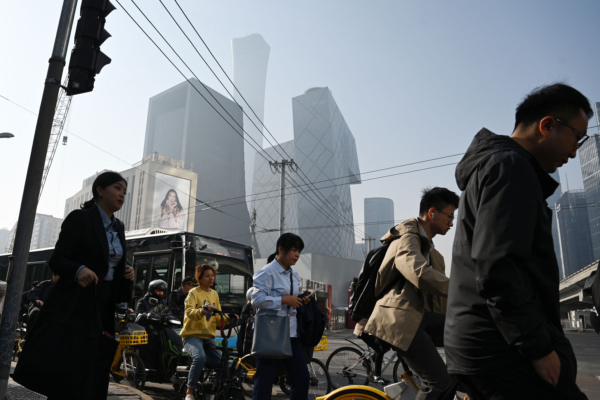
In recent years, Beijing, once a sought-after place for many young people, has not been able to escape the effects of the continuing economic downturn. The dream of young people to seek opportunities in the capital city has quietly evolved after the Chinese New Year, with many starting to hesitate about whether to return to Beijing to continue their entrepreneurial journey.
According to official data from the Beijing Municipal Bureau of Statistics and others, as of the end of 2024, the number of young residents aged 20 to 34 in Beijing had decreased by 345,000 compared to the previous year, reaching 4.542 million. Compared to 2020, there was a decrease of 1.216 million young people in the city. Data for 2025 has not been released yet.
At the same time, China’s overall youth employment situation is also under pressure. Official data released by the Chinese Communist Party on January 22 showed that the unemployment rate for non-students aged 16 to 24 in December 2025 was 16.5%, continuing to decline for four consecutive months.
Chinese issues expert Wang He previously told Epoch Times that this data does not reflect the true situation because the CCP’s statistics only include youth unemployment rates in urban areas, excluding youth living in rural areas, resulting in many hidden unemployment cases not being reflected in the statistics.
Against the backdrop of increasing youth employment pressure, some young people have begun to reconsider whether to continue staying in first-tier cities for their development. These shifts are also evident in the post-New Year rush back to Beijing.
Zhou Lin, a post-90s college graduate who did not return to his hometown for the New Year this year, spent the holiday alone in a rented room in Beijing. He told Epoch Times, “I feel like there are fewer people around now; the whole society is confused, and everyone can’t see the direction of the future.”
Four years ago, Zhou Lin joined the ranks of the “Northern Drifters,” moving to Beijing alone for work and life. In previous years, he would bring home a year’s worth of income to reunite with his family for the New Year, but this year was different.
The reason he did not return to his hometown was that he could not find a stable job in 2025, and his income had also decreased. Zhou Lin said, “There are indeed many people who cannot find jobs. Some work hard every day for a meager monthly salary of a few thousand yuan.”
According to Zhou Lin, most of his friends and colleagues have returned to their hometowns for the holiday, but some have decided not to return to Beijing or are considering whether to continue working and living in the city. “Many people are not coming back to Beijing, especially those born in the 90s and 00s; many of them want to relax at home.”
He mentioned that many people think, “If I relax at home, my monthly living expenses won’t cost much. This generation of people born in the 90s and 00s, their parents still have some savings. Parents with money are considered affluent while those without are reliant on their parents.”
Lin Ming, also a member of the “Northern Drifters,” earns a monthly salary of 10,000 yuan, but he admitted that this is not considered high in Beijing. “I want to earn more. I tried delivering food after work, coming home late at night after tough work, earning around 1,800 yuan a month. It is exhausting.” He is uncertain how long he can sustain in Beijing.
For people like Lin Ming with relatively decent income, the pressure of living is already significant, let alone for younger individuals with lower incomes.
Lu Xin, who lives alone in Beijing, earns just over 6,000 yuan per month. He calculated his expenses, with 2,000 yuan for rent, 1,500 yuan for meals, 600 yuan for utilities, internet, phone bills, and 1,000 yuan for daily necessities and clothing. Plus, socializing and sending money to parents during festivals leave him with no savings.
He said that before the Chinese New Year, his colleagues and friends had already left Beijing for their hometowns. Some friends who are in business mentioned that the business is getting tougher, and they do not plan to return after the holiday.
Some choose to stay, some choose to return to their hometowns, and others are considering moving south to find new opportunities. Sun Wu, a local resident of Beijing, expressed, “Why do many people choose not to stay in Beijing? Life here is tough!”
He mentioned that the political environment in Beijing is becoming increasingly tense, and discussing such topics is considered sensitive. “I’m not staying in Beijing anymore.”
From striving to make it to Beijing by any means necessary to questioning whether to stay, for young people, is it an ideal or a burden? They are making their choices.
(Interviewees are all given pseudonyms)