
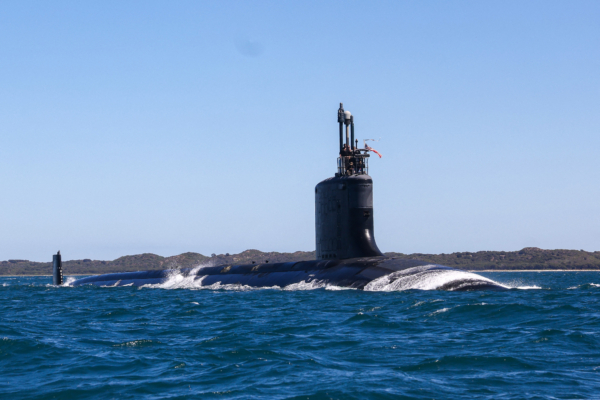
Australian Prime Minister Anthony Albanese confirmed on Friday that three Australian defense personnel were on board the U.S. submarine that sank the Iranian escort ship IRIS Dena in the Indian Ocean this week.
Albanese emphasized that the presence of Australian personnel aligns with longstanding international training agreements. Australia, a close ally of the United States, supports efforts to prevent Iran from developing nuclear weapons but stated that it will not play any military role in the current conflict.
The incident took place in the waters near the southern coast of Sri Lanka in the early hours of Wednesday. U.S. Defense Secretary Pete Hegseth described it as a “decisive and devastating” victory during a briefing at the Pentagon.
He stated, “A U.S. submarine sank an Iranian military ship that thought it was safe in international waters. It was sunk by a torpedo – a silent death.”
This marks the first time since World War II that a U.S. submarine has sunk an enemy vessel in a combat mission. Sri Lankan authorities later recovered the bodies of 87 Iranian sailors from the sea, with 32 survivors. Defense media speculate that the involved submarine may have been the USS Minnesota, a Virginia-class submarine.
On Friday, Albanese explained in an interview with Sky News that the personnel were rotated on U.S. vessels under the AUKUS agreement (the trilateral security partnership between the U.S., UK, and Australia), aiming to accumulate practical experience for Australia’s future operation of nuclear-powered submarines.
He pointed out, “This is a major advantage of the AUKUS agreement, allowing Australian personnel to gain experience across various military assets, including nuclear-powered submarines operations, facilitating comprehensive exchange.”
Albanese further noted that this cooperation model is not unprecedented and has been in place as a third-country arrangement for a long time.
According to Australian Navy data, about one-tenth of the crew in U.S. attack submarine fleets are Australians, showcasing a high level of integration among allies.
Donald Rothwell, an international law professor at the Australian National University (ANU), analyzed that in light of the armed conflict between the U.S. and Iran, under international law, the Iranian warship is a legitimate target.
This incident once again brought the AUKUS agreement into focus. Strategic analysts widely believe that the primary aim of the agreement is to enhance military deterrence against China’s expansion in the Indo-Pacific region.
Albanese highlighted that one of the significant advantages of AUKUS is providing Australian talents, including engineers and technical personnel, with training on the world’s most advanced defense assets.
This operation unexpectedly became a microcosm of the practical operation of AUKUS, demonstrating the close collaboration between the U.S. and Australia in safeguarding regional security.