
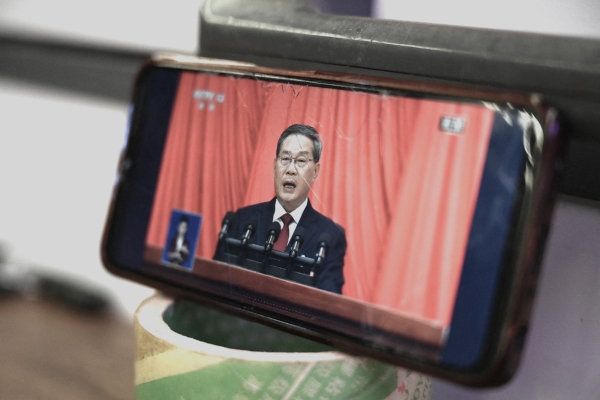
On March 5, Chinese Premier Li Keqiang delivered the government work report to the fourth session of the 14th National People’s Congress, announcing a lowered GDP growth target for 2026 to between 4.5% and 5%. He also unveiled a special fund of billions of yuan to boost domestic demand and advance the “AI+” strategy. Experts pointed out that the downward adjustment of the target reflects the continued slowdown of the Chinese economy, signaling serious issues that are difficult to avoid, and structural problems that are hard to eradicate within the current system.
Li Keqiang set the economic growth target for 2026 at 4.5% to 5%, the lowest specific growth target China has set since 1991 and the third time in history adopting a range target.
The expansion of fiscal policy reached a new high. This year’s planned fiscal deficit ratio is around 4%, with a deficit scale of 5.89 trillion yuan, marking the second consecutive year at a historical high.
Analysts believe that the lower growth target reflects the authorities’ tolerance for economic slowdown. China’s economy has been facing challenges in recent years due to weak household consumption, a sluggish real estate market, and weakening investment momentum, putting continuous pressure on growth prospects.
Chinese economic expert Wang He stated in an interview with Epoch Times that this signifies the shift of the Chinese economy from a stage of high-speed growth to a lower-speed growth phase, representing a transitional period with significance.
“When Xi Jinping came to power, China was still in a phase of high-speed growth, but it later turned into an L-shape, pursuing medium-high speed. However, even the medium-high speed cannot be sustained,” Wang pointed out. The International Monetary Fund predicts that China’s economic growth rate from 2027 to 2030 could drop to around 3%, indicating a long-term downward trend that is hard to reverse.
He believes that the growth target of around 4.5% is more of a politically directed figure related to the Chinese Communist Party’s goal of “basically achieving modernization” by 2035. To double per capita GDP compared to 2020, the annual average growth rate needs to be maintained at around 4.6%.
“This is politically deduced and does not necessarily represent economic reality that can support this figure,” he said, emphasizing that in the absence of structural reforms, the authorities mainly rely on fiscal and monetary stimulus, similar to continuously injecting stimulants into a structurally necrotic body.
Li Keqiang openly acknowledged various economic difficulties in the government work report, including insufficient domestic demand, a sluggish real estate market, high local government debt, and categorized “restraining the irregular increase of hidden debt” as “iron discipline”.
Wang He believes that the public acknowledgment of these issues indicates that China’s economic difficulties have become so severe that they are hard to avoid.
The real estate slump has become one of the significant factors dragging down the Chinese economy. Li Keqiang stated in the report that efforts in 2026 will focus on “stabilizing the real estate market,” including encouraging the acquisition of vacant commercial housing for the use of affordable housing, advancing reforms in the housing provident fund system, and preventing the risk of default on housing enterprise debts.
Since the implementation of the “three red lines” policy in 2021, many real estate companies have faced debt crises due to restricted financing, leading to massive unfinished building incidents. Subsequently, the authorities introduced a “white list” financing system to ensure project completion.
Data shows that in 2025, China’s real estate development investment was 8.28 trillion yuan, a decrease of 17.2% year-on-year; newly started area of houses decreased by 20.4%; sales area of commercial housing decreased by 8.7%, and sales amount dropped by 12.6%. Since the government emphasized in 2016 that “houses are for living, not for speculation,” Chinese housing prices have generally dropped by about 40% or even more. However, the market has yet to find solid ground.
Wang He believes that the crisis in the Chinese real estate sector has caused a significant impact on residents’ wealth and consumer confidence. The government’s policy adjustments toward the real estate industry also carry evident structural intentions. “Xi Jinping hopes to weaken private real estate enterprises through the real estate crisis and have state-owned capital take over leadership. This is also one of the reasons for the delayed market rescue.”
Carlos Casanova, a senior Asian economist at UBP, pointed out that without the stabilization of the housing market, a shift in consumption would not be possible.
The Chinese Communist Party has set this year’s Consumer Price Index (CPI) target at around 2%, the same as last year. However, achieving this target might be challenging, as China’s CPI year-on-year growth rate was only 0.7% last year, indicating persistent weak consumer confidence and increasing concerns among the Chinese people about job prospects and property values.
In reality, China has long faced structural problems of excessive investment and low consumption. Statistics show that China’s investment as a share of GDP is about 20 percentage points higher than the global average, while the share of household consumption is approximately 20 percentage points lower.
This structural imbalance leads to overcapacity, trade friction, and accumulating deflationary pressures.
An article in the French newspaper “Le Monde” points out that more and more international observers believe that the Chinese economy is showing a clear “K-shaped” differentiation. On one hand, industrial production and exports continue to grow. In 2025, China’s trade surplus reached approximately $1.2 trillion, hitting a historic high, with exports’ contribution to economic growth at the highest level in nearly three decades.
On the other hand, domestic consumption remains weak. In December 2025, the total retail sales of consumer goods increased by only 0.9% year-on-year, while industrial output rose by 5.2%.
With inadequate demand, industrial capacity continues to expand, leading to fierce price wars among enterprises, squeezing profit margins, and exacerbating deflationary pressures.
Li Keqiang proposed the establishment of a special fund of 100 billion yuan in fiscal financial coordination to boost domestic demand, the introduction of around 800 billion yuan in policy financial instruments to facilitate investment, and authorization for local governments to issue about 4.4 trillion yuan in special bonds to expand consumption and support the service industry.
However, despite the Chinese Communist Party repeatedly rolling out policies to stimulate consumption, they have often failed to have a substantial impact, lacking concrete and effective measures.
Wang He believes that the root cause of this problem is not economic policy but institutional structure. “To expand consumption, we must strengthen the middle-income group; to strengthen the middle-income group, we must establish a civil society,” he said. “However, a civil society is precisely the thing that the Chinese Communist Party fears the most.”
He describes the Chinese economic structure as a “birdcage economy” – while private enterprises exist, they remain confined within the institutional framework. “Private companies can fly but are restricted within the cage. No matter how high they fly within the cage, they cannot get out.”
In Wang He’s view, what the Chinese economy truly needs is institutional reforms that disrupt the current power dynamics, which are almost unachievable under the existing political system. “Current fiscal stimulus, investment expansion, and technological inputs are primarily aimed at delaying the eruption of problems rather than solving them.”
He concludes that the future direction of the Chinese economy largely depends on whether fundamental institutional adjustments can be made. However, under the backdrop of political and strategic priorities, such changes remain highly uncertain.
Amid the economic slowdown, Beijing views the technology industry as a new growth engine. Li Keqiang introduced the concept of a “new form of intelligent economy” for the first time in the report, emphasizing the advancement of artificial intelligence, quantum technology, brain-machine interfaces, embodied intelligence, and 6G, among other future industries.
Simultaneously, a significant amount of capital is being directed into AI and semiconductor fields. Many traditional companies are also diversifying into the technology sector, hoping to find new growth opportunities with the wave of artificial intelligence. For example, some real estate, tourism, and even food companies have announced acquisitions of semiconductor company shares, in a strategic move to enter the chip industry chain. The stock prices of some listed companies surged significantly in the short term after announcing related acquisition plans.
However, regulatory authorities have raised questions about certain cross-sector mergers and acquisitions, demanding that companies explain their commercial rationale. Some loss-making companies attempting to enter the semiconductor industry are also required to demonstrate ongoing financial capabilities.
Wang He believes that this “technological impetus” reflects the pressure of economic transformation but also carries evident national strategic motives. “The Chinese Communist Party promotes technological self-reliance, which essentially resembles a Soviet-style state mobilization model, driven by political and strategic objectives instead of market demand.”
He warns that a technology route dominated by national will could come at the cost of sacrificing the vitality of private enterprises. “The Soviet Union once competed with the United States through massive military technology investments, ultimately crippling the overall economy.”
Wang He points out that China is currently facing not just the cyclical slowdown of the economy but also simultaneous blockages in domestic and international cycles. With Western countries pushing for “de-risking” China, especially restricting exports of high technology, China’s external development environment continues to tighten.
“To escape this dilemma, China must fundamentally adjust its external strategy, abandon the policy goal of comprehensive competition with the United States, but this is almost impossible in practical politics,” he said.