
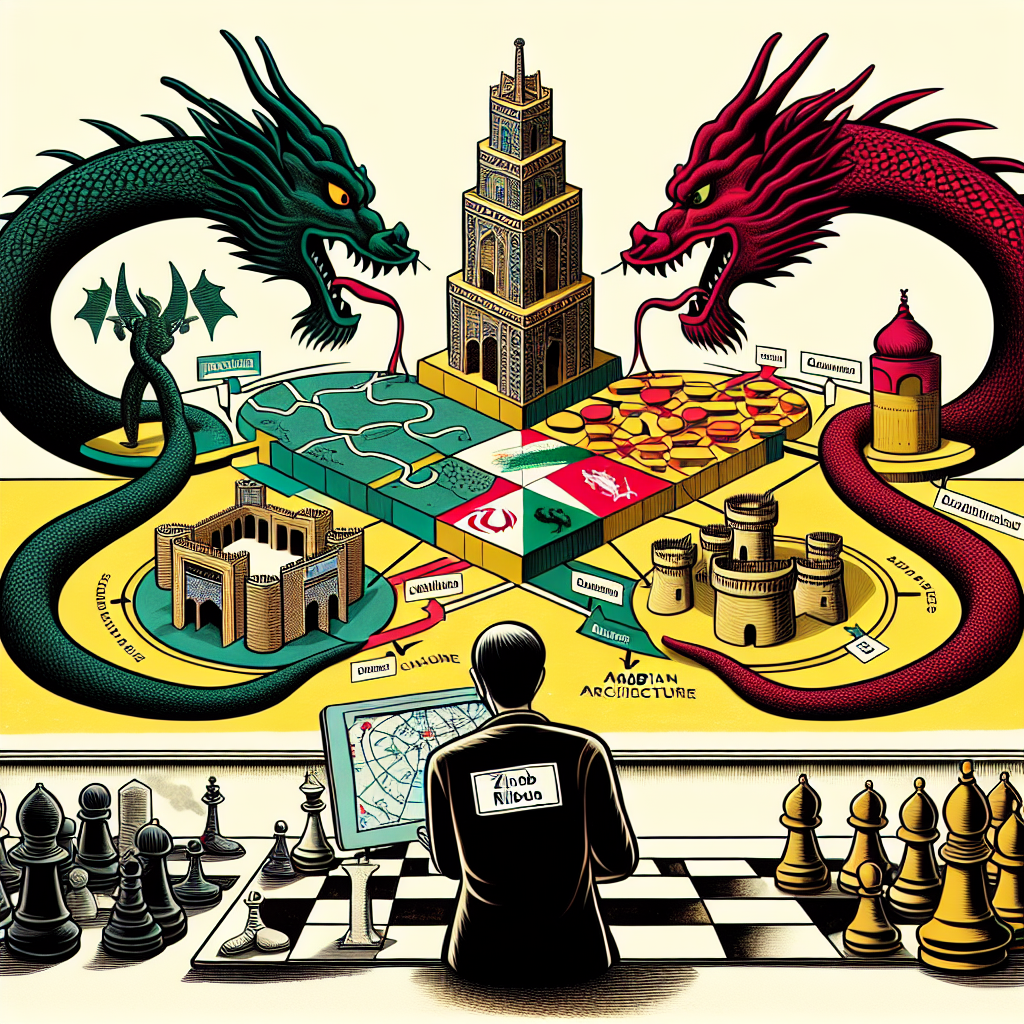
For the past twenty years, Zineb Riboua, a researcher at the Hudson Institute, pointed out that the Chinese Communist regime has been continuously cozying up to, investing in, and cooperating with the Iranian regime, its proxies, and Gulf states to build bases for its “global new order.” However, the American operation “Epic Wrath” has brought this Chinese layout to an end.
On March 4th, Riboua stated in an interview with “American Thought Leaders” that from the perspective of the United States, intervening not only aids allies but also signifies reshaping the Middle East landscape – an area long considered (Communist) China’s chessboard.
She emphasized that Beijing’s expansion inevitably comes at the cost of weakening the United States, and “Iran is a pawn of the Chinese Communist Party in the Middle East.”
Despite China’s efforts to strengthen Iran’s military capabilities and regional influence, the rapid collapse of the Iranian regime will have global ramifications, prompting countries negotiating with China to reassess Beijing’s true position.
Riboua published an article titled “The Iran Question Is All About China” shortly after the start of the American “Epic Wrath” operation, describing the Iran crisis as the prologue to the Indo-Pacific century.
China not only assisted Iran in obtaining various components from its military equipment arsenal, including crucial chemical elements required for missile expansion programs, but also exported its digital authoritarianism to Iran by selling large-scale surveillance technology to the regime. The reliance of Iran’s telecommunications infrastructure on Chinese companies such as Huawei and ZTE has also been noted.
However, Riboua pointed out that in the face of the U.S.-Israel united strike against the Iranian regime on February 28th, China’s support proved to be futile.
She mentioned that many countries, including those in Africa and Southeast Asia, are currently in turmoil and urgently require stability to maintain power. The technologies purchased from China by countries like Venezuela and Iran have proven ineffective, showcasing a significant embarrassment when attempting to compete with the United States.
Riboua estimated that some countries may still engage in cooperation with China, but China will no longer dominate and dictate excessively favorable terms as seen in initiatives like the Belt and Road.
The sudden turn of events in Iran could also lead to embarrassment for the Chinese regime domestically. Beijing has been perpetuating narratives of America’s decline to its 1.4 billion citizens, highlighting Eastern ascension and American helplessness. However, recent events have debunked these misleading claims.
Riboua emphasized that if Chinese leader Xi Jinping attempts to invade Taiwan, Iran would play a crucial role. Iran serves as a significant hub for circumventing sanctions, allowing China to establish parallel systems to sidestep Western financial channels.
Riboua cited Chinese officials boasting about the rise of the Global South and the establishment of a “brand-new world order excluding the U.S.” as indicators of their satisfaction with current alliances, which might vanish with a change in the Iranian regime.
Furthermore, Riboua highlighted the financial burden and prolonged nature of the proxy wars Iran has waged in the Red Sea, potentially leading allies to question American military capabilities.
In the aftermath of the war between Iran and Israel last year, the Islamic regime has been weakened and faces the threat of dissolution, which carries profound geopolitical implications.
She elaborated on the disarray that Iran’s regime is facing, indicating a significant collapse of their command structure and leadership during the conflict.
Riboua’s recent article “China is Scrambling” further expands on the immense impact the Iran crisis has on Beijing.
Iran’s recent attacks on neighboring countries, including Turkey, demonstrate their desperate attempts to compel U.S. allies to call for a ceasefire, which is a clear manifestation of Iran’s increasing frailty.
The ongoing decline of the Iranian regime, especially following the war with Israel, indicates that the regime will bear the consequences of its defeat.
Riboua emphasized that the Islamic Republic, once adept at delaying negotiations with the United States and scoffing at peace efforts, now faces disillusionment from both supporters and dissenters among the Iranian populace.
The inefficacy of the Islamic Republic in fundamental governance matters like water resource management has led to escalating protests from disillusioned young Iranians.
Riboua concluded by emphasizing that President Trump’s actions are not solely anchored in the “Iran threat” narrative or democratic transplantations but rather in a global reorganization aimed at safeguarding American and free world interests.
The opening of the Iranian market to European enterprises in the event of a friendly regime change could lead to immense opportunities and potentially undermine China’s Belt and Road Initiative.
In summary, Riboua’s analysis underscores the shifting dynamics in the Middle East, particularly with China’s entanglement in the Iran crisis and the broader implications for global geopolitics.