
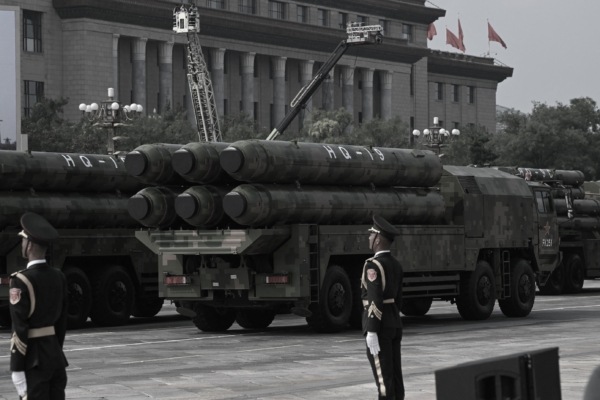
The National People’s Congress of the Chinese Communist Party (CCP) opened today on March 5th. Official data shows that the CCP’s military budget has exceeded 7% for five consecutive years, with this year being the lowest in five years but still higher than the GDP growth target. The GDP growth target for this year has also been adjusted. Several experts have interpreted the underlying signals.
According to the budget report released by the CCP’s Ministry of Finance today, China’s military budget for this year is 1.909561 trillion yuan, a 7% increase from last year.
Since 2022, the CCP’s military budget has seen growth rates exceeding 7%. It increased by 7.1% in 2022, 7.2% in 2023, 7.2% in 2024, 7.2% in 2025, and the defense expenditure budget for 2026 grew by 7%, marking the lowest increase since 2022.
Premier Li Keqiang announced today that this year’s economic growth target is set at 4.5% to 5%. This figure is lower than the previous “around 5%” growth target.
The local CCP congresses held since late January have seen more than ten provinces adjusting their GDP growth targets for 2026 downwards, indicating a conservative outlook on the economic prospects at the local level.
American economist David Huang mentioned to Dajiyuan that this figure illustrates the current strategy of the CCP government, focusing on stability in growth rather than pursuing high growth rates. One reason is the downward pressure on the current Chinese economy, with serious issues in the real estate market, local government debts, and insufficient consumption, leading to more cautious target setting. Additionally, setting too low of a target may undermine market confidence.
Independent financial media figure “Financial Insight” told Dajiyuan that China’s military spending has seen significant growth over the past two to three decades. As the world’s second-largest military spender, its budget has already expanded substantially. The slight decrease now could be due to significant financial issues within the CCP. The adjustment in China’s economic growth target indicates significant problems within the Chinese economy.
Senior political commentator Chen Pokong mentioned that since Xi Jinping took office, the Chinese economy has been steadily declining. With recent changes in Venezuela and Iran, major oil suppliers to China, combined with the ongoing China-US trade war, the future of China’s economy has become increasingly uncertain, making the CCP’s planned 4.5% economic growth target unbelievable.
China’s military budget has maintained single-digit growth since ending double-digit growth in 2016, consistently exceeding the GDP growth targets each year. Since the late 1990s, the growth rate of the CCP’s military budget has surpassed the GDP growth target in most years.
Researcher Shen Mingshi from the Taiwan Institute for National Defense and Security Studies told Dajiyuan that China’s current economic growth is only at 5%, yet its defense budget is increasing by 7%, indicating the CCP’s need to continue investing heavily in its military capabilities. However, with China actively building its fourth aircraft carrier and increasing its nuclear arsenal, the actual increase in budget may be greater than reported.
Huang commented that synchronizing GDP growth with military budget adjustments is logical from the government’s perspective. However, the military budget growth still surpassing GDP growth shows that despite the economic slowdown, Beijing continues to prioritize military spending, reflecting a prioritization of military over economic development, although not as obvious as in North Korea.
Chen added that the CCP’s policy of prioritizing military spending is inevitable. Similar to North Korea, regardless of economic difficulties, they uphold a military-first policy with a large military force. Despite the slight reduction in the 7% increase in the CCP’s military budget, the total amount continues to grow.
Countries worldwide, from the United States to Germany to Japan, are increasing their defense budgets. The US proposed a defense budget of $1.01 trillion for the 2026 fiscal year, a roughly 13.4% increase from the previous year. Compared to their main geopolitical rivals, the CCP’s defense expenditure budget appears modest, at least based on official data.
“Financial Insight” believes that many Chinese state-owned or private enterprises undertake military research functions, reducing the need for direct government expenditure. Thus, the actual military expenditure by China may be much higher. Democratic countries in the West are unlikely to allow private enterprises to conduct military research for free.
Shen mentioned that typically, China’s actual defense budget is about two to three times the publicly announced figure, including hidden budgets within central ministries and state-owned enterprises for military procurement or technology development. Some projects, especially sensitive weapon systems, involve secretive imports followed by clandestine handling by defense industry.
Due to the lack of transparency and oversight mechanisms in the increased defense budget, Shen noted, it may lead to various corruption cases. With the significant annual increases in military spending in recent years, resulting in large-scale purges of military equipment systems and rocket forces within the People’s Liberation Army, or corruption among high-ranking officials. The destination of a substantial portion of the defense budget remains unclear, challenging even Xi Jinping’s management and supervision.
Chen said that the publicly disclosed military spending by the CCP only scratches the surface of military expenditure. The spending on maintaining social stability is astronomical, and regardless of any supposed “savings,” it inevitably leads to reductions in public welfare spending.