
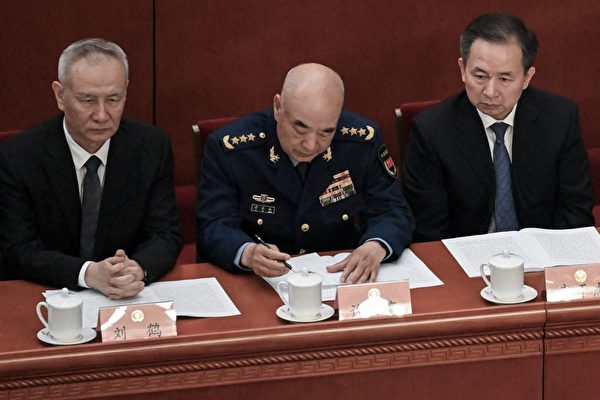
On the afternoon of March 4th, the 4th session of the 14th National Committee of the Chinese People’s Political Consultative Conference was held at the Great Hall of the People in Beijing. Wang Huning, member of the Political Bureau of the Communist Party of China and chairman of the National Committee of the CPPCC, delivered a work report, while Shi Taifeng, vice chairman of the CPPCC, presided over the meeting. The seating arrangement of the CCP officials on the podium has sparked external attention on the high-level power struggle.
According to observers who have long monitored the personnel changes within the CCP leadership, the absence of Li Ganjie, Minister of the United Front Work Department, from the leadership of the CPPCC is unusual compared to past decades. Normally, the Minister of the United Front Work Department concurrently serves as a vice chairman of the CPPCC and holds a membership in the CPPCC. However, Li Ganjie is currently not a member of the CPPCC based on the public information available as of the 4th session of the 14th National Committee of the CPPCC.
Public records show that in 2024, there was a rare personnel adjustment within the CCP leadership. Politburo member Shi Taifeng and Politburo member Li Ganjie swapped positions: Shi Taifeng transitioned from Minister of the United Front Work Department of the CCP to Minister of the Organization Department of the CCP, while Li Ganjie moved from the Organization Department to the United Front Work Department.
A senior Chinese media editor, using a pseudonym, expressed to reporters that the Propaganda Department, the United Front Work Department, and the Organization Department are considered the three most important departments within the CCP. The United Front Work Department specifically corresponds to the CPPCC. Li Ganjie’s transition to the United Front Work Department Minister without taking over Shi Taifeng’s position as vice chairman of the CPPCC has raised eyebrows externally.
This structural arrangement change in the United Front Work System of the CCP diverges from traditional setups. Historically, the Minister of the United Front Work Department usually serves as the top-ranked vice chairman of the CPPCC, responsible for coordinating between the United Front Work System and the CPPCC.
The CPPCC has long been an essential political stage for the United Front Work of the CCP. The integration of the United Front Work Minister into the leadership of the CPPCC has been institutionalized for decades and has been a part of the long-term operation of the United Front Work System within the CCP.
For instance, after You Quan assumed the role of the United Front Work Department Minister in 2018, he quickly entered the CPPCC and became a vice chairman. Previous United Front Work Ministers, Sun Chunlan and Liu Yandong, also ascended to the leadership of the CPPCC and utilized the platform to drive the operations of the United Front Work within the CCP.
However, since Li Ganjie took on the role of United Front Work Minister, he has yet to enter the CPPCC system. According to CPPCC protocols, serving as a vice chairman requires first becoming a CPPCC member. Li Ganjie’s omission as a CPPCC member remains remarkably rare within the conventions of the United Front Work System of the CCP.
A journalist from Beijing who attends the annual CPPCC sessions mentioned that this year’s CPPCC Standing Committee meeting did not appoint Li Ganjie as a CPPCC member. This implies that he still won’t enter the leadership of the CPPCC during this session, indicating a noticeable decline in the power status of the United Front Work Minister within the CPPCC system.
The journalist added, “The absence of the United Front Work Minister as a CPPCC member is quite uncommon in recent years within the CCP’s high-level structure. According to institutional logic, the United Front Work Minister should typically enter the CPPCC system, but now this chain has abruptly broken.”
Meanwhile, Shi Taifeng retains his position as vice chairman of the CPPCC. This suggests that within the current power structure of the CCP, the Organization Department Minister still holds a significant position within the CPPCC system.
In response to this, an independent political commentator from Beijing, using a pseudonym, stated: “The current structure is such that the Organization Department Minister concurrently serves as the CPPCC vice chairman, while the United Front Work Minister fails to enter the CPPCC system. This arrangement blatantly disrupts the power conventions formed within the CCP over the past decades.”
He explained, “This indicates that the internal power configuration of the CCP is not solely based on institutional operations but heavily relies on political trust at the highest levels. Those trusted hold key positions; once trust diminishes, marginalization swiftly follows.”
The commentator believes that within the CCP system, high-level personnel arrangements often reflect power struggles and individual trust relationships rather than standardized political operations. The United Front Work Minister’s exclusion from the leadership of the CPPCC demonstrates evolving power structures within the United Front Work System of the CCP.
He stated, “While on the surface it may seem like a mere assignment change, it actually reflects the redistribution of power at the top levels of the CCP. Within this system, personnel arrangements are often a result of internal power plays rather than public rules.”
With the reconfiguration of personnel within the organizational and United Front Work systems, the internal power dynamics of the CCP leadership are continuously adjusting. Some observers believe that the current anomaly of the United Front Work Minister failing to enter the CPPCC reflects new changes within the high-level power structure of the CCP.