
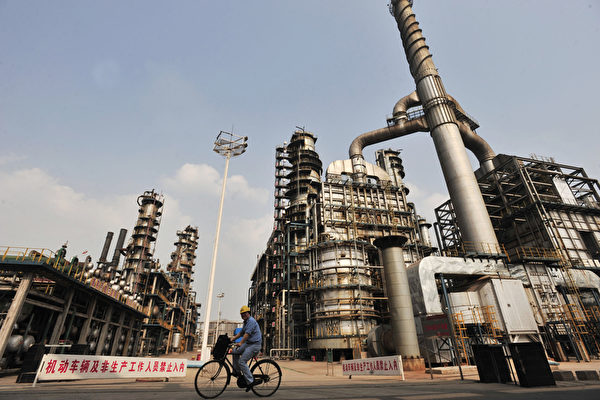
China is the world’s largest importer of crude oil, with over 70% reliance on imports. Analysts believe that with the United States arresting former Venezuelan president Maduro at the beginning of the year and launching military strikes against Iran last weekend, China’s crude oil imports are facing triple pressure, especially local refineries in China that heavily rely on crude oil from these two countries, known internationally as “tea kettle refineries,” are facing existential threats.
According to a report from BBC Chinese on Wednesday, since the beginning of the year, China’s crude oil imports have been under pressure from three directions: firstly, the joint US and Israeli strikes against Iran last weekend have plunged China’s largest sanctioned oil source into high uncertainty.
Secondly, after the US arrested Venezuelan President Maduro at the beginning of the year, Venezuelan ports have completely stopped loading crude oil destined for China.
Thirdly, the actual suspension in the Strait of Hormuz will further threaten China’s legal purchase of over 7 million barrels of Middle Eastern crude oil daily.
Liu Ting, Chief Analyst of Nomura Securities China, stated on Tuesday that China is the world’s largest importer of oil and natural gas, with 73% of its crude oil consumption and 40% of natural gas consumption relying on imports. Approximately 50% of crude oil imports and 16% of natural gas imports need to be transported through the Strait of Hormuz.
In 2025, China’s seaborne crude oil imports totaled around 10.27 million barrels per day, reaching a record high for the year. Data from commodities analysis firm Kpler shows that in 2025, China imported around 1.38 million barrels per day of Iranian crude oil on average, accounting for 13.4% of seaborne imports.
Regarding Venezuela, there is a slight discrepancy between the data from Kpler and another ship tracking firm, Vortexa: the former’s data is around 389,000 barrels per day on average, accounting for 4% of seaborne imports, while the latter’s data is around 470,000 barrels, accounting for 4.5%. Despite the different tracking methods of the two institutions, the figures are largely consistent.
When combining Iran and Venezuela, these two sanctioned sources account for approximately 17% to 18% of China’s seaborne crude oil imports, with an absolute quantity between 1.76 to 1.85 million barrels per day.
A report from Le Monde, filed from Shandong, China earlier this year, indicated that the “tea kettle refineries” along the coast of Shandong, which rely on oil from Venezuela and Iran, are under threat. These local refineries are usually able to obtain sanctioned crude oil at discounted prices.
According to Reuters, since December 2025, the discount for Iranian light crude oil has risen to $8 to $10 per barrel, compared to around $6 in September.
Historically, the onshore discount for Venezuelan Merey crude oil has been around $15 below the ICE Brent benchmark price. However, following the arrest of Maduro, the immediate discount for Venezuelan Merey crude oil has narrowed from around $15 below ICE Brent to $10 to $11, but the market has essentially come to a standstill – the discount has decreased, and trading volume has nearly disappeared.
According to the BBC report, for the local refineries in China operating long-term at low or even negative profit margins, and recently facing continued pressure from low domestic demand for refined products, the $8 to $15 price differential per barrel is a key variable in determining a refinery’s monthly profit or loss.
Since July 2022, there have been no import records from Iran in China Customs data, often carried out by traders completing “ship-to-ship” transfers in Malaysia or Indonesia, entering China under the name of a third country of origin.
The aforementioned report from Le Monde stated that an anonymous engineer in Dongying, Shandong, engaged in the oil and gas industry, mentioned that these “tea kettle refineries” have “very slim profits and very high financial risks. It is at times like these that the extent of China’s exposure to global conditions can be clearly seen.”