
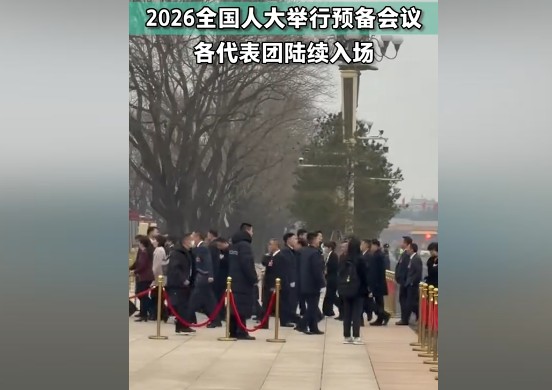
Amidst the annual convening of the National People’s Congress (NPC) and the Chinese People’s Political Consultative Conference (CPPCC), the security work across the country has once again been put on high alert. However, at this moment, insiders have revealed that the security budget for the year 2026 is insufficient, and the allocation situation appears to be particularly tight. There are even reports of grassroots units having to “advance payments and reimburse later,” reflecting the financial difficulties at the local level, reaching a critical situation.
Leading up to the two sessions, security personnel across regions have been stationed in advance, intensifying patrols and control at key locations such as train stations, docks, and residential buildings in certain neighborhoods to prevent petitioners from coming to Beijing. Responsibilities for control have been implemented at all levels from local to grassroots units. The personnel needed for security, transportation, and travel expenses have become significant expenditures.
According to an informant in Beijing, Gu Yuanyuan, in a recent conversation with a Chinese national security personnel, it was disclosed that the security budget is tight. Leading up to the Chinese New Year and the two sessions, related expenses have mostly been covered in advance by individuals or units, amounting to tens of thousands of yuan, but they have not been fully reimbursed yet.
She said, “This year’s security work for the two sessions is quite interesting. Each province has a total budget, like here in Hebei including Xiong’an New Area and eleven prefecture-level cities, basically it’s around two hundred thousand yuan. If it’s not enough, their leaders will chip in first, and then reimburse afterwards. This also applies to security measures in Beijing.”
Gu Yuanyuan mentioned that the current financial situation is not optimistic, with the other party acknowledging the poor financial condition. “They admitted that the finances are not good, saying that even if funds were allocated, they wouldn’t reach down to the prefecture-level cities. They believe that it should be managed by the local public security or national security in the places where the petitioners reside, not by the entire provincial government. The provincial government office in Beijing simply does the coordination, that’s how it works.”
She also noted seeing many scholars before the two sessions, saying that they seemed to be nervous and unwilling to discuss certain topics.
“A financial lawyer from the People’s Bank of China Shanghai Branch stated today (March 3) that this year’s Chinese GDP growth target is likely to be lowered and may not reach five percent. He talked about some issues, and even used his media pseudonym instead of his real name because they are currently more sensitive.”
For many years, prior to the two sessions, dissidents and human rights activists across regions have often been “taken into custody,” summoned for talks, or even arranged for “travel.” This practice known as “being traveled” by outsiders is actually a means for local national security or relevant departments to relocate individuals from their original residences to ensure they are not present in Beijing or public places during sensitive periods. This has become a “common practice.”
However, from the descriptions provided by several interviewees in a recent Epoch Times interview, this year’s situation seems to have undergone some adjustments, also referred to as “soft security.”
A prominent Beijing dissident, Lan Jun, stated that in previous years, they would usually be taken away several days before the session, but this year the national security only arrived to take him away on the day before the two sessions. The delay in timing, he speculated, may be due to “whether the relevant departments are more strained in manpower or financial arrangements, in other words, they may simply not have enough money.”
Haor Jie, a dissident in Guangzhou, revealed that this year there were only “general greetings” with no specific actions. There were no obvious upgrades in surveillance or mandatory arrangements for going outside. In comparison to previous years, it appeared relatively “peaceful.”
Another well-known dissident from Wuhan, Zheng Li, mentioned that the authorities were concerned about his trip to Beijing, visiting him almost daily recently to “express care,” even inviting him for meals, adopting a softer approach to control his actions. He believed it was a form of “soft security” tactic in disguise.
Liu Qiang, a dissident from Chongqing, stated that he was still restricted from returning to Beijing during the two sessions, with the CCP creating an atmosphere of panic and maintaining strict control over the core region of Beijing. He said, “I can’t even go back to Beijing, I can only stay in other places, trapped at my parents’ home. This shows that even if the CCP is facing financial constraints, the control over Beijing’s core area remains tight.”
(The names in the article are all pseudonyms)