
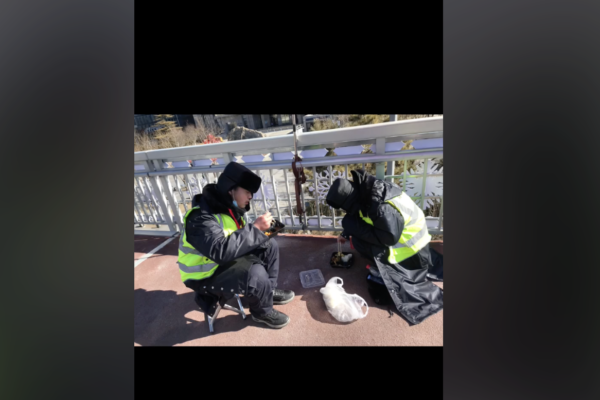
On March 4th, the annual “Two Sessions” of the Chinese People’s Political Consultative Conference and the National People’s Congress began in Beijing. In recent days, a large number of “bridge watchers” have once again appeared on pedestrian overpasses in downtown Beijing. Since banners protesting the Chinese Communist Party were spotted on bridges in Beijing ahead of the 20th National Congress of the CCP in 2022, authorities have been recruiting a large number of “bridge watchers.”
According to official information from the CCP, the National Committee of the Chinese People’s Political Consultative Conference will open on March 4th at 3 p.m. and close on March 11th in the morning, lasting 7 days. The National People’s Congress will open on March 5th and close on March 12th in the afternoon, lasting 8 days.
On March 3rd, a security recruitment agency in Beijing told the press, “There is a great need for bridge watchers now. Watching the bridge for 12 hours a day pays 280 yuan, and 360 yuan for 24 hours. Bridge watching is only during the Two Sessions.”
Another security recruitment agency in Beijing mentioned that bridge watching is quite laborious, requiring standing for 24 hours. While the pay is indeed higher than other jobs, there are challenges involved. “Bridge watchers are mainly young people who need to be able to use smartphones, take photos, report incidents, and earn 350 yuan for a 24-hour shift. We are currently short of staff for this position.”
The agency stated, “During the Two Sessions, people are needed to maintain order around the vicinity of the meetings, fearing sudden incidents.”
A recent online video circulated, claiming that there are soldiers stationed on every pedestrian bridge in Beijing. Some Beijing netizens commented that there are always two militia members on duty 24 hours a day. People joked, “Defending His Majesty,” while others quipped, “With (Iranian leader) Khamenei gone, they are even more fearful. A timid bird startles at every sound; the grass and trees are perceived as enemies.”
The video went viral online, sparking discussions. Some netizens commented, “Beijing Railway Station has undergone a comprehensive second security check, according to friends.” Others questioned the significance of such “excessive security measures” in reflecting the current societal psychology.
Furthermore, a video showed street interviews on February 26th with a bridge watcher in Beijing. The individual mentioned earning 320 yuan per day for watching the bridge 24/7, with the job duty of preventing any damage to the bridge. The position requires males under the age of 55.
A knowledgeable source in Beijing told reporters that the appearance of bridge watchers is related to the Four Tongs Bridge incident. Since banners were hung by Peng Lifa in protest against the CCP leader Xi Jinping, Four Tongs Bridge immediately became a popular spot in Beijing. The authorities then removed the sign of Four Tongs Bridge, and now it’s unclear what the bridge is called. Authorities also fear that visitors from other places might come looking for the bridge.
On October 13, 2022, just days before the CCP’s “Twenty Congress,” Chinese citizen Peng Lifa (online alias Peng Zaizhou) publicly protested against CCP leader Xi Jinping at Four Tongs Bridge in Beijing. Peng posed as a construction worker, hanging banners and igniting smoke to attract attention, with demands listed on the banners. Peng was taken away by the police, and the incident spread worldwide.
In fact, not only in Beijing, but in various cities across China, the unique role of “bridge watchers” has emerged. Wu Shaoping, head of the Overseas Chinese Human Rights Lawyers Association, expressed that “this is a very absurd situation.” Shaoping criticized the CCP’s single-party dictatorship becoming a personal dictatorship, turning the entire society into a politically chaotic entity.
He emphasized, “It does not address the root of the problem. For example, if China were to undergo political system reform, grant freedom to the people, provide rights to the people, and conduct fair elections, these issues would not exist. Instead of solving the problem, they eliminate those who raise concerns.”
The reliance on bridge watchers highlights the increasing control and security measures implemented by the authorities, reflecting a shift towards tightening political control over society.