
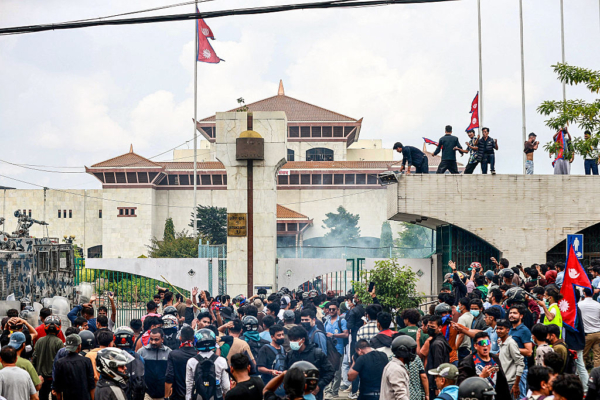
Nepal will hold a national election on Thursday (March 5), the first major event in the country since the protests led by “Generation Z” last September. The youth movement at that time called for an end to corruption, increased employment opportunities, and political transparency. Unfortunately, 77 people lost their lives during the protests, eventually leading to the resignation of the entire cabinet.
For decades, this small Himalayan country sandwiched between China and India has endured political turmoil. Since 1990, Nepal has experienced 32 changes in government, causing its primarily agriculture-based economy to stagnate and forcing millions to seek livelihoods overseas.
Out of Nepal’s population of 30 million, nearly 19 million people are eligible to vote. They will elect 275 members of parliament, with 165 seats filled by direct elections and another 110 seats through a proportional representation system based on party votes.
Following the protests last year, around one million new voters have been added, most of them young people. This new force, through previous protests, has strengthened the call for comprehensive reform of the political and economic systems, with the public hoping for better treatment and more advantageous wages through regular employment opportunities.
Bibas Pariyar, a 22-year-old painter in the capital Kathmandu, plans to return to his hometown of Gorkha on March 5 to cast his vote. Gorkha is well known for its Gurkha soldiers who served in the British and Indian armies.
Pariyar stated, “We need new leaders who can provide employment opportunities, reform agriculture, and offer fair wages to laborers because the old politicians only fill their own pockets with corruption and do not work for the people.”
The election features established parties like the center-right pro-India Nepali Congress and the Communist Party of Nepal (Unified Marxist–Leninist), which have dominated Nepali politics for decades.
However, most analysts believe that another centrist party, the Rashtriya Samaj Paksha (RSP), is currently leading in terms of popularity. Balendra Shah, a 35-year-old former rapper turned politician, joined the RSP, founded just three years ago, in January and has become the party’s prime ministerial candidate.
Shah, a former mayor of Kathmandu and a prominent figure in the September protests, will face off against 74-year-old former Prime Minister K.P. Sharma Oli of the Communist Party of Nepal, who has served four times and has been known for his pro-China stance and promotion of the Belt and Road Initiative, making him Beijing’s “old friend.” He was forced to step down last September after demonstrators were killed.
Jay Nishaant, founder of the Nepal Democracy Foundation think tank, pointed out that Nepal is the second country in the region after Bangladesh to hold a national election triggered by protests by “Generation Z,” but the political dynamics of the two countries are vastly different.
“The outcome of any election depends on three elements: policies, leadership, and grassroots organization,” Nishaant stated, “This is the key difference between Nepal and Bangladesh. Student leaders in Bangladesh in July 2024 had specific demands and high public profiles but lacked a well-tested grassroots organization.”
This year, more than 40 countries worldwide will hold national-level elections. These elections include presidential and parliamentary elections, involving a total population of 1.6 billion, approximately one-fifth of the global population.
Countries holding parliamentary elections and leader elections from February to November include Vietnam (March 15), Hungary (April 12), Peru (April 12), Colombia (May 31), Russia (expected in September), Brazil (October 4), Israel (scheduled for October 27), Denmark (before October 31), United States (November 3), and more.