
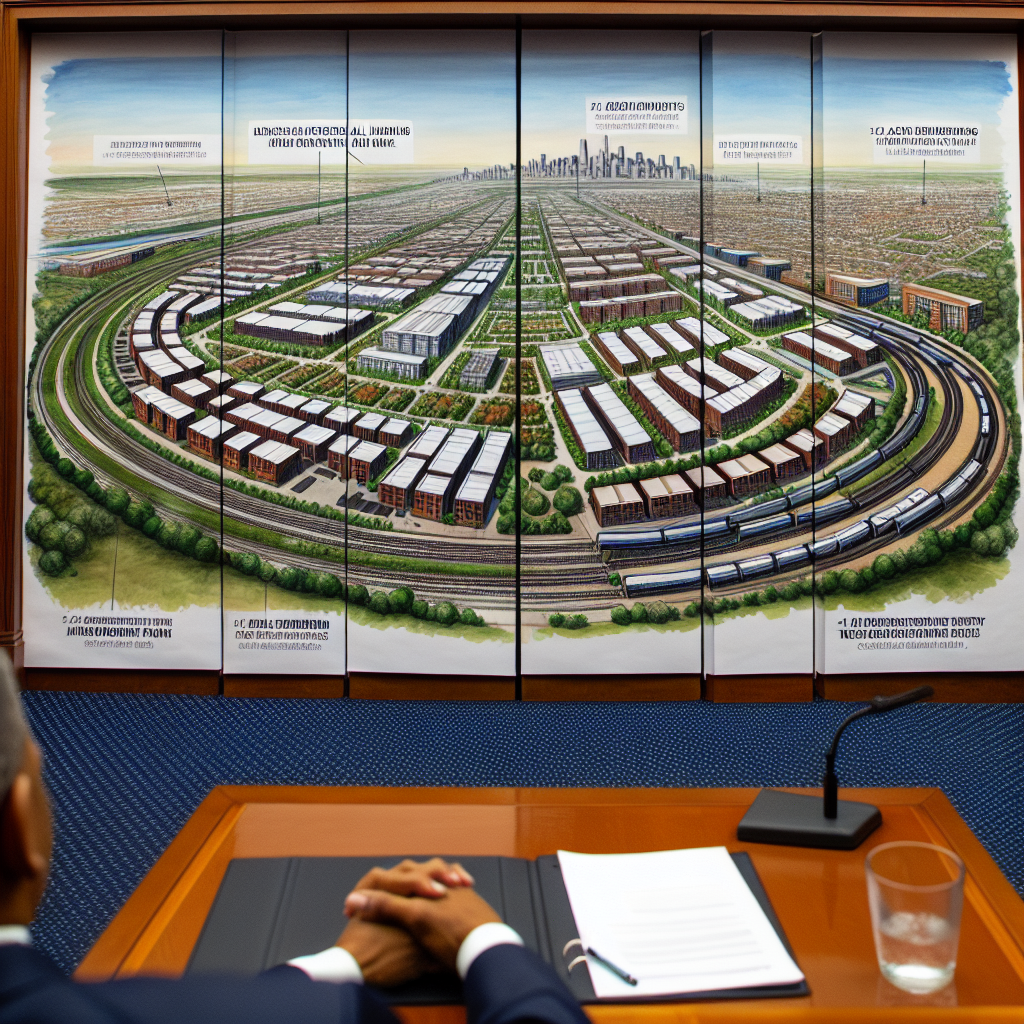
New York Mayor Mamdani recently presented a large-scale development plan to reopen the Sunnyside Yard in the Queens neighborhood during a closed-door meeting with U.S. President Trump. The proposal involves constructing 12,000 affordable housing units on the 180-acre rail yard, along with amenities such as parks, schools, and healthcare facilities. The city government stated that the project would require around $21 billion in federal funding. If successfully implemented, it would be six times the size of the Hudson Yards in Manhattan and could become the largest aerial platform development project in New York’s history.
Mamdani emphasized that in a city with highly limited land resources like New York, building the world’s largest railway platform to “create new land” is a crucial opportunity to alleviate the housing crisis. He stressed that the Sunnyside Yard could not only provide a significant number of affordable housing units but also be planned as a new type of community core integrating residential, educational, medical, and public spaces.
However, this idea has yet to materialize after several administrations. As early as 2007, former Mayor Bloomberg had explored the possibility of constructing a platform development above the rail yard, but officials at the time admitted the need for highly innovative engineering techniques. In 2015, former Mayor de Blasio announced plans to build over 11,000 affordable housing units there and initiated a feasibility study. The New York City Economic Development Corporation released the study results in 2020, but the project stalled due to the impact of the COVID-19 pandemic.
The project still faces challenges in terms of engineering and funding. Industry experts point out that constructing large platforms above operational railway tracks involves complex structural design and long-term construction coordination, with costs far exceeding those of ordinary ground developments. For comparison, the completion of the 5-acre Hudson Yards took nearly a decade, while the 28-acre Hudson Yards project spanned almost twenty years. Sunnyside Yard covers 180 acres, significantly increasing the scale and engineering challenges.
Additionally, the project will require approvals from the property owners, Amtrak and the Metropolitan Transportation Authority (MTA), as well as passing through community and city council approval processes. Councilmember Julie Won of the district stated that no formal public approval process has been initiated yet and emphasized that major development projects must involve thorough community participation in the early stages and cannot be unilaterally pushed forward behind closed doors. State Senator Michael Gianaris of Queens pointed out that the project’s difficulties over the past 40 years stem from involving too many agencies.
Despite ongoing controversies, the concept has gained preliminary support from some political and industry figures, including Governor Cuomo, Democratic U.S. Representative AOC, and the New York Building Congress. Supporters believe that if federal investment can be successfully integrated with urban planning resources, this project will bring significant breakthroughs in New York’s housing and infrastructure.
Regarding the construction timeline, experts estimate that even with smooth funding and approvals, the project is not expected to commence for at least four years and overall completion may be extended to around 2040.