
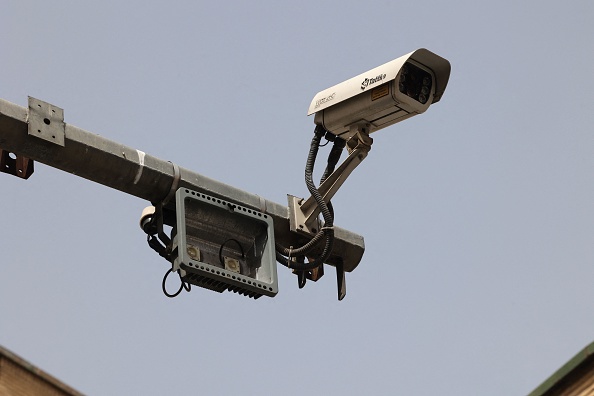
Media reports have revealed that the United States and Israel were able to conduct a precise “decapitation operation” against Iran’s Supreme Leader, Ayatollah Khamenei, this time because Israel had hacked into Tehran’s traffic monitoring system several years ago, gaining insight into the movements of Khamenei’s bodyguards and entourage. Israeli intelligence officials even claim that their knowledge of Tehran is as familiar as their capital city, Jerusalem.
According to the Financial Times, Israeli intelligence agency Mossad’s operatives had been using Tehran’s traffic cameras to surveil Khamenei, his bodyguards, and other senior Iranian officials for years.
Sources disclosed that Israel had nearly unrestricted access to all of Tehran’s traffic cameras which were originally used by Iran to monitor political dissidents and citizens.
One particular camera angle proved crucial as it allowed Israel to track Khamenei’s bodyguards parking their vehicles near the Supreme Leader’s residence on Pasteur Street in central Tehran.
Images were encrypted and sent back to Israel, where Mossad used a mathematical method called “social network analysis” to analyze billions of data points, ultimately deriving patterns in the bodyguards’ “lifestyle,” including their addresses, shifts, commuting routes, and the individuals they typically protected.
A current Israeli intelligence official told the Financial Times, “Our familiarity with Tehran is like our familiarity with Jerusalem. When you know a place so well, like the streets you grew up on, any anomalies stand out immediately.”
The gathered information helped Israel and the United States confirm that on the fateful morning of February 28, the 86-year-old Khamenei would be present in his office and who would be accompanying him.
Moreover, Israel was able to interfere with a component of roughly a dozen mobile communication base stations near Khamenei’s residence, making outgoing calls appear busy and preventing his security detail from receiving potential warnings.
An insider revealed to the Financial Times that the attack on Iran had been planned for months, but adjustments were made by the US and Israel after intelligence confirmed Khamenei and his senior officials would meet at his official residence in Tehran on the morning of February 28.
Israel’s past targets had mostly been the leadership of the Iranian Revolutionary Guards, missile launchers, ammunition depots, and Iran’s nuclear facilities and scientists, with no publicly confirmed assassination attempts against Khamenei himself.
Targeted hits on individuals like Khamenei cannot afford to fail, as failure could elevate their status. Israeli military protocols require two senior officers operating independently to confirm the target’s location and their entourage with high certainty.
Two informed sources disclosed that Israeli intelligence agency confirmed the planned meeting of Khamenei and senior officials near his residence by using information from traffic cameras and signal intelligence from the mobile networks around the Supreme Leader’s residence.
On the US side, there was more specific information. Sources revealed that the US had an informant. The Central Intelligence Agency declined to comment on this.
Once Israel and the US confirmed the location of Khamenei’s meeting, they acted swiftly as he would likely seek refuge in underground shelters once full-scale warfare began.
Thus, hours after fighter jets took off from Israeli military bases, up to 30 precision-guided munitions were launched at Khamenei’s residence. Hours later, Khamenei’s body was found among the ruins.
Iran’s top national security official and advisor to the Supreme Leader, Ali Shamkhani, as well as the commander of Iran’s Ground Forces of the Revolutionary Guards, Mohammad Pakpour, were also killed in this attack.