
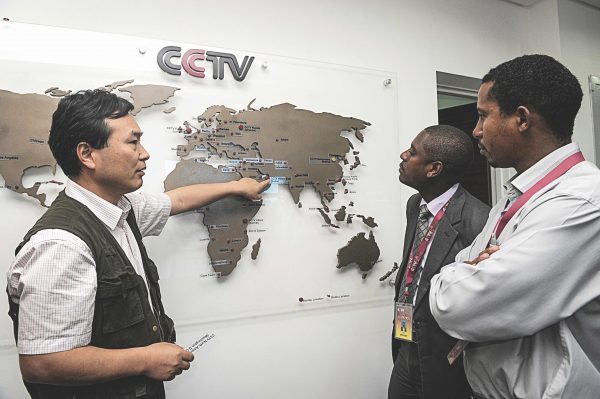
For the past two decades, the Chinese Communist Party (CCP) has spared no expense in creating a massive media empire in Africa. Controlling broadcasting companies, news agencies, and print media, the CCP has employed tens of thousands of journalists, established dozens of branches, built state-of-the-art studios, and even hired renowned local anchors in an attempt to establish a large-scale external propaganda network across the entire African continent.
However, money cannot buy viewership. Despite years of effort, the CCP’s foreign propaganda media in Africa continues to struggle with dismal viewership ratings, as African audiences still prefer to watch Western media outlets like the BBC. Many of the CCP’s iconic external propaganda brands in Africa garner little to no interest.
According to an article on Forbes, Confidence MacHarry, an analyst at Lagos-based political risk consultancy SBM Intelligence, pointed out that Africans are more interested in Western news rather than news from China.
Since seizing power in 1949, the CCP has invested heavily in creating its international image by sending a large number of Xinhua News Agency journalists overseas and broadcasting programs globally through the then Beijing Radio. In the mid-2000s, the CCP vigorously promoted Chinese companies to expand into foreign markets, thereby establishing a vast external propaganda network. According to estimates by the US State Department, the CCP now invests billions of dollars annually in external propaganda worldwide.
Today, Nairobi has become the core of CCP’s external propaganda efforts in Africa. In 2006, the CCP’s official media Xinhua News Agency relocated its sub-Saharan African bureau from Paris to the Kenyan capital, Nairobi. Following suit, China Global Television Network (CGTN) established a production center in Nairobi in the same period. Since 2012, CCP’s English-language mouthpiece China Daily began publishing its African edition in Nairobi.
However, a recent study published in the journal “Online Media and Global Communication” (OMGC) reveals that since 2018, the viewership growth of CCP’s external propaganda in major markets has been insignificant. Even CGTN, which performs relatively well, struggles to achieve viewership rates of less than 10% to just about 11% in various African countries, lagging behind BBC and CNN’s 30% to 40%. Some African viewers have expressed that they never watch CCP media, only opting for BBC, and are unaware of the CCP’s presence in Africa with studios.
CCP’s investments in social media have also been largely unproductive. A recent study by the German Marshall Fund of the United States revealed that between August and October 2023, the average views for the 851 videos uploaded by China Global Television Network Africa channel (CGTN Africa) on YouTube were less than 1,000, with only 20 likes.
While CCP’s external propaganda extensively promotes how Western democratic countries and multilateral organizations harm Africa, and glorifies CCP’s aid in helping African people break free from Western exploitation towards prosperity, it disregards the successful experiences of other countries’ media outlets.
Al Jazeera is a typical success story, operating more like a newsroom rather than a government mouthpiece and attracting a global audience. Turkey’s TRT World and the recent TRT Afrika have also achieved success through a similar approach.
Unable to build news brands successfully, the CCP has resorted to providing free news to African news agencies, or funding journalists and content creators to attend conferences or exchange activities under various pretenses to expand its influence. Alternatively, they have adopted infiltration methods, such as the operation of CGTN in Nairobi, by hiring African journalists and local anchors, initially gaining some success. However, with the new leadership in 2021 intensifying internal management and requiring African staff to incessantly promote CCP ideology and broadcast various political conferences, many African employees have become disillusioned and switched to Al Jazeera or TRT.