
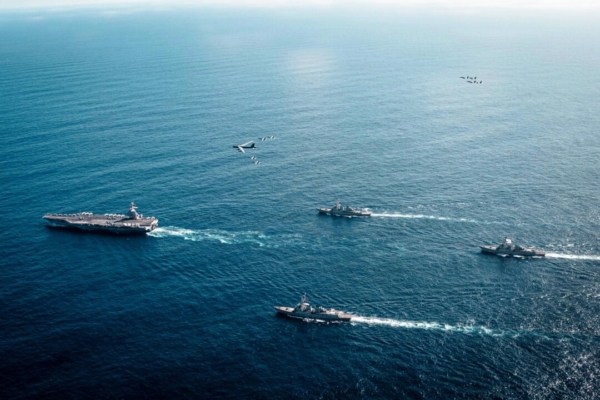
The close connection between the Chinese Communist Party (CCP) and Iran poses a significant threat to the United States’ military presence in the Middle East, creating a very dangerous situation. If Iran were to sink a US aircraft carrier using CCP-made missiles, it would constitute an act of war.
On February 24th, there were reports that Beijing is set to reach an agreement with Iran to export CM-302 anti-ship missiles. The CM-302 is a supersonic missile capable of carrying 500 pounds of explosives, using a zigzag flight trajectory when approaching its target, posing a threat to American aircraft carriers and their thousands of onboard personnel.
If Iran were to use CCP-exported missiles to sink a US aircraft carrier, the US military response would not only target Iran but also the CCP. Therefore, the risks Beijing undertakes in exporting CM-302 anti-ship missiles to Iran are enormous.
In fact, there are numerous potentially criminal connections between Beijing and Tehran, with the CM-302 missile being just one example. The CCP purchases over 80% of Iran’s oil, accounting for 13.4% of China’s total oil imports. China often transports oil using illegal shadow fleets through third countries. In exchange, the CCP reportedly exports radars capable of tracking US stealth aircraft to Iran, along with other military sensors and weapon components usable for drones and ballistic missiles.
Iran is also seeking to procure man-portable surface-to-air missile systems (MANPADS) from the CCP, which could be used by Tehran’s terror proxies like Hamas, Hezbollah, and the Houthis to attack commercial planes.
Furthermore, Tehran and Beijing are discussing the export of anti-ballistic missile systems and anti-satellite weapons. Beijing provides satellite imagery to Iran, supports Iran’s ongoing propaganda efforts, and offers diplomatic support to Iran at the United Nations. It is said that CCP intelligence operatives are stationed in Tehran to counter US and Israeli intelligence.
Beijing and Tehran, along with Moscow and Pyongyang, are cooperating in the field of cyber warfare in defense. On February 17th, naval vessels from Iran, Russia, and the CCP had planned to conduct joint exercises in the Strait of Hormuz in the Middle East. A Russian helicopter carrier participated in the exercise before leaving shortly after its conclusion. The actual participation of CCP vessels remains unclear, but Iranian media reports suggest that the CCP plans to participate in similar exercises in the near future.
The CCP’s ability to project its naval forces globally is due to China’s rapid economic growth over the past two decades.
One way to slow China’s economic growth is to reduce the CCP’s access to oil. Over 70% of China’s oil is imported, with over 90% of these imports coming via sea transport. Given the US Navy’s superior control over global shipping compared to the CCP Navy, this represents a significant vulnerability for Beijing.
The US has taken a series of actions, such as seizing Venezuela’s dictator, detaining shadow oil fleets, and pressuring the new Venezuelan president, forcing Venezuela to sell oil to the US and thereby cutting off the CCP’s oil supply from Venezuela. Now, this vulnerability of the CCP is becoming apparent.
The same applies to Iran’s oil exports to China. The fewer sources of oil the CCP has, the higher the price it will need to pay on the global market, making it more difficult for the CCP regime to achieve its economic goals. Slower economic growth resulting from this will reduce the CCP’s tax revenue, diminishing funds available for naval shipbuilding, nuclear modernization, and plans to invade Taiwan.
Slow economic growth could also exacerbate discontent among the Chinese people towards the CCP regime, prompting them to push for democratization in their own country.
The message the US should convey to the CCP is clear: if the CCP continues to antagonize the US, the US will seek to cut off the CCP’s global oil supply, including from Venezuela, Iran, and other sources.
By severing the oil connections between rogue regimes like the CCP and Iran, it can increase the oil supply from other countries that adhere to international law, a principle advocated by the US post-World War II through “Pax Americana.” This policy supports democratic nations and punishes their authoritarian adversaries.
Therefore, the US fleet stationed in the Middle East may consider adding the following options to its target list: completely stop Iran’s oil exports to the CCP or impose tariffs on Iran for exporting oil to China, including shadow and non-shadow fleet tankers. If Iran wants to sell oil to China without tariffs, it should abandon its ambitions to develop nuclear weapons and hypersonic missiles since these weapons pose a threat to US military forces in the region. Tehran should focus on the democratization process.
It is worth noting that in Venezuela, the US has not been drawn into another endless war. The US captured Venezuela’s dictator, confiscated assets of the authoritarian regime, and redirected the country’s oil resources from supporting the CCP to supporting democratic processes in Venezuela.
Targeted strikes against dictatorial leaders, confiscation of assets of authoritarian regimes, and using the proceeds from asset sales to cover the costs of US military operations is a far superior model to burdening American taxpayers with the endless cost of regime change and global security maintenance. American taxpayers should not bear the burden of overthrowing foreign dictators and maintaining global security.
Washington should clearly inform Beijing that if Iran uses Chinese-made missiles to attack a US aircraft carrier, the US will consider it a CCP act of war. This serves as an extended deterrence measure. This could also be used to curb the nuclear terrorism risk the US faces for allowing Iran to develop nuclear weapons. If a deal to sell long-range missiles to Iran by the CCP is reached, CCP-produced CM-302 missiles should be intercepted during transit or destroyed upon arrival. Iran must not be allowed to possess weapons capable of striking US aircraft carriers.
Since CCP support strengthens the Tehran regime, the US should impose extensive economic sanctions on the CCP. Past US sanctions targeted specific Chinese companies or individuals with limited success. By restraining the overall Chinese economy, reducing China’s role as an economic export and technology reserve for rogue regimes like Iran, it will weaken these countries relative to the US. In the long run, this will help prevent hostile authoritarian regimes from launching dangerous attacks on the US and its allies.
Author’s Profile:
Anders Corr, holds a Bachelor’s and Master’s degree in Political Science from Yale University in 2001 and a Doctorate in Government Management from Harvard University in 2008. He is the President of Corr Analytics Inc., the publisher of the Journal of Political Risk, with research spanning North America, Europe, and Asia, among other regions. His latest works include “The Concentration of Power: Institutionalization, Hierarchy, and Hegemony” (2021) and “Great Powers, Grand Strategies: The New Game in the South China Sea” (2018).