
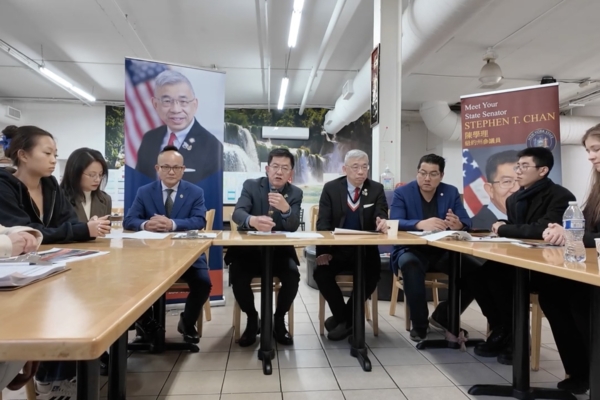
New York Mayor Mamdani proposed a 9.5% increase in property taxes, which sparked discussions among state senator Steve Chan and state assemblyman Lester Chang at a community meeting in Brooklyn’s Chinese community. They addressed the impact of the city government’s fiscal policies on the middle class and fixed-income families. Attendees urged the community to continue speaking out against shifting the financial burden to low and middle-income homeowners before the city council votes on the budget on June 30th.
Steve Chan pointed out that New York City landlords already face high utility bills, insurance costs, and one of the highest tax burdens in the country. A further increase in property taxes could make it difficult for many small landlords and elderly individuals to afford. He warned that the actual increase in property taxes could exceed 9.5%, as the city government would first reassess property values before applying the new rates. Despite the temporary freeze on the proposal due to the city council speaker Manning’s opposition amid the election year, community voices must persist to prevent its reinstatement.
Lester Chang emphasized that a 9.5% increase in property taxes would significantly impact fixed-income families, potentially forcing many homeowners to sell properties or seek additional mortgages. He criticized the city government for proposing tax hikes as solutions to the $57 billion budget deficit by suggesting raising property and income taxes or depending on state aid, without addressing wasteful spending. Chang recommended cutting consultant contracts, non-essential DEI administrative projects, and other non-core expenses, as well as streamlining regulatory processes to reduce construction and operational costs.
Numerous small landlords shared their experiences at the event. Rachel, a landlord in Dyker Heights, mentioned the financial strain of property taxes, insurance, utilities, and maintenance costs after collecting rent, leaving minimal profits. She highlighted the misconception that landlords are all wealthy, emphasizing the management and maintenance pressures many small property owners face, making their lives far from easy.
Tenant Zhao Jing’an stated that any increase in property taxes would likely be passed on to tenants, ultimately burdening them. He noted governmental controversial policies pushed during periods of decreased public attention, such as canceling the SHSAT specialized high school entrance exam, urging the community to remain vigilant.
Steve Chan criticized the city government’s tactic of using tax increases as leverage against the state government, essentially treating the middle class and homeowners as “hostages.” He raised concerns over approximately 300,000 rent-stabilized apartments left vacant due to high renovation and maintenance costs. Without a reasonable rental adjustment mechanism, landlords would struggle to invest in property improvements, further limiting housing supply.
Regarding city expenditures, Lester Chang suggested halting the expensive and unpopular community jail project and preserving Rikers Island. He proposed reallocating related budgets to affordable housing construction to alleviate the city’s financial burden and increase revenue streams.
The two elected officials also proposed alternative uses for Rikers Island, including converting some vacant facilities into single-room occupancy housing for the homeless or individuals in need of long-term treatment and rehabilitation services, supplemented with subsidies and training to aid their reintegration into society. They believed efficiently utilizing existing public assets would alleviate the city’s financial strain more effectively than constructing new facilities.
The elected officials outlined the subsequent advocacy path, mentioning that the property tax rate would ultimately be negotiated between the city council and the mayor’s office in the annual budget and enforced by the city’s finance department. Discussions are expected to intensify during spring public hearings and budget negotiations, with the budget vote scheduled before June 30th. If the city government does not compromise during the budget negotiations, they did not rule out organizing protests in front of City Hall.
In conclusion, several residents urged expressing their position through emails, phone calls, organizing protests, signing bilingual petitions (c.org/RRvmpCKMqv), and participating in voting to bring about democratic change from a single-party dominance to a more diverse political landscape. Steve Chan mentioned that if necessary, the state legislature would introduce relevant legislation, but ultimately, it would require support from the majority of lawmakers. He stressed that the community’s collective stance is against shifting the fiscal pressure onto the middle class and small property owners.