
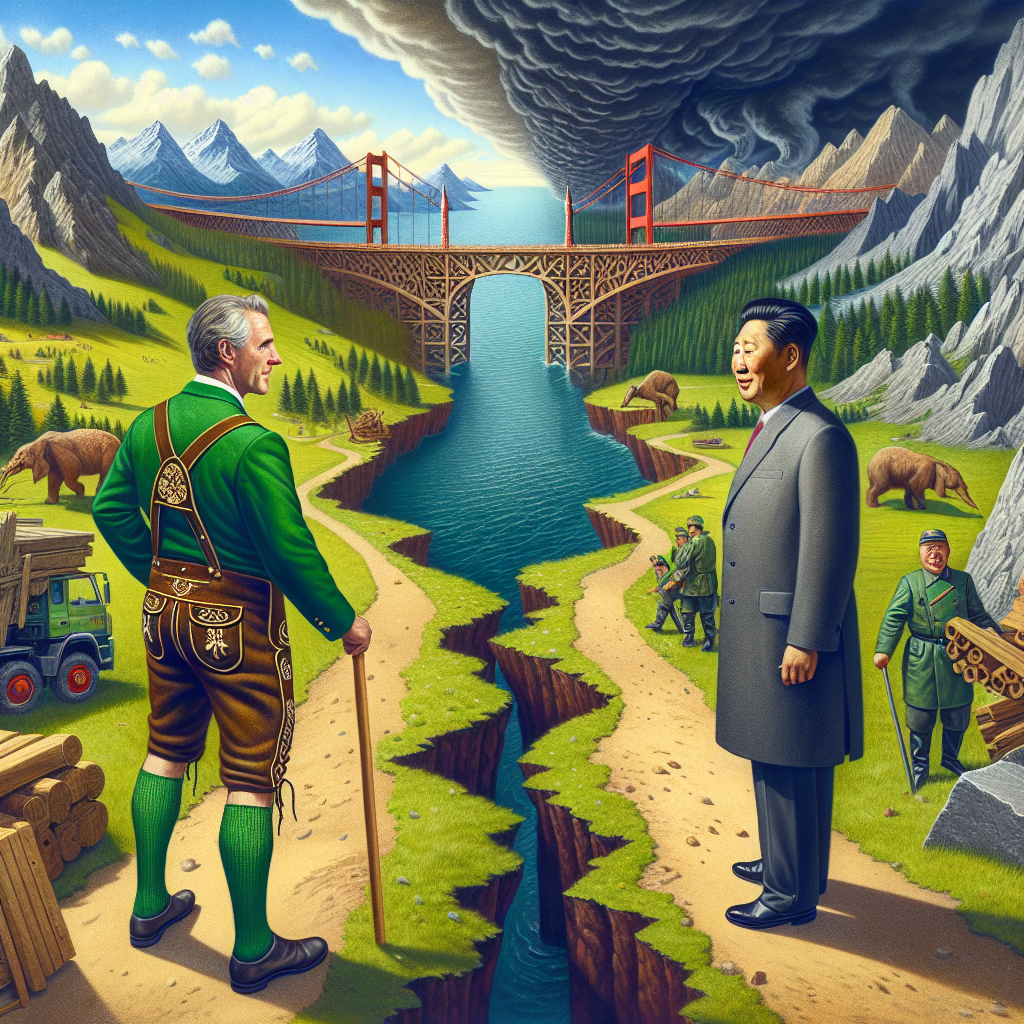
Germany Chancellor Merz recently visited China in an attempt to rebuild the relationship between Germany and China amidst economic challenges and widening trade deficits. However, several experts have pointed out that Beijing’s long-term reliance on its economy model of overcapacity production and export orientation makes it difficult for Germany to improve trade imbalances through cooperation. Berlin’s strategy of rebalancing towards China is facing a significant gap between idealism and reality.
Chancellor Merz, Friedrich Merz, embarked on his first visit to China on February 25th-26th since taking office, leading a large delegation of trade representatives to Beijing, including top executives from Volkswagen, Mercedes-Benz, BMW, Airbus, and Siemens.
Germany is currently facing two consecutive years of economic recession while also navigating changes in US economic and trade policies. Merz hopes to rebalance the economic and trade relationship between Germany and China amid multiple pressures.
According to data from 2025, China has replaced the United States as Germany’s largest trading partner, but the accompanying structural issues have become more prominent. The data shows that Germany’s trade deficit with China expanded to 87 billion euros (approximately $100 billion) in 2025.
German officials attribute this mainly to the long-term undervaluation of the Chinese yuan and restrictions faced by German goods entering the Chinese market, thus reversing Germany’s trade surplus pattern over the years.
Commentator Tang Jingyuan bluntly states, “Merz’s attempt to correct the German-China trade imbalance is almost impossible to achieve.”
Tang Jingyuan told Epoch Times that the trade imbalance between China and Germany is not a policy mistake but a deliberate industrial strategy set by the Chinese Communist Party. Beijing has long created overcapacity through substantial subsidies, then undercut European and American companies with low-price exports to ultimately dominate the market.
To Germany, the “China Shock” presents a new reality. Noah Barkin, a Rhodium Group advisor on EU-China relations, pointed out in a recent report that China has evolved from being Germany’s “growth engine” to its “biggest economic threat.”
Barkin stated that Germany’s core manufacturing-focused economic model is facing significant challenges from Chinese manufacturing. The changes in the automotive industry are particularly illustrative. The automotive industry, as a pillar of German-China trade, had contributed nearly one-third of Germany’s exports to China, but from 2022 to 2025, German automotive exports to China plummeted by 66%, hitting the lowest level since 2009.
He mentioned that the German manufacturing sector is losing about 10,000 jobs per month, surpassing the scale of layoffs during the COVID-19 pandemic, reflecting the shift in German-China relations from “cooperative partners” to “direct competitors.”
Meanwhile, Chinese electric vehicle brands such as BYD and NIO have rapidly increased their market share in Europe, rising from less than 1% in 2020 to 12% in 2025. Barkin believes that the key challenge for German carmakers is their excessive reliance on the Chinese supply chain – China controls about 70% of global rare earth and battery material supplies.
Moreover, due to the delayed response of the EU’s trade defense mechanisms, Chinese goods originally blocked by high US tariffs have turned to the European market, further squeezing the survival space of German enterprises.
Germany’s economy has been deteriorating in recent years, with negative growth in 2023 and 2024, and only a slight increase of 0.2% in 2025. In addition, Germany’s goods exports to China in 2025 were around 81.8 billion euros, a 9% decrease compared to the previous year, plummeting 23% from its peak in 2022 to a ten-year low.
During his visit to China, Merz met with Chinese Communist Party leader Xi Jinping and Premier Li Keqiang, with both sides pledging to establish a “strategic partnership.” He also urged Beijing to exert influence on Russia in the Russia-Ukraine conflict.
Tang Jingyuan believes that this move is akin to “seeking skin from a tiger.” He pointed out that China’s support for Russia is not purely economic but part of a geopolitical strategy—by consuming Western resources and attention through the war, including those of the US and NATO, Beijing aims to gain greater strategic space in the Taiwan Strait direction.
Chinese affairs expert Wang He holds a similar view, stating that the long-term strategic objective of CCP’s support for Russia lacks sufficient leverage for Germany to pressure Beijing. Therefore, “such appeals mostly remain at the level of diplomatic gestures and are difficult to produce substantial effects.”
In terms of diplomatic strategies, Wang He observes that Beijing is adopting a “distant attack, close defense” strategy to counter international pressure. On February 24th, the day before Merz’s arrival, China imposed sanctions and export controls on Japan, targeting its military-industrial complex, while showing a more accommodating attitude towards Germany.
Beijing judges that “even if Germany expresses condemnation on the Taiwan Strait issue, it is mostly at the verbal level,” and is unlikely to engage in military intervention like the US and Japan. Therefore, Beijing may offer economic benefits – such as purchasing 120 Airbus aircraft – in exchange for political space, or even attempt to weaken the consistency of Europe and America’s policies towards China.
On the other hand, Germany’s engagement with China is seen as a bargaining chip in negotiations with the US. Wang He believes that given the Trump administration’s implementation of a policy of global equivalent tariffs, US-German relations are still in a transitional phase, so Berlin chooses to maintain stable interaction with Beijing strategically.
Commentator Li Linyi pointed out that the EU currently views its policy towards China through the lens of “de-risking,” which aims to reduce dependency; however, recent trends have shifted towards “selective engagement” for economic benefit.
Nevertheless, he judges that although Merz’s visit to China closely follows French President Macron and British Prime Minister Johnson, the shadow of EU-China relations looms large. In the short term, German-China relations may still maintain a cooperative tone, but the fundamentals of economic and trade have not changed: Germany’s trade deficit continues to expand, manufacturing exports are declining, and asymmetric market access issues persist.
Regarding Chancellor Merz’s visit to China, Eva Seiwert, a senior analyst at the Mercator Institute for China Studies (MERICS), observed that Merz adheres to a “principled realism,” but the visit has yielded limited tangible results, with agreements focusing on low-sensitive areas such as climate and agriculture. Beijing did not make concessions on structural issues such as market access and subsidies.
Tang Jingyuan further pointed out that Europe has long been trapped in a structural dilemma of “economic dependence on China and security dependence on the US.” He advocates for Europe to strengthen its alliance with the US to reduce economic reliance on China.
However, he also believes that the leftward shift in Europe’s political spectrum in recent years has led to friction in values with the Trump administration, weakening Europe’s viable strategic options and putting the EU in a dilemma.
At the Munich Security Conference in mid-February, US Secretary of State Marco Rubio’s speech reflected the core position of the Trump administration: the US does not want allies to maintain the existing status quo but seeks new modes of cooperation. Ideally, Europe and America will continue to work together, but the premise is shared values and strategic direction.
Analysts believe that against this backdrop, Europe’s strategic space for compromise with China is extremely limited.
Seiwert warned German companies not to misinterpret the temporary political stability as an improvement in the economic environment; short-term benefits for individual companies do not necessarily enhance the economic resilience of Germany or Europe.
Merz also admitted that there are still “many tasks” to be handled in the bilateral relationship between Germany and China.