
Every year, as the National People’s Congress and Chinese People’s Political Consultative Conference are held in Beijing, the authorities’ stability maintenance measures are stepped up in advance. Against the backdrop of political pressure and economic instability in China, this year’s sessions, scheduled for next week, are reportedly seeing a relatively subdued and delayed approach to stability maintenance compared to previous years. However, signs indicate that the authorities have already begun strict screening of petitioners entering Beijing.
An informant in Beijing, known as Chen Fang, told Epoch Times reporters that he had inquired with the stability maintenance office and learned that they started working on the first day of the Chinese New Year (February 17), mainly to handle petitioners.
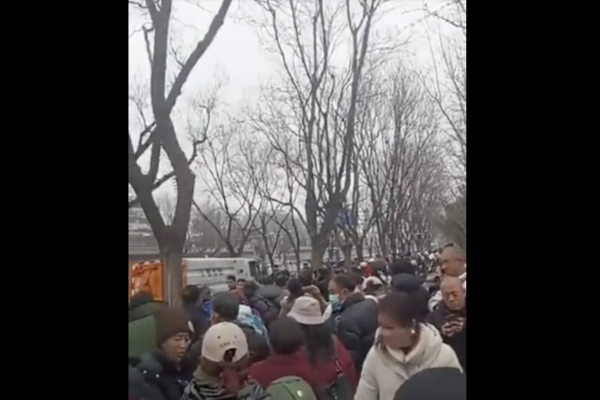
Video footage from February 25 showed a crowd of petitioners gathered outside the National Letters and Calls Office in Beijing.
However, even before the Lunar New Year, Beijing petitioners had informed Epoch Times that a large number of imposters were queuing up at the National Letters and Calls Office, pretending to be petitioners to secure a spot in line, while genuine petitioners were blocked outside the reception hall.
Video footage also showed petitioners attempting to climb over wire fences to enter Beijing’s jurisdiction.
On the seventh day of the Lunar New Year (February 23), several elderly petitioners made speeches at the queueing site outside the Letters and Calls Office. A female petitioner criticized the Chinese Communist Party leaders without directly naming them, saying, “Is this national peace and stability? You can see everything that happens abroad, but are you blind to what’s happening to Chinese people? How are you governing the country? Your governance is ruining the nation and destroying the youth of many.”
She also advised other petitioners that queuing was useless and urged them to learn from peasant uprisings and large-scale strikes, advocate for human rights, adopt a different way of life, and not expect to achieve justice through this method as it would be futile.
Every year, there is a long queue of petitioners from all over the country outside the National Letters and Calls Office in Beijing. Temporary institutions in the suburbs of Beijing, such as Jiujingzhuang and Majialou, exist to divert petitioners from outside Beijing. There are also numerous detention centers across Beijing and other parts of the country, as well as some places disguised as “hotels,” established on local government orders as illegal black jails to handle petitioners intercepted on their way to Beijing.
An informant named Chen Fang informed Epoch Times that he understood the period from February 25 to March 12 as the main “security period” for the sessions, with all stability maintenance work and the arrival times of foreign journalists for coverage falling within these two full weeks, and second-level security checks already underway. “All trains arriving in or passing through Beijing’s terminal must undergo a second security check.”
As the National People’s Congress and Chinese People’s Political Consultative Conference approach each year, dissenters in Beijing are subjected to “forced travel,” soft detention, and surveillance by the Chinese Communist authorities. Chen Fang mentioned that someone told him yesterday (26th) that many dissenters have yet to be notified to leave Beijing, speculating that one reason could be the government’s financial constraints.
Beijing veteran journalist Gao Yu’s social media account has not been updated since the 26th, prompting speculation about whether she has been taken away from Beijing.
According to a report by Hong Kong’s Ming Pao on February 27, the Year of the Horse had arrived slightly late, with less than a week left until the sessions, and the atmosphere in Beijing did not feel as tense as expected. While security checks were in place along Chang’an Street, the deployment of security measures and duty rosters had already been discreetly activated by various units.
On Dong’erhuan Street, retirees who typically wear red vests and keep an eye out for passersby at this time of year were absent yesterday. Additionally, the previous evening, Hong Kong media reporters traveled on Line 1 of the subway from Tian’anmen East Station to Jianguomen Station and found no visible changes in the security checks, even at Jianguomen Station, where identification checks are often required, no police officers or plainclothes officers were present.
However, Hong Kong media noted that police checkpoints were set up at key entrances to Beijing from the 24th afternoon, where vehicles heading towards Beijing underwent security checks. Non-Beijing-registered vehicles destined for Beijing were required to open their front and rear trunks for inspection, and even at the Beijing inspection point on the Da’guang Expressway, vehicles bound for the city underwent another round of security screening.
In recent days, Beijing officials have issued multiple notifications related to security measures for the upcoming sessions: a notice on February 27 stated that from March 1 to 12, the release of balloons, kites, and other objects that threaten flight safety in the administrative area of Beijing is prohibited, as well as the operation of unmanned aerial vehicles and the launching of sky lanterns; a notice on the 25th declared a 12-day ban on vehicles transporting hazardous chemicals from operating in Beijing.