
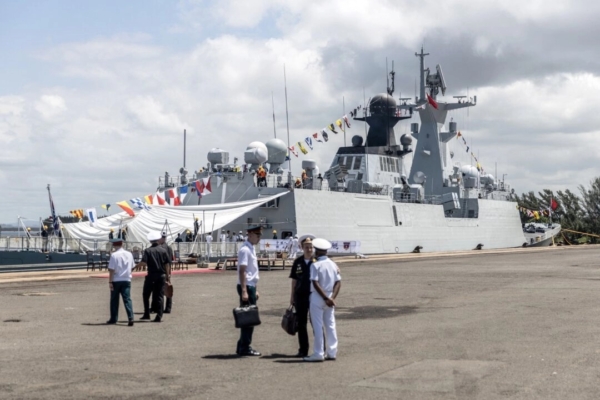
In recent years, the influence of the Chinese Communist Party (CCP) in Africa has expanded at an astonishing rate. Projects such as the railway in Kenya, ports in Tanzania, energy initiatives in Sub-Saharan Africa, and militarized infrastructure across the continent have been supported by billions of dollars in state-backed loans. Beijing has long positioned itself as Africa’s largest trade partner and most active financier of infrastructure development.
However, the situation has undergone a significant shift. In certain areas, such as energy loans from Chinese development financial institutions, investment levels have plummeted by as much as 85% from their peak, indicating a strategic retreat rather than a mere minor adjustment.
So, what exactly is happening? Is China withdrawing from Africa, or do the developments in Africa reveal deeper economic challenges within China itself?
Undoubtedly, the current CCP situation encompasses all of these aspects and more.
Research cited by the Clean Air Task Force (CATF) based in Boston, Massachusetts, has shown an approximate 85% reduction in Chinese financing for energy projects in Africa since 2015, pointing to a sharp contraction in capital inflows. Another report from the Global Development Policy Center at Boston University indicates a substantial decrease in Chinese loans to Africa in recent years, with some forecasts predicting a nearly 46% year-on-year drop in Chinese investment in Africa by 2024.
This is not merely a temporary pause but a significant reset.
For years, Beijing has driven infrastructure development across the continent through state-backed loans associated with the Belt and Road Initiative (BRI). While the financial gates have not completely closed, they are no longer flowing as freely as before.
Before jumping to the conclusion of “China’s exit from Africa,” it is essential to consider some key facts.
Firstly, China remains Africa’s largest trade partner, with a substantial trade volume that has even seen growth in recent years. However, loans and investments differ from trade.
Beijing appears to be shifting its focus towards more commercially viable projects and private sector-led foreign direct investment, moving away from relying on massive sovereign infrastructure loans. Additionally, there is a preference towards expanding trade rather than increasing debt.
This policy shift carries significant implications. Analysis of China’s outward investment patterns for 2025 suggests a more cautious and selective capital strategy on a global scale, indicating a departure from the past approach not only in Africa but worldwide.
In essence, China is not abandoning Africa but mitigating risks.
However, the underlying issue may not lie solely in Africa but within China itself. The country’s economy is facing substantial pressures, including long-standing challenges in the real estate market, high local government debts, slowing GDP growth, and weak domestic consumption.
These challenges have prompted Beijing to enhance capital controls and financial risk management, signaling a departure from the economic model that once propelled China to global prominence.
In summary, the era of double-digit economic growth in China is long gone. A new set of challenges has emerged and appears difficult to overcome. The Chinese regime is increasingly focused on ensuring stable employment, preventing the spread of financial crises, and addressing issues such as declining population.
As domestic funding tightens, large-scale overseas projects become more challenging to greenlight—especially in politically complex or high financial risk environments. Thus, Africa is not being punished but rather realigned in priorities.
Even critics of the “debt trap diplomacy” narrative acknowledge that China, as a creditor nation, has become more cautious in recent years.
China’s Africa policy framework continues to operate through the Forum on China-Africa Cooperation (FOCAC) held every three years, which continues to promote trade, eliminate tariffs for the least developed countries in Africa, and foster development cooperation.
Recent reports indicate that trade between China and Africa is close to $300 billion, underscoring the robust economic ties between the two sides. However, there exists a fundamental distinction between promoting trade and providing guarantees for sovereign debt.
The earlier model of offering massive state-backed loans for infrastructure construction had associated political and financial risks. Some projects underperformed, making it challenging for other countries to repay the loans, thus falling under Beijing’s dominance in an increasingly scrutinized global landscape.
Beijing seems to have decided to reduce exposure to such risks, tightening investment standards and directing funds towards areas with clearer returns. This shift is not ideologically driven but a matter of asset-liability management.
The 85% reduction in overseas investment in certain categories does not just reflect a change in diplomatic policy; it signals that large-scale overseas loans no longer align with the CCP’s internal priorities. Retaining capital becomes imperative amidst tightened liquidity and risk preferences.
Chinese authorities acknowledge that as the economic situation deteriorates, domestic stability also weakens. Therefore, safeguarding domestic stability takes precedence, achieved through debt control, stabilizing the real estate market, and ensuring employment. These increasingly severe domestic issues evidently hold greater importance for the CCP than expanding geopolitical infrastructure influence.
This doesn’t imply the end of boundless expansion under the Belt and Road Initiative but rather marks China’s transition into a phase of selective participation driven by returns, rather than widespread strategic support.
This is a sign of economic maturity—or economic strain.
China’s global expansion ambitions are now constrained by domestic economic realities. Addressing domestic economic vulnerabilities while excessively expanding overseas territories poses a risky combination.
Cutting expenditure may signify discipline, economic pressure, or both. Economic pressure demands fiscal discipline, and when the world’s second-largest economy slashes spending in critical areas by 85%, it impacts not only Africa’s financial future but also China’s financial future.