
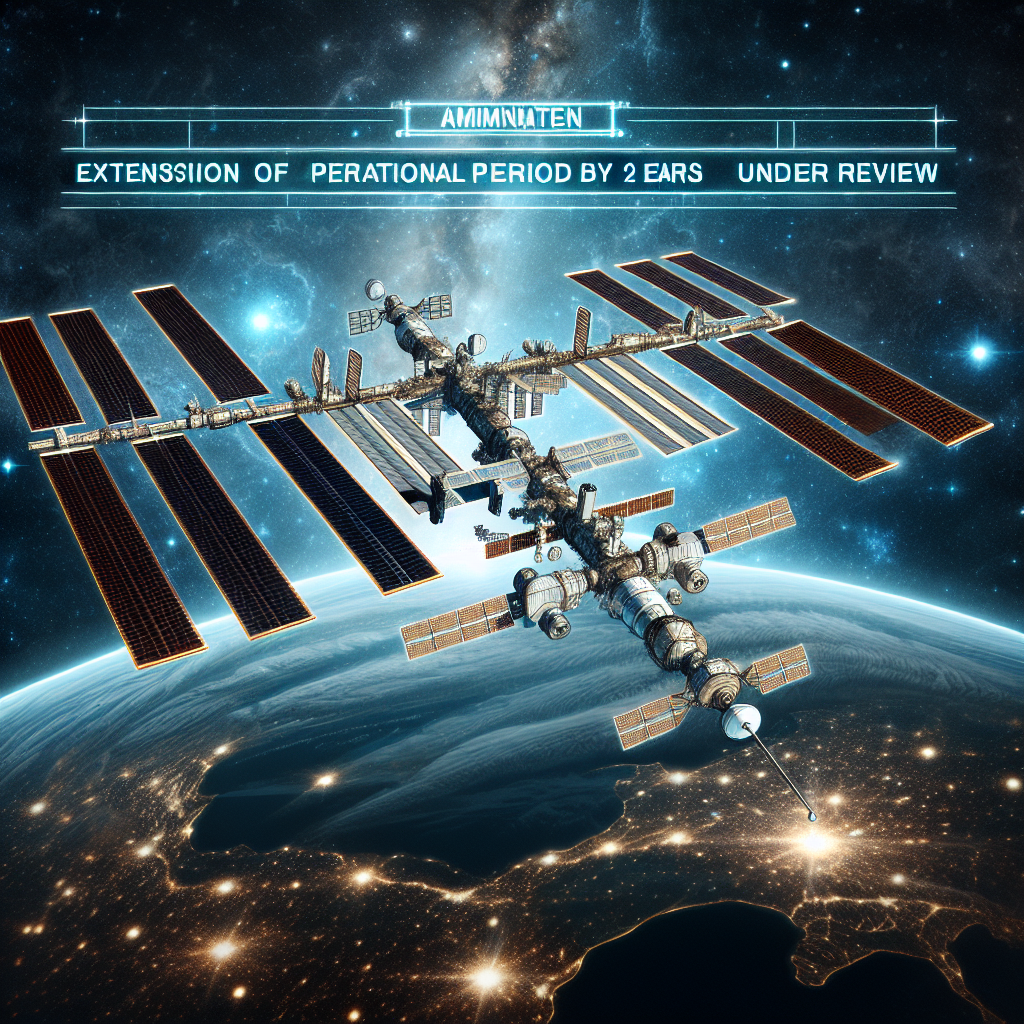
The United States Senate committee will review an amendment to the NASA Authorization Act next week. The proposed amendment aims to extend the operational period of the International Space Station (ISS) by two years to allow companies more time to develop alternative commercial space stations. It also includes a provision mandating NASA to establish a base on the lunar surface, with the goal of strengthening America’s leadership in space and countering China’s expansion.
The legislation, titled the “2026 NASA Transition Authorization Act,” is set to be discussed by the Senate Committee on Commerce, Science, and Transportation on March 4. It serves as a substitute amendment to the S.933 bill, known as the “2025 NASA Transition Authorization Act.”
Not only does the proposal plan to extend the ISS retirement date from 2030 to 2032 (when commercial space stations are expected to begin operations), but it also includes a clause requiring NASA to establish a permanent base on the moon as part of its Artemis lunar program, serving as a stepping stone for future manned missions to Mars.
This bipartisan proposal, co-led by Committee Chairman Ted Cruz and ranking Democratic Senator Maria Cantwell, demonstrates a high level of political consensus with a clear focus on China. China aims to achieve manned lunar missions by 2030 and is considering involving foreign partners in its Tiangong space station.
Preventing a “Low Earth Orbit Gap”
NASA originally planned to transition to using commercial space stations post-2030, such as Jeff Bezos’ Blue Origin company’s Orbital Reef project or the Voyager Space project. The ISS, in orbit for over 20 years, has experienced minor leaks and equipment malfunctions in recent years. NASA views these issues as signs of aging equipment and believes that U.S. private companies are gradually gaining the capability to take over low Earth orbit missions.
However, the development progress of commercial space stations is not as expected. The extension of the ISS for two years aims to provide these private enterprises with more research and development time to ensure there are no talent or experimentation gaps in near-Earth orbit.
Countering China’s Space Expansion
The legislation explicitly states that this is to counter China’s expansion in space. With the intensifying geopolitical competition in low Earth orbit, concerns have been raised that once the International Space Station retires, the United States might face a gap in manned space missions.
Paving the Way for Future Mars Missions
Furthermore, the inclusion of a “Moon Base” requirement in the bill will help solidify NASA’s determination to establish a long-term presence on the moon and accumulate experience through lunar missions to pave the way for future missions to Mars.
The U.S. Congress aims to secure its leadership position in the space race by extending the ISS’s lifespan and strengthening moon base construction.
The ISS is a collaborative project involving multiple countries. While the U.S. leans towards extending the ISS’s operation, it still requires synchronous support from the European Space Agency (ESA), Japan Aerospace Exploration Agency (JAXA), and the Canadian Space Agency (CSA). Especially, Russia’s commitment currently extends only until 2028. If Russia refuses to cooperate, the technical maintenance of the ISS (such as orbit maintenance propulsion) will become extremely complicated.
Additionally, last year NASA commissioned Elon Musk’s SpaceX to build a dedicated spacecraft to ensure the safe disposal of the International Space Station into the Earth’s atmosphere to avoid generating space debris and incurring high maintenance costs by leaving it in orbit.
Musk, who has previously advocated for a “direct flight to Mars,” announced support for the idea of establishing a moon base in mid-February. SpaceX is actively developing the Starship rocket as part of NASA’s Artemis program, intended to serve as the Human Landing System’s lunar module. On the other hand, Blue Origin’s Blue Moon lander is also in development. NASA hopes to accelerate the development progress of the lunar landers to ensure a moon landing by the late 2020s (even within President Trump’s term).