
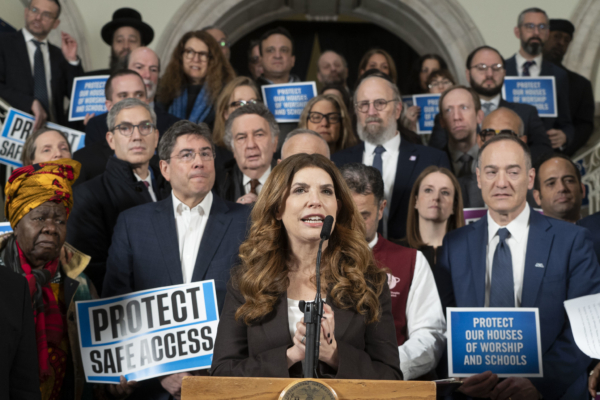
On Wednesday, February 25, the New York City Council’s “Hate Crimes Task Force” held a hearing to discuss legislation proposed by Speaker Menin and other council members to strengthen laws combating hate crimes targeting religions. These proposed laws have garnered widespread attention, with hundreds of citizens attending the hearing, including religious leaders and representatives from civil rights groups.
Prior to the hearing, Speaker Menin organized a gathering with interfaith leaders, elected officials, and educators to rally for public attention on this series of proposed legislation aimed at combating hate crimes.
Menin stated that her proposed bill 1-A is part of the “Five-Point Plan to Combat Anti-Semitism” that she introduced at the beginning of her term. It calls for the New York City Police Department (NYPD) to develop and publicize a plan to address potential instances of physical harm, intimidation, or restricted access that may hinder individuals from entering religious places. This includes establishing “buffer zones” at places of worship where protesters are not allowed to cross.
Proposal 1-A and Councilmember Dinowitz’s bill 175-A emphasize transparency and accountability in exercising existing powers without creating new criminal offenses or criminalizing protest activities in any way.
“Today, we come together with a common belief: that there is no place for hate in New York City,” Menin said in a statement. “These bills are based on a simple yet urgent principle: every New Yorker should feel safe entering their places of worship or schools.”
Menin further emphasized the transparency required by the proposals, stating, “We must defend our city’s constitutionally protected First Amendment rights while safeguarding religious and educational freedoms.”
Supporters and opponents of the legislation both stress the importance of the First Amendment rights to free speech, religious freedom, as well as the rights to assemble and petition. However, their positions are diametrically opposed, with one of the key points of contention being the necessity of “buffer zones.”
A Chinese-American lawyer surnamed Wang from the Legal Aid Society opposed the proposal’s requirement for setting up police lines at protest sites during her speech.
“Doing so would inevitably increase police deployment and could lead to stricter surveillance on people of color,” Lawyer Wang said. “The presence of police in protest activities may escalate tensions in crowds rather than enhance safety.”
Another typical argument from the opposing side is that federal and state laws already clearly protect the rights of individuals to enter religious places, and these proposals “threaten the constitutional rights of New Yorkers” because they would deprive them of their freedom of speech rights.
On the other hand, the majority of supporters for this series of bills are from New York City’s Jewish community. According to the 2025 data from the NYPD, although the number of anti-Jewish hate crimes has decreased, there were still 330 hate crimes against Jews recorded last year, accounting for 57% of all hate crimes.
Many speakers referenced the incident that occurred last month in Queens at Q Gardens. At that time, the “Youth Israel Synagogue” was hosting an event promoting real estate investments in Jerusalem, which was disrupted and protested by pro-Palestinian demonstrators displaying slogans supporting the terrorist organization Hamas.
A young Jewish man expressed during his speech that on November 5, 2023, a few weeks after the Hamas terrorist attack in Israel that resulted in the deaths of thousands on October 7, his Holocaust survivor great-grandmother organized a community unity meeting. His grandparents were planning to attend but were blocked by a large group of protesters, forcing them to retreat to their home.
“If there had been a reasonable buffer zone between protesters and Jewish synagogues, my family members could have entered their place of worship to pray for peace,” the Jewish man said, while also emphasizing, “The purpose of this legislation is not to suppress protest activities or limit the freedom of speech guaranteed by the First Amendment, but solely to protect individuals’ ability to fully and safely exercise the rights granted by the First Amendment, including the freedom to assemble and practice religion.”
Menin’s bills have received support from State Attorney General Jane Roberts. “Our strength lies in our diversity, and we will not allow fear or prejudice to divide us. I commend Speaker Menin and the City Council for their efforts to protect all faith practitioners in our city.”
At the time of submission, the hearing was still ongoing.