
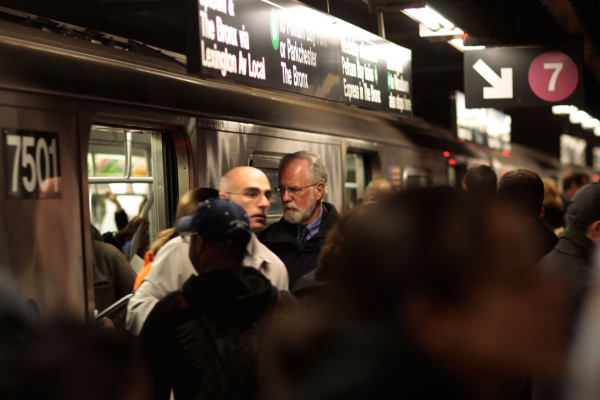
After the passage of a snowstorm, the New York City subway system experienced massive service disruptions on Tuesday (February 24), leaving commuters stranded in long queues to board trains, overcrowded carriages, and trains delayed for extended periods of time, with reports of smoke billowing from some trains.
In the aftermath of the recent snowstorm, several subway lines had implemented temporary adjustments or suspensions starting on Monday (February 23). The heavy snowfall and strong winds had caused tracks to ice over, signal delays, and equipment malfunctions, resulting in a significant increase in wait times for passengers.
Some trains, such as the C line, were completely suspended, prompting passengers to switch to neighboring lines like the A line. Additionally, a section of the G line experienced mechanical issues, leading to a service suspension between Bedford-Nostrand Ave and Court Square until Tuesday afternoon.
Passengers reported to Gothamist that while riding a G line train, they heard a loud noise followed by thick smoke filling the carriage, leaving them trapped inside without clear explanations from officials, causing alarm among passengers.
At the Nostrand Ave station in Brooklyn, overcrowding and delays due to train shortages led to staircases packed with waiting passengers, reportedly with some enduring wait times of several hours. Many passengers expressed frustration at the authorities’ lack of timely updates on service disruptions, with the displayed wait times on their phones vastly differing from the actual situation.
An MTA driver, also waiting for the subway, pointed out that one of the reasons for the system’s operational issues was a shortage of manpower, as many train crews were unable to report for duty due to being stranded at home following the snowstorm, thus limiting scheduling and train dispatch.
The snowstorm brought over two feet (about 60 cm) of snow to the city, prompting the municipal government to issue emergency status orders and transportation bans on the 22nd, advising against non-essential travel. Despite MTA’s efforts to maintain full subway and bus operations during the storm, the massive snowfall and freezing conditions significantly impacted service quality.
According to meteorological observations, the snowfall in the Central Park area reached nearly 19 inches (about 48 cm), coupled with strong winds, making snow removal and transportation coordination extremely challenging.