
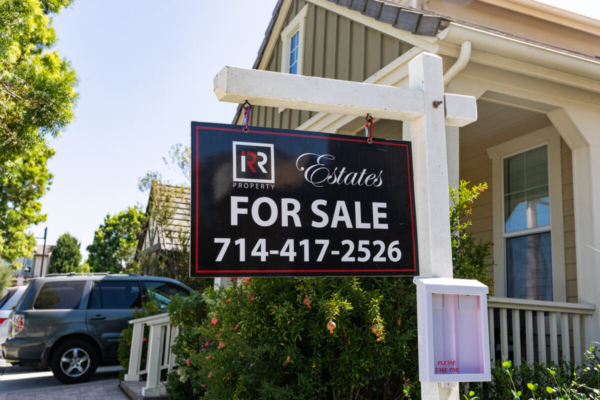
The latest report from the US real estate brokerage firm Redfin shows that in January of this year, the number of sellers in the US housing market exceeded buyers by about 44% (about 600,000 units). This indicates that most areas have shifted to a buyer’s market, with particularly strong performances in the southern and western regions.
Redfin defines markets where the number of sellers exceeds buyers by more than 10% as buyer’s markets. In such situations, buyers have more choices and usually have the upper hand in negotiations.
Even in the hot California housing market, including metropolitan areas like Los Angeles, San Diego, and San Jose, there has been a phenomenon of a buyer’s market emerging.
In January, the number of homebuyers in the market decreased by 1% compared to the previous quarter, marking an 8% year-on-year decline, hitting a historic low. High home prices, persistent mortgage rates, escalating economic and political uncertainties have led to buyers pulling back, resulting in a supply-demand imbalance.
Meanwhile, many sellers are also buyers themselves and with softening housing demand, they have started to back off as well: some sellers choose to withdraw listings after months of no interest, while others opt not to list their homes for sale after seeing nearby homes sell below asking price.
According to Redfin’s data, among the top 10 strongest buyer’s markets in the US, 9 are concentrated in Florida and Texas, with one in Las Vegas, Nevada.
Currently, Miami, Florida is the strongest buyer’s market with the number of sellers exceeding buyers by a significant 2.5 times. The main reason is the significant housing supply in the area, especially a large number of apartments.
Researchers analyze that during the pandemic, homes in the “sunbelt” regions have become highly popular, attracting a large number of buyers from other higher-priced areas in the US. To meet the surge in demand, construction companies have ramped up construction, leading to an oversupply of homes for sale compared to the number of buyers.
The number of newly constructed homes significantly impacts the bargaining power for both buyers and sellers as it affects the supply-demand balance. Florida and Texas have consistently higher levels of housing construction compared to other states. In California, a long-standing shortage of new homes has led to severe supply deficits, strong rigid demand, and continuous upward pressure on home prices.
Redfin analyzed the housing market in the 50 most populous metropolitan areas in the US and found that in January, only 5 metropolitan areas were seller’s markets. This means there are limited housing options for buyers, driving up prices and intensifying competition.
Among them, the strongest seller’s market is in Newark, New Jersey, where sellers outnumber buyers by 31%. The other four seller’s markets are in Nassau County, Long Island, New York, Milwaukee, Wisconsin, Montgomery County, Pennsylvania, and New Brunswick, New Jersey.
California remains one of the most expensive housing markets in the US, with ongoing supply shortages. However, in January, both home sales and prices in California witnessed declines.
According to data from the California Association of Realtors (C.A.R.), the median home price in California in January was approximately $823,000, showing the largest annual decline since June 2023. Despite this, the median home price in California remains twice as high as the national average of $400,000.
Based on Redfin’s data, the largest buyer’s market areas in California currently are Riverside, Los Angeles, the capital Sacramento, San Jose, Anaheim, Oakland, San Diego, and San Francisco.
This article is for general informational purposes only. Epoch Times does not provide investment, tax, legal, real estate planning, or other personal financial advice, nor does it assume investment responsibility.