
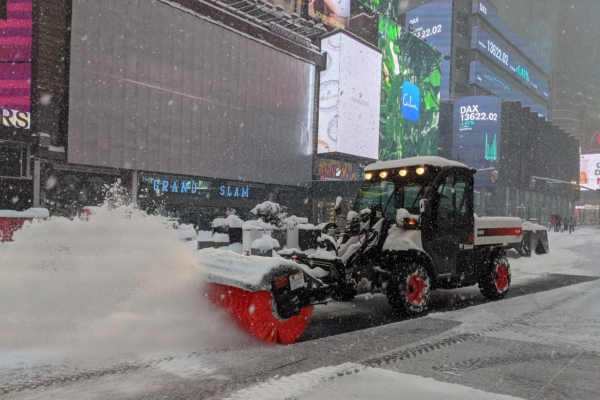
A recent snowfall with temperatures hovering around freezing point has hit the New York area, where some snowflakes are melting upon hitting the ground and refreezing, forming dense and highly water-laden wet snow. Experts point out that this type of snow can weigh twice as much as regular powdery snow, making it not only difficult to shovel but also increasing the risk of icy and slippery road surfaces and potential damage to tree branches and power lines, thereby raising the risk of power outages and traffic accidents.
The New York City Emergency Management Agency (NYCEM) has warned residents that shoveling snow is not suitable for everyone. Officials emphasize that individuals with a history of heart disease or other high-risk health factors should avoid shoveling snow on their own. When engaging in snow removal activities, it is essential to slow down, take regular breaks, pay close attention to your body’s condition, and avoid pushing yourself to clear every last bit, as it may put you at risk.
Looking back at recent cases in New York City and surrounding areas, the primary risk posed by wet heavy snow often targets cardiovascular stress. In January of this year, a retired police lieutenant in Floral Park, Long Island, collapsed while assisting in clearing snow from the sidewalks outside a church during a snowstorm and subsequently passed away. Preliminary investigations suggest that the incident may be related to a sudden onset of heart disease during shoveling. Doctors point out that shoveling wet heavy snow is equivalent to repeatedly lifting heavy objects and, coupled with the cold causing vasoconstriction and increased blood pressure, poses a significant risk for older individuals or those with cardiovascular diseases.
The second danger comes from a slight misstep in snow removal tools and operating details. Last December in Port Jefferson, Long Island, a serious accident occurred when a resident operating a snow blower accidentally cut off several fingers, requiring immediate medical attention. Police point out that many snow removal injuries do not occur on public roads but rather in front of residences or private driveways, often due to clearing snow by hand or rushing to remove blockages without turning off the engine. What appears to be a simple action often results in lengthy rehabilitation or even permanent injury.
The third risk is more subtle but equally deadly – carbon monoxide poisoning. In February, a suspected carbon monoxide poisoning incident occurred in Flushing, Queens, where police discovered a man and a dog dead inside a mobile veterinary vehicle, with another septuagenarian found unconscious outside the vehicle. Initial investigations suggest that the accident may be related to snow blocking the vehicle’s exhaust pipe, preventing proper carbon monoxide discharge and leading to its accumulation inside the compartment. Municipal data indicates that incidents of poisoning due to snow-covered exhaust pipes during snowstorms are not uncommon, as snow not only piles up on roads but can also silently block the “lifeline vents.”
In addition, snow removal not only affects the shovelers themselves but may indirectly jeopardize road and pedestrian safety. When highways or main roads undergo snowplowing operations, if snow flows back onto the lanes, and subsequently refreezes after melting, forming black ice, the risk of vehicles skidding and causing chain collisions significantly increases. Moreover, snow removal vehicles have limited visibility during snowfall, with snowdrifts obstructing sightlines, leading to blind spots when reversing or turning, and pedestrians standing too close are at risk of entering dangerous areas.
Experts advise residents facing wet heavy snow to shovel in small amounts multiple times with breaks every 10 to 15 minutes; older individuals or those with a history of cardiovascular disease should consider seeking assistance from family, neighbors, or professional snow removal services; before using a snow blower, carefully read the safety instructions and never clear blockages by hand; clear accumulated snow around exhaust pipes before starting vehicles. If symptoms such as chest tightness or difficulty breathing occur, promptly dial 911 for assistance.