
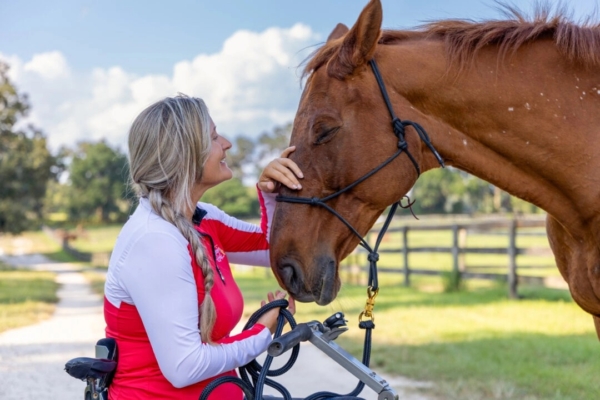
When the 100-pound bale of hay fell from the towering stack and crashed onto her back, Lauren Barwick knew immediately that everything would never be the same again. It was her second day on a Canadian ranch where she was starting her dream job. The ranch was responsible for training horses for advertising and film. In a split second, everything cruelly changed. As she lay trapped beneath the barn floor, unable to move and calling for help, she realized – she was paralyzed.
Little did she know at that moment that this catastrophic accident would pave the way for extraordinary achievements beyond her imagination. Not only would she excel in equestrian competitions, but she would also be able to mentor and inspire equestrian enthusiasts around the world, profoundly impacting them, helping them overcome difficulties, and establishing better communication and interaction with their massive equine partners weighing over a thousand pounds.
Raised in British Columbia, Canada, Lauren had always been passionate about sports, excelling in equestrianism, cross country running, and skiing.
However, horses held the biggest place in her life. She understood horses, had a profound bond with them, and confidently rode even the tallest and intimidating horses that others found daunting. She dreamt of one day appearing in movies alongside horses.
After a successful internship, she accepted a job at the same ranch, which offered her the opportunity to pursue her dreams. On her second day at work, when Lauren was preparing to collect hay stacked in the barn, the towering stack looked like a giant tower.
Determined to remove the hay on top by herself, she climbed up. As the hay stack wobbled, she jumped down. Landing in a crouching position, a bale of hay crashed heavily onto her back from a height of three meters, knocking her to the ground.
“I couldn’t feel anything at that moment,” she recalls twenty-five years later, sitting at a picnic table under an oak tree on her Florida farm, speaking to a reporter from The Epoch Times. “I grabbed my leg, but I couldn’t feel anything. It all happened in an instant, my spine had cracked.”
Later, someone told Lauren that the hay bale hitting her from above equaled to thousands of pounds of force. It took about ten minutes for anyone to discover her after the accident. When other workers heard her cries for help, they thought she had been attacked by a violent stallion and rushed to another stable.
Despite her severe spinal injury, Lauren’s spirit remained unbroken. As she was carried to the ambulance, she joked, “I’ll be back tomorrow. But remind you, I haven’t fed the bulls yet.”
For months, Lauren struggled through physical therapy, always hoping to walk again.
“You know your horse is waiting for you,” her mother encouraged her one day.
Avoiding horses since the accident, she finally wheeled her chair to the paddock fence. There, her horse – her friend, waited silently for her.
The mare didn’t shy away from the unfamiliar wheelchair; instead, she leaned her soft nose against Lauren’s leg.
“I cried then,” Lauren recalls. “I cried hard; it seemed to understand what had happened.”
She fitted the horse with a bridle, then pushed her wheelchair forward, leading the mare named Peanut out of the ranch.
For Lauren, riding a horse wasn’t just being carried on horseback; it was about building a true partnership with the horse.
She gestured her old friend to step back, and the mare obeyed. She gestured for Peanut to circle the wheelchair, and the horse followed. Ultimately, Lauren had Peanut, together with the wheelchair, pulling her as if she was in a chariot.
However, riding – true riding, seemed impossible for her now, or at least not in the way she desired.
Her mother suggested therapeutic riding, a practice where individuals with physical, emotional, cognitive, or developmental disabilities benefit from being carried by horses. Therapy horses move very slowly, often accompanied by assistants to maintain the rider’s balance.
Lauren firmly refused.
“That’s not therapeutic for me in any way,” she said, telling herself that it would only bring more pain.
She had always been the one to help others overcome equestrian challenges. Her mother would proudly say, “Put my daughter on, and she can ride any horse.” Now, having to ride with assistance from others was hard for Lauren to accept.
One day, as she watched riders and their horses seamlessly working together, a strong sense of loss suddenly overwhelmed her. She burst into tears, wheeled her chair away. But friends stopped her. Moments later, they lifted her onto a horse.
“My worst nightmare became a reality,” Lauren said. “I sat paralyzed on the saddle, feeling nothing of being on horseback, only being led in circles around the arena.”
That night, she pondered over everything that had happened and contemplated how to move forward. Soon, she realized she had a choice.
“In the future, I can’t make excuses and say, ‘Oh, you know, I can’t ride because I broke my back.’ That’s simply not true,” she said. “Now all I can say is, ‘I broke my back, and I choose not to ride.’ And I didn’t want to live with that.”
The next day, Lauren returned to the ranch with a firm determination. She began riding again – initially with a hunched posture, but with daily practice, her strength and balance gradually improved. Friends helped her try various methods to sit securely in the saddle, allowing her to eventually ride independently.
As her confidence and skills grew, people involved in para-equestrian sport encouraged her to join. Lauren declined.
“I didn’t want to participate in the Paralympics because I didn’t want to be lumped together with other paralyzed people,” Lauren said. “I didn’t know then that it was a parallel event to the Olympics.”
The Paralympics are held after each Olympic Games, using the same venues and attracting top athletes from around the world.
Lauren learned that people with various physical disabilities could compete at the highest levels in para-equestrian sports, including dressage. Dressage, from French meaning “training,” showcases the harmonious coordination of horse and rider performing intricate movements resembling a dance. It is judged based on precision and beauty.
Para-equestrian riders are classified into five grades based on the extent of their physical impairments, and riders in the same grade compete against each other. Grade I riders have the most severe impairments. Due to her paralysis from the waist down, Lauren was classified as a Grade II rider for many years. With rule changes, she is now categorized as a Grade III rider.
To prepare for competition, a handle was added to the front of Lauren’s saddle to help her mount and dismount and maintain balance; leg straps secured her legs. She also learned to command the horse with voice cues and used two sticks to lightly tap the horse’s body to issue commands.
Just four years after the accident, Lauren represented Canada in the 2004 Summer Paralympics held in Athens.
“Becoming an excellent rider at top-tier international events is just one challenge,” Eleanor Brimmer, a para-equestrian athlete and chair of the United States Para-Equestrian Association, told The Epoch Times.
“You need talent, funding, reliable equine partners, and a support team to compete at the highest level of competition.”
At the Paralympics that year, Lauren placed sixth and seventh respectively. Failing to win medals only solidified her determination to return to competition.
Seeking to deepen her understanding of the sport, Lauren attended a seminar hosted by renowned American equestrian coach Pat Parelli. With over forty years of experience in teaching horsemanship, Parelli instructs students globally on communicating and “connecting” with horses through trust, a method known as “natural horsemanship.”
At the seminar, Lauren made another life-changing decision.
“After the seminar ended, she came up to introduce herself and asked if I could help her participate in the next Paralympics and win gold,” Pat Parelli recalled in an interview with The Epoch Times.
“I said, ‘First of all, why do you believe that I am the one who can help you? Secondly, how can you convince me that you are someone I can help?’ That’s how everything started. She simply said, ‘I know I can do it.’ I said, ‘Then you need to prove it to me.'”
During a two-week “audition” on Parelli’s farm, Lauren helped with farm work and rode horses with able-bodied riders, sometimes traversing rugged terrain. This experience was starkly different from her previous horseback riding experience in a controlled environment. For Lauren, it was the first time in a long while that she felt… freedom.
Sponsoring a Paralympic hopeful comes with a hefty price tag, and the training required to qualify for equestrian competitions demands a significant time investment. For this reason, Parelli needed to ensure that Lauren had the resilience required, in addition to verifying: was she a skilled enough rider? Was she a serious enough student? Did she possess the “competitor’s mentality” to handle the pressure of competition?
“Her performance over those two weeks left me with complete confidence in her, and we subsequently began our official collaboration,” Pat Parelli said.
It was no surprise to Parelli that Lauren excelled as a rider and equestrian instructor while in a wheelchair. The imposing size and strength of horses had no impact on her whatsoever.
“The wheelchair is just a restraint,” Parelli said, “and freedom is about learning to move freely despite constraints. We all have our own constraints.”
With his sponsorship, Lauren acquired the high-level competition horses she needed, along with the funding for training and competition fees. After a series of successful equestrian competitions, she qualified for the 2008 Beijing Paralympics. There, her dressage performance earned high scores, leading to a silver medal. In the freestyle music competition, she and her horse Maile clinched a gold medal.
In 2012, with support from another sponsor, Lauren, along with her competition horse Off to Paris, competed in the London Paralympics and placed sixth and eighth in the aforementioned events.
Two years later, she won a silver medal in freestyle music and a bronze medal in the individual event at the 2014 World Equestrian Games held in France. The International Equestrian Federation named her the world’s top para-equestrian rider.
During this time, she purchased land in Reddick, Florida, with the help of her father and gradually built an equestrian training facility. In 2013, one of her students’ brothers flew from Sweden to learn from her. Fabian Brandt, a professional dancer, aspired to be involved in equestrian training.
Soon they discovered that their shared passion for horses forged a deeper connection between them.
Ten years after they wed, Viola, 8, and Braxen, 3, have joined Lauren and Fabian in their home – adding a new dimension to their lives.
Yet, amid life’s changes, one thing remains unchanged – Lauren’s determination.
She competed again at the 2016 Rio de Janeiro Paralympics, riding with Onyx and finished sixth and seventh in her division. At the postponed Tokyo Paralympics in 2021, with her horse Sandrino, she placed sixth and ninth.
With Onyx now retired and Sandrino leased, Lauren declines to push Sandrino back into Olympic-level competitions due to its previous injuries.
Lauren’s aim is to compete once more at the 2028 Los Angeles Summer Paralympics. She states that she needs sponsors to help cover associated costs and requires a special horse. Lauren has learned from her experiences that nothing should be deemed impossible.
She hopes that people passionate about chasing Olympic dreams will lend a helping hand to join her on her “journey.”
Lauren continues to attend some of Parelli’s seminars. Parelli stated that witnessing her build trust and communication with horses while in a wheelchair has inspired many.
“You can train a dog with a piece of meat, but with horses, it’s entirely different,” he said. “You can’t lure them to obey. People think they can, but it doesn’t work at all. So we teach people how to make their horses willing to connect with them. That’s what Lauren learned at the beginning – how to establish that connection and bond. That’s where it all begins.”
Even the farm manager, Franky Muller, was amazed by Lauren’s ability to care for the farm’s horses, complete various tasks, and handle horses that other riders found difficult.
Muller expressed that Lauren made those around her feel astonished every day.
“We often forget how severe her disability is because she is so capable,” he said.
When called an “inspiration” by others, Lauren simply shrugged it off.
“I prefer to empower others because empowerment provides them with a path forward,” she said. “Inspiration generally disappears after a week.”
Lauren insists that the daily goal should be to become the “best version of yourself” in the circumstances you find yourself in.
She quickly added that life is full of challenges – for everyone.
The real question, she said, is, “How do you figure out how to navigate those challenges and ultimately, with a smile on your face, welcome the moment when the clouds part and you see the sunshine?”