
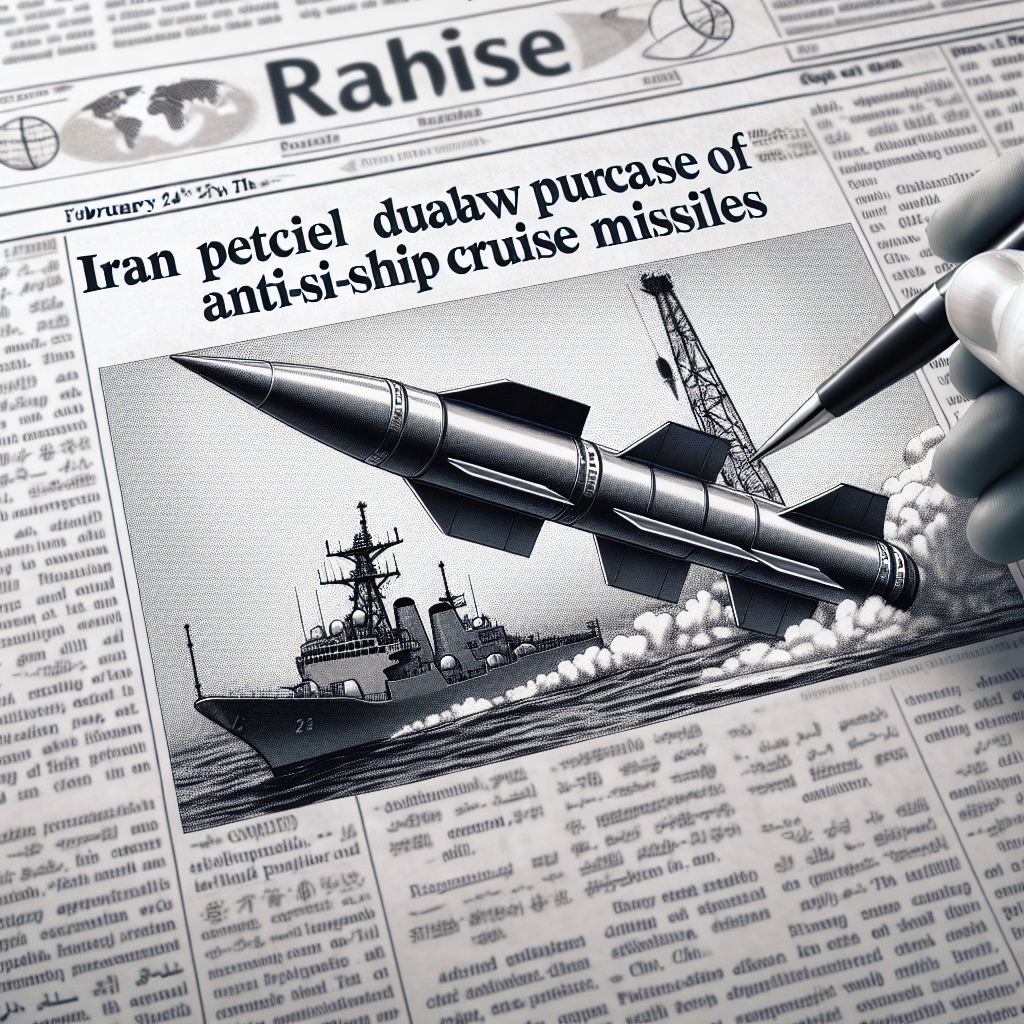
On February 24th, according to a report by Reuters, it was revealed by informed sources that Iran is in the process of purchasing anti-ship cruise missiles from China, and the two sides are close to reaching an agreement. This development comes at a time of heightened tension between the United States and Iran, with the U.S. military gathering near the Iranian coast.
The six informed sources disclosed to Reuters that Iran’s purchase of CM-302 missiles from China is nearing completion, although the delivery date has not been finalized. The supersonic missiles have an approximate range of 290 kilometers and are designed for low-altitude high-speed flight to evade shipborne defense systems.
Among the six sources are three Iranian government officials who received briefings and three security officials, although Reuters did not specify their exact identities.
It is reported by the sources that negotiations for Iran’s procurement of missile weapon systems from China have been ongoing for at least two years, with the pace accelerating after last June’s “12-Day War” between Israel and Iran. During the final stages of negotiations last year, senior Iranian military and government officials, including Deputy Defense Minister Massoud Oraei, reportedly visited China, a trip that had not been reported previously.
An Iranian Foreign Ministry official told Reuters, “Iran has military and security agreements with its allies and is now utilizing the appropriate timing for these agreements.”
Reuters noted that the potential transaction’s missile quantities, the amount Iran has agreed to pay, and whether China will continue to fulfill the agreement given the current regional tensions have not been confirmed.
The Chinese Foreign Ministry claimed to be unaware of any negotiations regarding missile sales.
The White House has not directly commented on the matter. An official quoted President Trump as saying, “Either we make a deal, or we will have to take very tough measures, just like last time.”
Danny Citrinowicz, a senior Iran researcher at the Israeli Institute for National Security Studies and a former Israeli intelligence official, stated, “If Iran gains the capability to launch supersonic attacks on ships in the region, it would be a complete game-changer. These missiles are very difficult to intercept.”
Supersonic missiles are hard to intercept due to their fast speed, low-altitude flight, and certain stealth and anti-jamming capabilities, leading to a very short interception window. However, the actual performance of China’s CM-302 missile, which lacks combat records, remains unclear. Chinese weapons are generally heavily promoted, with performance parameters often based on laboratory data, which may differ from actual combat performance. To date, no country has publicly equipped this type of missile, and there are no publicly available videos of test launches.
China has close relations with Iran. During a visit by Iranian President to China last September, Chinese leader Xi Jinping declared his “support for Iran in maintaining sovereignty.”
China, Iran, and Russia hold joint naval exercises annually. Last year, the U.S. Treasury Department imposed sanctions on several Chinese entities, accusing them of providing chemical precursors for missile propellants to the Iranian Islamic Revolutionary Guard Corps for its ballistic missile program. In response, China vehemently denied any knowledge of the matter.
After reinstating sanctions on Iran last September, China, along with Russia and Iran, jointly penned a letter stating they believed the decision to reinstate sanctions was a mistake.
Iran expert Citrinowicz stated, “China does not want to see a pro-Western regime in Iran, as it would pose a threat to their interests. They want the current regime in Iran to continue.”
The sources further revealed that Iran is in discussions to purchase China’s surface-to-air missile systems, anti-ballistic missile weapons, and anti-satellite weapons.
In the 1980s, China was Iran’s main arms supplier, but large-scale arms transfers gradually decreased in the late 1990s due to international pressure. In recent years, U.S. officials have accused Chinese companies of providing missile-related materials to Iran.
(This article is based on a report by Reuters)