
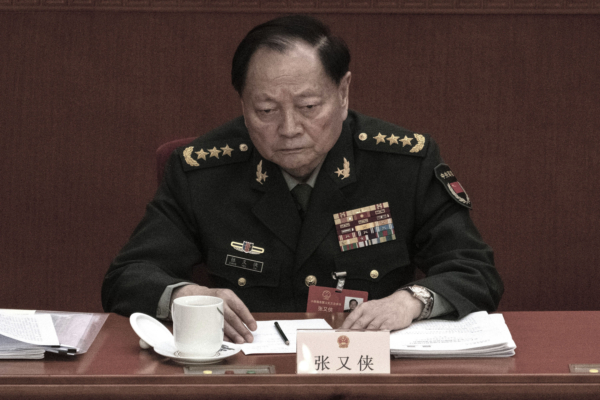
The ongoing Zhang Youxia case continues to attract attention. According to sources close to the Chinese Communist Party military, authorities are planning to charge Zhang Youxia and Liu Zhenli from the angle of “selling official positions,” but they have not emphasized the previously mentioned “serious trampling and destruction of the system of the Chairman of the Military Commission” as a political charge. This approach transforms the political issue into a criminal path, making it easier to proceed procedurally and also signifies that the real power conflict is being repackaged as an anti-corruption issue.
Zhang Youxia and Liu Zhenli have been under official investigation for over a month now. Regarding whether Zhang Youxia has been arrested, there is currently no authoritative public information confirming this, and there are various versions of it circulating in the community and overseas media.
Sources close to the military have stated that the highest Chinese Communist Party authorities are shifting the focus of the narrative on Zhang Youxia and Liu Zhenli from “political charges” to a “criminal path”: on one hand, they accuse the two of “profiting by selling official positions through personal power and influence over the past decade,” involving various military branches and large amounts of bribery; on the other hand, they elevate “selling official positions” to the most taboo “clique forming” within the CCP, explaining it as an organizational and power network issue.
The sources also mentioned that the authorities are primarily planning to prosecute from the angle of “selling official positions,” rather than directly using “seriously damaging the system of the Central Military Commission Chairman” as the core external accusation. This layered approach deliberately separates political purges from judicial procedures.
This view contrasts with an editorial published in the Chinese Communist Party’s Liberation Army Daily around January 24, 2026. When naming Zhang Youxia and Liu Zhenli, the editorial explicitly used expressions like “seriously trampling and destroying the system of the Chairman of the Military Commission,” characterizing the issue as a “political and corruption problem,” emphasizing that the investigation will “rectify the original principles politically.” In the official CCP context, “destroying the Chairman’s system” is more significant than mere corruption, indicating a political level of the problem.
Chinese independent scholar Huang Bin (pseudonym) believes that the statements from the mentioned “sources” suggest a consensus, that the CCP authorities are advancing the handling of Zhang Youxia and Liu Zhenli for political purposes but choosing a path of criminal charges operationally. He said, “For decades, buying and selling official positions has been an open secret in all levels of the CCP government and is even more common within the military. Senior military officials often acquire positions through purchasing them, then develop their subordinates through selling positions. Besides bribery, it also involves kickbacks. However, in the eyes of the highest authorities, this clearly falls under forming cliques and engaging in private dealings.”
Huang Bin added, “The issue of Zhang Youxia selling official positions existed before he became Vice Chairman of the Military Commission, and the military disciplinary committee could not have been unaware. Why could it be tolerated back then, but now they want to pursue him for violating party discipline, military discipline, and national law? It’s obvious that capturing Zhang Youxia and Liu Zhenli is a power struggle. I recently heard that the authorities are preparing to handle Zhang Youxia from a corruption angle. When high-ranking officials talk about corruption, it mainly refers to selling official positions, there’s nothing else more lucrative to sell.”
A lawyer surnamed Zhang from Guangdong believes that the Chinese criminal law has long abolished politically charged offenses like “counter-revolutionary crimes,” replacing them with handling political issues through non-political charges, with bribery being the least controversial and easiest to establish. He said, “This charge is easy to operate. In the past, arresting two corrupt officials might have resulted in one being wrongfully accused, but such situations are rare now. When Bo Xilai was tried, wasn’t it also for being convicted of receiving over twenty million yuan in bribes?”
A report by Reuters on January 26 stated that the Liberation Army Daily editorial mentioned that Zhang and Liu had “seriously damaged and violated the Chairman’s system,” but did not provide details. Several researchers see this language as a more severe political signal than the usual “serious violations of discipline and law,” implying that the authorities are emphasizing the single decision-making chain from the supreme commander to the military.
Lyle Morris from the Asia Policy Research Institute told Reuters that using the term “violating the Chairman’s system” suggests that Zhang Youxia had “too much power within the system, exceeding the highest level’s single power axis.”
A military scholar familiar with the military’s retroactive investigations and network connections, Lium Quan (pseudonym) from Xiamen, stated that after the Zhang Youxia incident, the top leadership has repeatedly emphasized the loyalty of lower-level officials to the central leadership, with the military system being no exception. He said, “Now, what’s more valuable is the loyalty of grassroots to seniors. Selling off positions not only brings money but also secures the loyalty of those bought positions. This is probably something the top leadership didn’t anticipate initially; you want absolute loyalty from the grassroots, but also fear them forming their own power that might influence your authority, which is quite challenging in itself.” He believes that the tension between this loyalty and control is the underlying unspoken contradiction behind this current purge.
Liu Quan mentioned that the Chinese National People’s Congress is set to convene, and the networks involved in the Zhang Youxia and Liu Zhenli cases are extensive, making it unrealistic to untangle these connections in a short period. He also revealed that the so-called “reversal of investigations” is facing resistance. He said, “Many of these people were promoted by him or his subordinates, who then promoted their subordinates. How can you investigate downwards? A slight push could shake up the entire body. The investigation into the entire relationship network may end without reaching a conclusion, but crucial figures will not be easily let go.”