
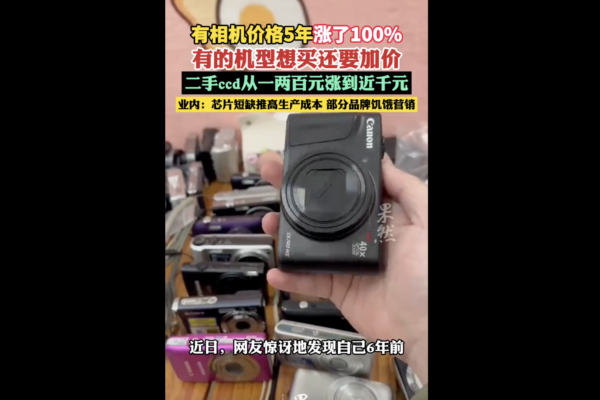
In the era of rapid iteration and quick depreciation of electronic products, cameras have taken a surprising turn. Before the end of the New Year holiday, a resident in Hangzhou discovered that the Canon camera purchased 6 years ago for 2,459 yuan has now increased in second-hand price to 4,048 yuan. This is not an isolated case. In recent years, some popular camera models have seen astonishing premiums, earning them the nickname “electronic gold”.
Recently, netizen “@黃油麵包貓” found a camera purchased 6 years ago and curiously searched for the same model’s price, only to discover that the Canon camera bought for 2,459 yuan now fetches a second-hand price of 4,048 yuan.
Multiple mainland Chinese media outlets, including “羊城晚報” (Sheep City Evening News), reported on the soaring camera prices, leaving Hangzhou resident Xiao Wu filled with regret. In 2020, she wanted to purchase a Ricoh GR3 camera, which was priced at over 4,000 yuan on the official website at the time, but she found it too expensive and did not buy it. Looking back now, the same model’s price has skyrocketed to nearly 9,000 yuan, with a price increase of over 100% in 5 years, far exceeding the price increase of gold during the same period.
The Fuji series takes the exaggeration further. The official website price of the xt30 second generation is over 8,000 yuan, but it is frequently out of stock, with only a few units available each time it is restocked, making it nearly impossible for ordinary consumers to purchase. To acquire it, one must pay a premium of one or two thousand yuan through authorized distributors. Xiao Wu eventually managed to purchase one at the original price of over 8,000 yuan through a friend studying in Australia.
The most remarkable price surge belongs to CCD cameras (Charge-coupled Device cameras). CCD cameras are early digital cameras that have been discontinued with the rise of smartphones. Four or five years ago, they could be easily obtained for a couple of hundred yuan in the second-hand market. However, with stars and internet celebrities showcasing the “vintage atmosphere” photos taken with CCD cameras, this wave of nostalgia has quickly ignited the market. Since they are out of production, the cameras circulating in the market are all old stock, leading to a supply shortage and a rapid increase in prices – some sell for as low as seven to eight hundred yuan, while those in better conditions could even exceed a thousand yuan, marking a price increase of nearly ten times.
Industry experts point out that this surge in camera prices is the result of a combination of global chip shortages, a tightened supply chain, and brand marketing creating a bubble. With social media platforms praising the “atmosphere” and “vintage tones”, cameras are no longer just professional tools but have become fashion accessories.
However, not all old cameras are valuable. Experts warn that not all old cameras are worth collecting, and blindly following trends carries risks.
According to camera collecting experts, there are four aspects to consider in determining whether an old camera is worth collecting:
1. Consider the brand and existence: Products from well-known brands with low existence are more valuable, such as Alpa, Leica, Rollei products from before the 1960s, and Zeiss series from before the 1950s.
2. Consider historical significance: Models with unique historical backgrounds, such as “Red Flag” and “East Wind”, and those with special designs or used by specific individuals, have higher collection value.
3. Consider usage value and condition: Cameras with a new appearance, high integrity, and functional completeness are more sought after. Check if the shutter, lens, flash, and accessories are complete, and having the invoice and manual is also a bonus.
4. Consider preservation: After buying an old camera, wipe it clean and keep it well-ventilated. Lenses should be kept dry, and camera bodies should avoid dryness, preferably stored separately. Improper storage can significantly affect the collection value.