
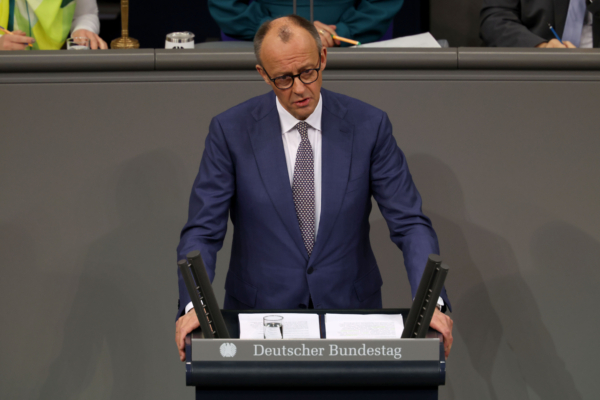
German Chancellor Friedrich Merz is set to visit China, marking one of his most anticipated diplomatic moves since taking office. For Berlin, this is not just a bilateral diplomatic arrangement but also a strategic test in the context of restructuring global power dynamics.
The current Germany-China relationship shows clear dual tensions: deep economic interdependence with supply chains and markets still tightly linked, but decreasing strategic mutual trust, intensifying industrial competition, and increasing divergence in values and systems.
Therefore, this visit is not only about trade realities but also about larger issues – how Germany will position itself in the era of great power politics.
Economic Realities: High Dependence and Structural Imbalances
In 2025, Germany’s trade deficit with China was nearly 90 billion euros. German exports to China decreased by about 10%, while Chinese exports to Europe continued to rise. China’s overcapacity in electric vehicles, solar energy equipment, chemicals, and industrial components is accelerating its entry into the European market.
Concerns within the German economic sector focus on three aspects:
– Overcapacity and price competition impacting the European market
– Competition distortion caused by the yuan exchange rate policy
– Geopoliticization of rare earths and key material exports
The German Asia-Pacific Committee (APA) stated in a policy document submitted to Reuters that industry policy-induced overcapacity, massive subsidies, exchange rate policy distortions, and the increasing use of export controls as geopolitical tools are weakening fair competition and disrupting global market stability.
This pressure is not just theoretical speculation. The German industry warns that if China further tightens its export controls on rare earths, some German industrial production lines may face the risk of shutdown in the short term.
Merz’s Strategic Diagnosis: The Return of Great Power Politics
On the eve of his visit to China, Merz published an article on “Foreign Affairs” on February 13 titled “How to Avoid the Tragedy of Great Power Politics.” He wrote that China systematically cultivates dependency in other countries and reinterprets the international order; in the foreseeable future, China’s military power may rival that of the United States.
He further pointed out that great power politics operate on zero-sum logic: raw materials, technology, and supply chains are becoming tools of power.
This assessment aligns with his remarks at the Munich Security Conference, where he bluntly stated that China systematically exploits other countries’ dependencies.
Merz’s strategic diagnosis carries three implications. Firstly, the unipolar world has come to an end. The rule-based order post-Cold War is giving way to more direct power competition.
Secondly, Germany must “organize strength.” He emphasized that Germany is not powerless but can shape the environment; however, this requires integrating forces within the European framework and establishing strategic autonomy.
Thirdly, he opposes complete decoupling. He made it clear that completely decoupling from China is a misguided fantasy, but it is necessary to continue reducing risks and reducing unilateral dependencies.
Last Friday at the Christian Democratic Union (CDU) party conference, Merz further emphasized that China is attempting to redefine the multilateral order according to its standards, in which freedom of speech, religious freedom, and press freedom are no longer core. He stated that Europe should form a closer cooperation with the United States on the understanding of freedom and human rights to “provide better answers together.”
This statement shows that his approach to China is not just about economic issues but is embedded in a framework of values and institutional competition.
Expert Views: China is Strong, but Not Invulnerable
German foreign policy expert Daniela Schwarzer wrote in a column for “Handelsblatt” that China is powerful and aims for technological and industrial dominance, but it is not infallible.
Schwarzer, a former research director at the German Council on Foreign Relations and long-time EU strategic advisor, is one of the most influential strategic analysts in Germany’s policy circle.
She pointed out that China’s economic model generates overcapacity, weak domestic demand, and rising social pressures, constituting its structural weaknesses.
Moreover, she emphasized that merely pointing out mutual dependencies in rhetoric is not enough if China instrumentalizes interdependencies. Europe must set specific, measurable goals to reduce reliance, promoting European-level policy coordination in areas such as rare earths, key technologies, and digital infrastructure.
She also highlighted that Germany should set an example. If Berlin advocates for European unity on one hand and seeks special treatment for its own companies on the other, Europe’s credibility will be undermined.
Her core judgment is that Europe’s true strength lies in its single market and rule-making ability, but this power only works when there is internal consistency.
Enterprises and the State: Increasing Tensions
During this visit to China, Merz will lead about 30 business executives, marking the largest delegation in 20 years. Represented companies include Volkswagen, BMW, Mercedes-Benz, Siemens, Bayer, BASF, Adidas, DHL, Deutsche Bank, Henkel, Airbus, Covestro, and Boehringer Ingelheim, among others.
The business sector emphasizes that China remains one of the most important markets and innovation centers globally. However, several experts point out that corporate interests no longer automatically align with national strategy.
Academician Andreas Fuld questioned whether in Chinese policy, it is the government leading corporations or corporations influencing government direction.
Investor and China observer David Baverrez noted that there is now a clear divide between corporate interests and national interests.
MERICS expert Bernhard Bartsch predicted that in the coming years, the presence of German companies in the Chinese market may continue to decline.
The core contradiction lies in companies pursuing short-term profits while the state must consider long-term security and industrial foundations.
China’s Dependency and Vulnerability
Despite China’s critical position in the global supply chain, it still relies on the European market for export absorption, German high-end machinery and manufacturing technology, and specific semiconductor equipment and industrial software.
At the same time, China faces challenges such as a real estate crisis, rising youth unemployment rates, and local fiscal pressures. This means that China is not without negotiation pressure. If Europe can unify its stance, its market size itself becomes leverage.
Merz wrote in “Foreign Affairs,” “We are not helplessly subject to this world; we can shape it.” The question is whether Germany and Europe are willing to bear short-term costs for long-term autonomy.
Institutional Shift: Expert Committee and Action Plan
In addition to diplomatic expressions, Berlin is pushing for institutional adjustments.
On March 19, the Expert Committee on “Reviewing Germany-China Security-Related Economic Relations” will be officially established and begin operations. The committee consists of experts from the Federation of German Industries, MERICS, the German Council on Foreign Relations, the International Strategic Research Institute, and the German Confederation of Trade Unions.
This means that the assessment of economic reliance on China will enter a stage of institutionalization and normalization, rather than mere political debate.
Simultaneously, the German government is advancing an internal action plan, including strengthening investment review, expanding high-tech export controls, establishing raw materials partnerships, setting up resilience funds, and enhancing protection for critical infrastructure.
The timing of these measures aligning with the visit to China is not coincidental. They signal to Beijing that while dialogue continues, risk management has become part of national policy frameworks.
Symbolic Diplomacy or Structural Shift?
The true significance of Merz’s visit to China lies not in how many agreements are signed but in whether it releases two signals: externally – European unity and conditional cooperation; internally – willingness to bear costs for reducing dependency.
Schwarzer points out that the success of Germany’s China policy ultimately depends not on Beijing but on Europe itself.
In the era of great power politics, China is strong but not invulnerable; Germany relies on China but also has leverage.
The real issue is not whether to cooperate but how to maintain strategic autonomy between cooperation and competition.
This will determine Germany’s position in future global order.