
New York City has been experiencing its longest stretch of extreme cold weather since 1961, with the number of deaths related to the severe cold rising to 20 this year. During a deep freeze period lasting 13 consecutive days with temperatures dropping to 0 degrees Celsius or below, a forensic pathologist testified at an emergency hearing held by the City Council on February 10 that at least 15 of these deaths may have been directly caused by the cold.
Amidst this backdrop, how does the social service system in New York operate during such harsh conditions? What are the responsibilities and divisions of labor between shelters, emergency services, the police department, hospitals, and other institutions? What issues have been exposed by this severe winter weather, and what role can the community play when cold waves hit?
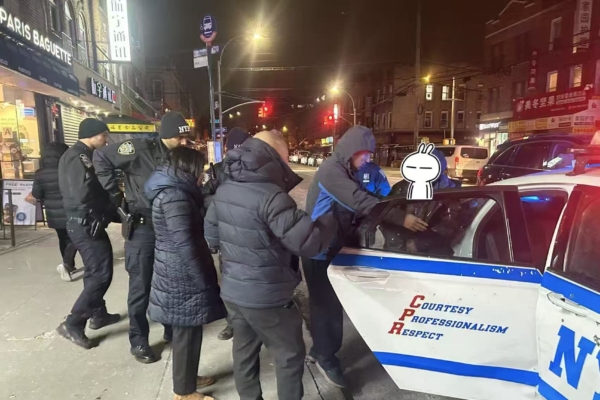
On the eve of a snowstorm on January 24th, a homeless Chinese man from Fuzhou on Brooklyn’s Eighth Avenue caught attention. That night, a netizen sent out a distress message on WeChat, indicating that this homeless man had been sitting outdoors on 59th Street for several hours without adequate clothing to withstand the cold. Once the message spread, community members Ling Fei, Huang Qiwang, as well as local leaders He Lining and Xie Xiaoqiong quickly mobilized, either driving or walking along the streets to locate the man.
After several hours, they finally found the man, and officers from the 72nd Precinct of the NYPD immediately arrived to assist. However, he initially refused to go to a shelter for warmth, with various individuals taking turns persuading him for over an hour. Eventually, accompanied by He Lining, the man was driven by the police officers to an emergency center on Atlantic Avenue for an overnight stay, where he was registered and provided with a bed and hot meal.
It was learned that the man in his fifties had mental health issues, had previously worked in a restaurant, and had been homeless on the streets for the past two years, becoming a familiar figure in the 59th Street area for local residents. If no one had intervened that night, he could have been another statistic of the extreme cold-related deaths.
“Community watchfulness requires the strength of the entire community,” stated Council Member Zhuang Wenyi, noting that the actions that night “saved a life.” However, the next day, the man left the shelter again, prompting Council Member Zhuang Wenyi’s office to immediately notify the 72nd Precinct to track his whereabouts.
During the cold spell, not every call for help can be smoothly addressed.
In the early hours of January 29th, a commuter outside a bank near Manhattan City Hall noticed a homeless person curled up on the ground, wrapped in newspapers to withstand the cold — at that time, the temperature was around 10 degrees Fahrenheit (minus 12 degrees Celsius). The person alerted the authorities through the emergency hotline 311, but hours later when revisited, the homeless person was still in the same spot.
In subsequent City Council discussions, relevant departments explained that outreach workers had made contact with the homeless individual, who had declined services; according to state law, whether forced removal is permissible needs to be assessed by clinical personnel to determine if it meets legal standards. Officials emphasized that even in extreme cold weather, without meeting legal thresholds, forced relocation may not be possible. Still, outreach teams will continue to make contact, aiming to check on him every two or four hours.
This case highlights the tension between institutional mechanisms and reality: bystanders may perceive the situation as critical, but legal and medical assessments delineate the boundaries of government intervention.
Under the extreme cold pressure, a marathon-style oversight hearing lasting five and a half hours was convened by the City Council on February 10, examining the operation of the safety net protecting vulnerable groups in the city and questioning the city’s response measures. Witnesses in attendance included representatives from the Department of Homeless Services (DHS), the police department, the Office of Emergency Management (NYCEM), medical and public health-related organizations, and community members.
First and foremost, the focus was on the core mechanism of cold weather response – the “Code Blue Alert.” Triggered when nighttime temperatures or wind chill fall to 32 degrees Fahrenheit (zero degrees Celsius) or below, it involves expanding shelter eligibility, increasing bed capacity, and enhancing outreach services; during extreme conditions, an “enhanced” version of the alert operates around the clock and boosts patrols and resource allocation. Additionally, calls made to the 311 helpline will be forwarded to 911 for quicker rescue responses.
The city indicated that before winter, drills are conducted to train outreach teams and assess high-risk cases and resources, with the DHS command center coordinating bed placements. Multiple agencies share the StreetSmart database, which adjusts patrol strategies and personnel deployment based on the historical gathering places of homeless individuals and 311 reports, with officers also scanning hotspots before blizzards. However, inadequate information on street cases, with some individuals identifiable only by clothing characteristics, presents challenges in identification and tracking.
The outreach teams compile a prioritized high-risk list each October, covering the elderly, those with serious illnesses, frequent medical visits, or complex health and addiction issues, and year-round outreach focuses on building trust and encouraging voluntary shelter entry. If citizens encounter individuals in need of assistance, they can dial 311 to report and receive alerts and resource information via Notify NYC, such as locations of nearby 24-hour warming centers or warming buses.
In 2025, it was estimated that New York City had 4,504 people sleeping on the streets and subways, a figure that continues to rise, predominantly comprised of elderly males, often with health, psychological, or addiction issues. In the fiscal year 2024, 770 homeless individuals died, with 77 of them succumbing outdoors. The leading causes of death among the homeless were drug overdose (48%), followed by heart disease (19%), accidents (excluding drug overdoses, 9%), and alcohol abuse (6%).
Implementation-level challenges also emerged: during the cold spell, 1,855 distress calls were received by 311, over half of which resulted in the affected person not being found and the case being closed. The police department responded to 2,679 calls, aiding 1,570 individuals with shelter and placement, forcibly hospitalizing 52 individuals; however, strict criteria for forced placement are set by law. Individuals with decision-making capacity and not presenting an immediate danger can refuse entry, even when facing risks from the cold. The Emergency Medical Services (EMS) faced issues of a surge in call volumes and inadequate personnel, accumulating 300 cases awaiting resolution at one point during a snowstorm.
The hearing also delved into the reasons for shelter refusal, including concerns about safety and privacy, negative past experiences, norms prohibiting smoking/drug use, and worries about losing personal belongings or pets.
During the cold spell, outreach teams often encounter homeless individuals who refuse to enter shelters due to fear of losing personal belongings (including bags, carts, and large items) or pets. The Department of Homeless Services indicated that they operate a storage facility to provide receipts for most belongings and secure them safely; only in cases where items are clearly infested with pests will receipts not be provided.
Recent policy adjustments have allowed three temporary shelters to accommodate pets. For items left behind without receipts and contaminated, removal operations are carried out after outreach teams engage and counsel individuals, ensuring trust established through the process is not compromised by the cleanup efforts.
On another front, communal living environments also pose challenges. As most shelters for single adults operate on a communal living model, a single room can accommodate over a dozen individuals, leading to significant anxiety among co-residing homeless individuals constantly vigilant. During extreme weather, the DHS endeavors to relax restrictions on personal items, provide additional seating, increase flexibility, and assist in storing bags and carts through the receipt system, aiming to strike a balance between safety, hygiene, and space constraints.
Street life itself is fraught with risks. Homeless individuals face threats of robbery, assault, sexual violence, unstable food resources, worsening chronic illnesses, and psychological stress from prolonged vigilance. However, despite these dangers, many individuals prefer enduring them rather than returning to collective shelter environments that make them feel more insecure. These realities underscore the complexity of the homeless issue, the gap between shelter systems and street realities, and highlight that encouraging individuals to seek indoor shelter during extreme weather is not just a matter of resource provision but also requires patience, trust, and meticulous communication efforts.
As discussions on future policy direction ensued, Graham Horn, a lawyer from the New York Legal Aid Society, emphasized that individuals do not “choose” to sleep on the streets but do so because shelters are deemed unsafe or unsuitable, posing unfeasible options for many traumatized individuals. Several officials pointed out that the long-term solution lies in expanding permanent housing placements, with specific adjustments including hastening the transition of adult family shelters and repurposing hotels that originally served “families with children” to provide more stable bed arrangements, not solely for temporary accommodations for single adults. The DHS defines adult families as those without children under 18 years, as long as there is a sustained emotional or financial dependency, representing a family unit irrespective of marital or blood relations, with efforts aimed at accommodating these “chosen families” within the social service system.