
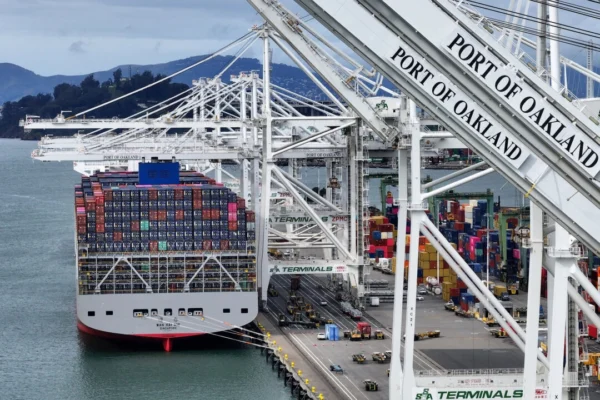
On Thursday, February 19th, a latest report released by the JPMorgan Chase Institute showed that while overall international payments by US businesses remained stable, payments to Chinese companies from small and medium-sized enterprises experienced a significant decrease of about 20% from 2024 to 2025.
The report indicated that among the major trading partners of the US, China suffered the most from tariff impacts, whether viewed from the perspective of overall effective tax rates (China’s effective tax rate was 37.4% in October 2025) or policy uncertainty (frequent changes, at one point China’s effective tax rate reached 125%), hence the result was not surprising.
Furthermore, the report found that small and medium-sized enterprises that previously made payments to China have increased their payments to other Asian regions such as Southeast Asia, Japan, and India. The authors of the report suggested that the underlying reasons for this phenomenon could be import substitution, among other factors.
Clark Packard, a researcher at the Cato Institute’s Herbert A. Stiefel Center for Trade Policy Studies, mentioned on Fox Business Channel that it is still uncertain whether Chinese products are being sent to these countries for reassembly or processing before being shipped in large quantities to the US.
Transshipment involves sending products to a country, affixing that country’s origin label, and then shipping them to a third country without undergoing substantial modification to evade tariffs and other trade rules. There are indications that this situation is likely occurring.
Packard pointed out that as long as the product undergoes substantial transformation or modification in the second country, it becomes the product of that country and not considered transshipment. With lower tariffs in countries like Vietnam and other Asian nations compared to China, Chinese companies could set up processing centers in these countries, make modifications, and then sell to the US.
Derek Scissors, a China economy senior research fellow at the American Enterprise Institute, also believes that imports from Vietnam and Taiwan are likely sources of transshipped goods from China.
Scissors stated that the rise in imports from Vietnam, particularly Taiwan, indicates involvement of Chinese goods being transshipped. Despite being competitors, Vietnam has lower tariffs compared to China, and Chinese investments in Vietnamese consumer goods that are widely purchased by Americans are substantial. Taking Taiwanese companies as an example, it’s relatively simple to avoid high tariffs in mainland China by either going through Taiwan in the production process or switching the final stages from China to Taiwan, and changing the label to “Made in Taiwan.”
The report from the JPMorgan Chase Institute also noted that since early 2025, the monthly tariff payments made by US small and medium-sized enterprises have doubled. Tariff expenditures for these enterprises increased from nearly $100 billion per month before 2025 to about $300 billion per month by the end of 2025.