
Brazil and India formally signed an agreement on Saturday (February 21) to strengthen collaboration in the crucial mining and rare earth sectors. With the Indian government actively seeking new suppliers to reduce dependence on China, this move is seen as a key element in its global supply chain layout.
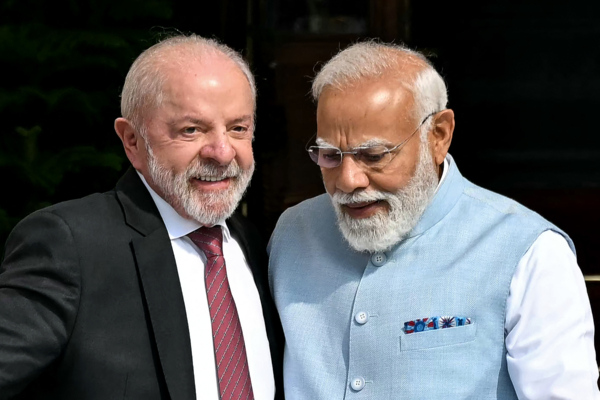
According to reports from Agence France-Presse, Brazilian President Luiz Inacio Lula da Silva arrived in New Delhi this week, attending an Artificial Intelligence (AI) summit and holding talks with Indian Prime Minister Narendra Modi on Saturday. Modi emphasized in a statement that this agreement represents significant progress in building diversified and resilient supply chains for critical minerals.
Expert Rishabh Jain from the Council on Energy, Environment and Water pointed out that India’s cooperation with Brazil complements recent collaborations with the United States, France, and the European Union in terms of supply chain integration.
He stated, “Western partnerships bring technology and capital to India, while the ‘Global South’ alliance is crucial for ensuring diverse access to on-the-ground resources.”
In recent years, India has accelerated various strategic actions to enhance cooperation with the US, Europe, and other allies to counter China’s dominant position in the rare earth sector.
US-India Initiative:
Through the Initiative on Critical and Emerging Technologies (iCET), the US supports India’s participation in the Mineral Security Partnership (MSP) to establish key mineral processing networks independent of China.
EU Collaboration:
Under the Trade and Technology Council (TTC) framework, India and the EU have deepened cooperation in semiconductors and clean energy supply chains, focusing on reducing risks from a single supply source.
Support from France:
France has engaged in joint research with India, utilizing French satellite remote sensing technology to assist India in rare earth exploration and jointly developing green hydrogen energy supply chains.
China currently dominates global rare earth mining and processing, and Beijing has recently tightened export controls. Brazil possesses the world’s second-largest reserves of critical minerals, crucial for industries such as electric vehicles, solar panels, and guided missiles, including iron ore, lithium, and niobium.
President Lula stated, “Increasing investments in renewable energy and critical minerals is at the core of this groundbreaking agreement.” In addition to minerals, the two sides also signed nine Memorandums of Understanding (MoUs) covering digital cooperation, healthcare, and entrepreneurship.