
The Chinese New Year has always been regarded as the most important consumption peak season of the year. From the market for New Year goods to festival decorations, from buying new clothes to the feast on New Year’s Eve, the festive atmosphere of the New Year often corresponds with consumer enthusiasm. However, this year’s holiday season is experiencing a decrease in excitement. From the feelings of the common people to the observation of economic data, it is evident everywhere that the consumption during the Chinese New Year is lackluster, reflecting stagnant incomes and uncertainties about the future.
Hebei entrepreneur Qi Jian (pseudonym) bluntly stated in an interview with Dajiyuan that the most visible change during this Chinese New Year is reflected on the dining table. In the past in Hebei, most families would prepare eight to ten dishes for the New Year’s Eve dinner, symbolizing reunion and prosperity, but this year there has been a general reduction, “now we make do with less.”
He observed on local social media that “there are fewer people having the New Year’s Eve dinner,” and even the posts enthusiastically sharing the dishes for the dinner have noticeably decreased.
Qi Jian recalled that in the past on the eve of the New Year, every household would be busy stocking up on New Year goods, “buying a lot, especially abundant,” but now even young people returning to their hometowns are cautious about spending, “indeed, they dare not spend recklessly.”
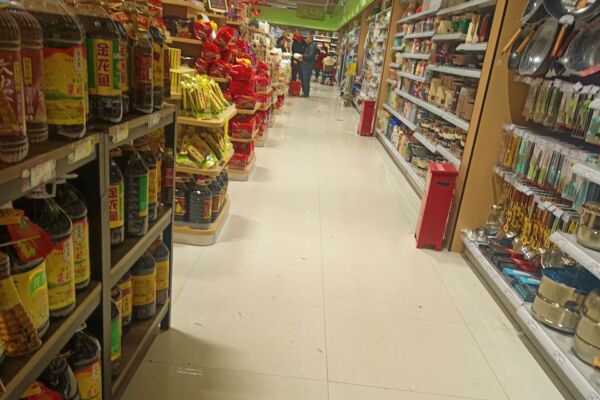
This feeling also extends to the shopping markets. Qi Jian pointed out that walking into the shopping malls before the festival this year, “there are no longer large crowds,” and the customs of buying New Year goods and new clothes are fading. The traditional hustle and bustle of the market on the twelfth month of the lunar year should have been lively, but the crowded scene of previous years has almost disappeared, with vendors openly saying that they can’t sustain their businesses.
Qi Jian admitted, “Now, whether you have money or not, no one dares to spend.” He describes how in the past he might have spent a thousand yuan in a day, but now “it might take a month to spend a thousand yuan,” reflecting a conscious downgrading of consumption.
He likened the current dilemma to “a pond with no fish”: “Before, even with poor fishing skills, you could throw a net and still catch a fish or two… now, even with better skills, you can’t catch anything, because there are no fish in the pond.” He said, “Now the whole of China is like a big pond, there are no fish left,” indicating that the issue lies not in individual efforts but in the disappearance of an environment and opportunities to earn money.
“People now cannot afford to spend money in this economic environment… unless it is absolutely necessary, they will not spend anymore,” he explained, as the era’s dividend has faded away and income sources have significantly shrunk.
“The common people have deeply felt the economic winter,” he said, many people burdened with mortgages, car loans, or other debts, “I am not in the mood to enjoy the New Year either.”
What used to be taken for granted customs during the holidays have now become burdensome. He lamented that simple things like wearing new clothes, eating a hearty New Year’s Eve dinner, or setting off firecrackers have “become luxuries.”
This feeling is not an isolated phenomenon. According to official data, China’s consumer price index (CPI) in January rose by only 0.2%, indicating ongoing weak demand. The producer price index (PPI) has been in negative growth for more than three years, with a 1.4% year-on-year decrease in January, indicating severe deflationary pressure facing the Chinese economy.
Companies struggle to sell their products, resorting to price competition and shrinking profits. As corporate profits decline, investments and hiring naturally decrease, putting pressure on household incomes and consumption.
CNBC’s financial news analysis points out that one of the major reasons for weakening consumption in China is insufficient income growth. Surveys show that among 16 industries, only the mining, public utilities, and information technology (IT) service industries have seen wage growth outpacing GDP growth. The labor market is contracting overall, with youth unemployment rates still hovering around 17%, and over half of respondents believing that the employment environment has become more challenging.
The downturn in the real estate sector, in particular, exerts heavy pressure on consumption. Analysis suggests that in China, real estate accounts for the vast majority of family wealth. When property prices decline, people feel poorer, and with limited insurance coverage, individuals are required to bear a significant portion of medical and retirement costs, naturally leading to spending cutbacks.
A survey by the People’s Bank of China also found that in 2025, nearly two-thirds of families preferred savings over consumption or investment. This indicates that people are reserving funds for future uncertainties rather than increasing expenditure.
Moreover, Chinese households are deleveraging at the fastest pace in years, accelerating debt repayment. Beijing think tank National Institute of Financial Development’s research discovered that household debt in 2025 had grown by only 0.5%, reaching a historic low, with even negative growth in the fourth quarter – a first since 1995.
A report from the Chinese Academy of Social Sciences’ Institute of Finance echoes these findings: the main reasons for household deleveraging are declining house prices and slowing income growth.
Researchers noted that many families started repaying loans early in 2025, adopting a more cautious attitude towards borrowing, while the impact of the government’s 300 billion RMB (approximately $43.1 billion USD) consumption subsidy program for trading in old for new products has weakened.
Consumer confidence has been shaken, leading to sluggish demand for bank credit, especially affecting mortgages and consumer loans.
Amid a prolonged period of stagnation in the property market, household mortgage loans have seen negative growth for eleven consecutive quarters; consumer loan growth has also dropped from 6.2% in 2024 to 0.2% last year, setting a new record low.
In recent years, authorities have implemented various measures to boost consumption, such as stimulus policies, interest rate cuts, consumer vouchers, trade-in programs, and relaxed consumer credit conditions, but the effects have been limited. Nationwide retail sales in 2025, a crucial indicator of consumption, only grew by 3.7%, lower than the 5% GDP growth rate.
Usually, bank credit business sees a significant increase in January, but according to a report from the central bank on February 13, banks issued 4.71 trillion yuan (approximately $681.56 billion USD) in new loans in January, lower than the 5 trillion yuan predicted by Reuters analysts and below the record of 5.13 trillion yuan in the same period last year.
While China’s booming exports helped drive GDP growth last year, structural economic imbalances, trade wars, and increasing geopolitical uncertainties pose significant risks to the outlook.
Data shows that total new bank loans in China in 2025 amounted to 16.27 trillion yuan, the lowest in seven years. This indicates that companies are hesitant to borrow for investments, and households and individuals are reluctant to borrow for consumption.
Bruno Lannes, a senior partner at Bain & Company, observed that in the decade before the pandemic, Chinese consumers were willing to pay for any “innovation,” but now they have become more rational, clearly knowing what they want.
Qi Jian, in his interview, also mentioned: “Those who were well off used to shop on JD.com or Amazon, while those with fewer resources turned to Taobao. Now, many people are shifting to Pinduoduo.”
Dajiyuan commentator Li Lin commented on this, stating that for many ordinary Chinese people, this year’s New Year feels less festive and more filled with calculations and concerns. When holidays no longer bring joy and relaxation but remind people of future uncertainties, downgrading consumption is not just an economic phenomenon but a form of lifestyle restraint and pressure.