
The International Monetary Fund (IMF) has characterized the large-scale industrial subsidies in the People’s Republic of China for the first time in its latest annual assessment report as “macroeconomic imbalances”. The report points out that China’s deflationary pressure is being exported through trade channels, exacerbating global overcapacity and trade imbalances. It also reveals that the actual depreciation of the Renminbi is driving further expansion of the surplus and calls for a reduction of subsidies by around half.
Experts believe that the Chinese regime will find it difficult to substantially cut subsidies and may resort to maintaining industry support through more subtle means in the future, as the transformation of consumption is also hindered by systemic barriers.
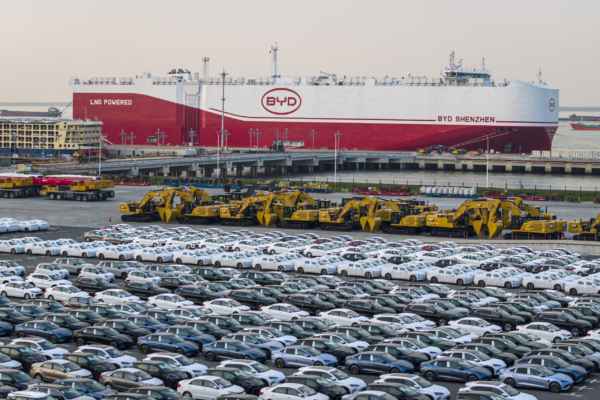
According to the IMF’s Fourth Article Consultation Annual Report, over one-third of China’s economic growth in 2025 came from net exports. The IMF Executive Board explicitly states that this model “raises concerns about overcapacity, which could ultimately lead trading partners to take trade actions and jeopardize China’s exports”.
The report quantifies the scale of Beijing’s industrial policies: by 2023, government fiscal support for priority industries amounts to about 4% of GDP, covering various forms such as government grants, tax incentives, low-interest loans, and land supply.
In comparison, European Union subsidies in 2022 were less than 1.5% of GDP, less than half of China’s. Based on this, the IMF suggests that Beijing should reduce “unnecessary” industrial policy measures by around 2% of GDP, roughly halving them.
It is noteworthy that there has been a significant shift in the language of this report – the term “external imbalances” appeared 14 times, a stark contrast to it never being mentioned in the 2024 edition.
The IMF has also lowered its growth forecast for China in 2026 and warned that deflationary pressures will persist. Mid-term economic growth is expected to further weaken due to labor force shrinkage, declining investment returns, and slowing productivity.
American economist Davy J. Wong pointed out to Epoch Times that this report is not a regular one but a “systematic qualitative and quantitative warning” issued by the IMF under the annual surveillance framework towards China’s growth model.
He believes that this report carries six significant implications: escalating the issue of Chinese industrial subsidies from bilateral trade disputes to macroeconomic imbalances; establishing a quantifiable discussion anchor with 4% of GDP; the “halving” target serves as a bargaining chip; providing a third-party authoritative standard for the unified stance of the US, EU, Japan, and South Korea towards China; offering Beijing a “dignified step” in political terms; and continuing to apply external pressure at the institutional level, laying the groundwork for future tariff reviews and derisking the supply chain.
Tian Xie, a professor at the Aiken School of Business at the University of South Carolina, emphasized the core significance of the IMF report in revealing that the Chinese regime’s subsidy policy “distorts the cost structure of high-tech industries”, putting related industries in China at an unfair competitive advantage, posing a substantial threat to similar technology industries in other countries.
Regarding exchange rates and trade imbalances, the IMF report revealed a set of critical data: after trade-weighted and inflation adjustments, the Renminbi underwent an actual depreciation of approximately 16% (estimated range from 12.1% to 20.7%). This significant depreciation enhances the price competitiveness of Chinese export goods and, coupled with weak domestic demand leading to stagnant imports, continues to expand the trade surplus.
Based on preliminary data from 2025, Bloomberg estimates that in 2025, China’s trade surplus accounted for 3.7% of GDP, with exports surpassing imports by about $1.2 trillion, setting a historical record.
The IMF predicts that the trade surplus may narrow in the medium term but will still be maintained at 2.2% of China’s GDP by 2030, significantly higher than the “normal” benchmark level of 0.9%.
Regarding the spillover effects, the IMF estimates that for every 1% decline in Chinese export price inflation, core inflation among Asian trading partners will decrease by around 0.1% six months later, indicating that China’s deflation pressure is being exported through trade channels.
Both experts believe that the likelihood of the Chinese Communist Party substantially cutting subsidies is very low.
Davy J. Wong analyzed the logic behind why China insists on subsidies from five dimensions: manufacturing investment is the most certain path for steady growth currently, with subsidies being indispensable; subsidies entail a large number of employment positions and affect social stability; the narrative of technological competition deems subsidies as a necessary condition for “overtaking on a curve”; the financial system of local governments is highly intertwined with state-owned capital, and halving would disrupt the entire chain of interests.
He predicted that the Chinese regime is more likely to “metastasize direct subsidies into hidden forms,” transitioning to tax incentives, targeted government procurement, implicit guarantees, and market access, or implementing policies through off-balance sheet channels such as policy banks and industrial funds, achieving an effect of “looking reduced but actually more covert”.
Tian Xie further pointed out from the geopolitical and regime security perspectives that the Chinese regime faces immense pressure from the US in critical fields such as chips and artificial intelligence; if subsidies are reduced, the technological gap would continue to widen, potentially leading to China losing the initiative in regional disputes such as in Taiwan Strait and the South China Sea.
“Even if it harms others and benefits oneself, the CCP must still subsidize,” Tian Xie criticized, stating that the CCP’s subsidy funds are squeezing public resources that could have been used to improve people’s livelihoods; in the dual-use military and civilian fields, more outputs flow towards the military industry rather than the private sector.
The IMF Executive Board explicitly states in the report that “transitioning to a consumption-driven growth model should be a top priority of China’s economic policy” and recommends the implementation of robust comprehensive policies; it also calls for resolving a large amount of unfinished real estate projects through government grants to rebuild consumer confidence.
However, the stark reality serves as a wake-up call. Epoch Times reported earlier that from January 1 to 11, 2026, national retail sales of passenger vehicles dropped by 32% year-on-year; sales of new energy vehicles saw an even steeper decline of 38%, with some stores reporting zero transactions.
This sudden decline occurred against the backdrop of the continued purchase subsidies by the Chinese authorities and price reductions promotions launched by over 20 automakers for 75 vehicle models, indicating that purely stimulating policies are becoming less effective in boosting domestic demand.
Global ratings agencies like S&P, UBS, and Morgan Stanley all predict that passenger car sales in China will experience negative growth in 2026, and it will take at least three years for the industry to absorb excess capacity.
Both experts hold a pessimistic view regarding the transformation direction proposed by the IMF.
Davy J. Wong pointed out that under China’s high taxation, low social security, and low labor income structure, expanding consumption among residents is “an impossible contradiction”; some subsidized industries (such as surveillance and security) have government agencies as their ultimate purchasers, with no genuine market demand.
He believes that a substantive transformation towards consumption-oriented means “conflicts fundamentally with the political and economic direction and system of the CCP”.
Tian Xie, from the perspective of wealth distribution, pointed out that over the past few decades, social wealth in China has been highly concentrated among the privileged class of the CCP; ordinary people are deeply entangled in housing loans, consumer debts, and the foundation of domestic demand has been severely eroded.
Tian Xie stated that the wealth redistribution required by the IMF’s proposed consumption transformation would only be possible after fundamental changes in the political system. Prior to this, the Chinese economy will continue to be pressured in a cycle of stimulus and constriction.