
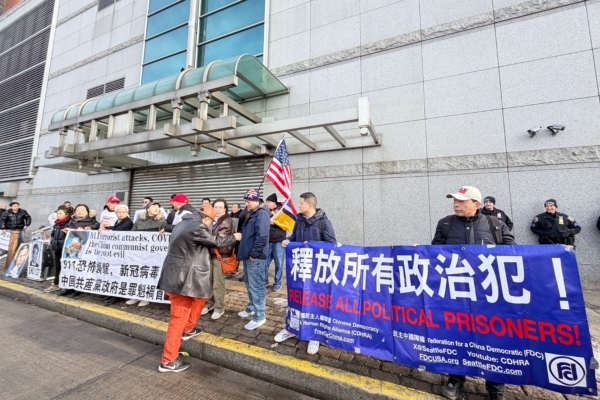
On the afternoon of the first day of the Lunar New Year (February 17th), more than twenty anti-communist activists gathered outside the Chinese Consulate General in New York to protest against the Chinese Communist Party’s atrocities against the Chinese people and call for the release of political prisoners such as Jimmy Lai, Wang Bingzhang, and Xu Zhiyong. The organizers stated that the action reflects the growing discontent of Chinese people with the current system in China, signaling a shift in public sentiment.
The event organizer, Ye Rong, mentioned that the participants included exiles who had been persecuted in China, dissidents, and religious figures. He emphasized that the main demand of the gathering was to “protest against the tyranny of the CCP” and urge the Chinese government to release all political prisoners.
Regarding the symbolic act of carrying a coffin outside the Chinese Consulate on Chinese New Year, Ye Rong explained that in Chinese tradition, a coffin symbolizes burial. By bringing a coffin to the consulate, it signifies a symbolic “burial of the CCP” and a rejection of the communist party’s ideology. In an interview, he emphasized that the protest was not directed at individuals but against the Communist Party itself, labeling it as a devil and likening its system to a meat grinder where anyone could become a victim. The ultimate goal is to bury this devil and to urge the international community to continue monitoring China’s human rights situation.
Speaking about the social climate in China in recent years, Ye Rong mentioned that with the ongoing high-pressure rule of the CCP, there is an increasing number of awakened individuals. He believed that this trend reflects a shift in public sentiment and asserted that any future change in China must come from the people.
Another initiator of the event, former Shanghai exile and anti-communist activist Bai Jiemin, highlighted the plight of overseas anti-communist activists who have been unable to return home for many years, especially feeling the pain of separation from their families during the holiday season. Bai explained that himself and other exiles and pro-democracy activists are unable to return to their homeland for the New Year every year, hence choosing to protest at the consulate on the first day of the Lunar New Year as a means of expression to draw attention from the international community and media.
Addressing the lack of understanding from some Chinese people regarding the act of “carrying a coffin” during the New Year, Bai Jiemin attributed this to differences in perception of the nature of the CCP. He noted that some individuals are still unaware of the dual nature of the CCP’s operation, and as a deeply affected individual, he aims to share his firsthand experiences to clarify the situation to the public.
During the gathering, in addition to the protests, individuals sang songs like “Plum Blossom” and the “National Anthem of the Republic of China” at the entrance of the consulate. According to Bai Jiemin, these songs symbolize their aspirations for freedom and democracy.
In recent years, apart from street actions by overseas pro-democracy activists, the United States government has also been sending messages through various means to the Chinese regime. Recently, the Central Intelligence Agency released a Mandarin-language promotional video on various platforms, depicting a Chinese military officer who chooses to pass information to the American side due to disappointment with the system, sparking public attention and concern.