
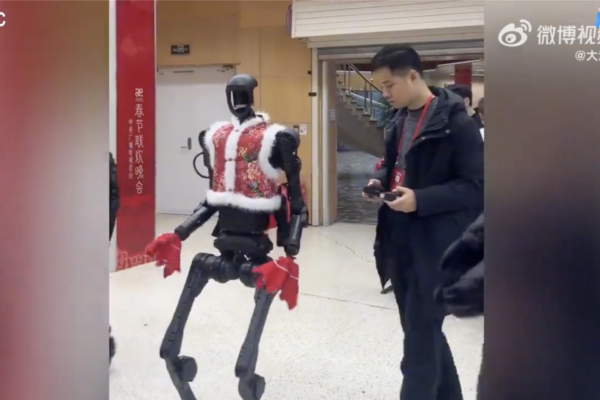
In the 2026 CCTV Spring Festival Gala held in the Year of the Horse, four humanoid robots from mainland China made their appearance, showcasing entertaining performances such as somersaults and dancing, which led many to believe that China’s humanoid robots have taken the lead globally. The related “we won again” propaganda flooded the scene. However, industry experts pointed out that what the audience saw were carefully trained “demonstration segments” and “capital roadshows,” and any actions that were not algorithm-trained or unmanned controlled could potentially lead to mistakes, making them no different from puppets.
Following their debut on the Spring Festival Gala in 2025, the lineup of humanoid robots in the 2026 gala expanded further, with several Chinese domestic robot companies collectively appearing, including Yushu Technology, Songyan Power, Milky Way Universal, and Magic Atom.
Chinese Foreign Ministry spokesperson Lin Jian posted on platform X: “Following last year’s appearance on stage, Chinese humanoid robots with stunning martial arts skills once again shine on the Spring Festival Gala.”
The mainland media is enthusiastic about reporting on the antics of robots, but unexpectedly, very few have invited industry experts to interpret the current state of the industry.
Some observers pointed out that many people praising the robots performing dances and martial arts on the Spring Festival Gala are getting too carried away, losing sight of what artificial intelligence and robots really entail, lacking a fundamental understanding.
In fact, Honda’s Asimo was once the most advanced humanoid robot in the world. It could perform alongside Japan’s famous boyband, and even received presidents. Asimo could run, jump on one leg, climb stairs, kick a soccer ball, and pour tea and water. However, Asimo officially announced its retirement in March last year.
Observers noted that the humanoid robots on the Spring Festival Gala are part of a selective and specialized “performance show.” The movements they exhibit are pre-programmed actions that require manual commands behind the scenes. The robots do not “think” or improvise like humans; they simply replicate optimized movements reliably on a controlled stage.
In the highly structured environment of the gala – with fixed lighting, level ground, and pre-programmed movements – these robots undergo thousands of training sessions, debugging, and modifications, rehearsing repeatedly for three months to showcase a few minutes on stage. This is completely different from robots replacing manual labor in factories or caring for the elderly at home.
On platform X, netizen Robinson specifically analyzed that watching the Yushu robot in the “Warrior Bot” on the Spring Festival Gala performing a somersault from a springboard left many netizens in awe, thinking that robots were about to dominate the battlefield. But in reality, there is still a long way to go.
1. What we see are “selected demonstration segments.” These actions are selected from a massive trial and error process, representing the robot’s best replicable performances. While impressive on stage, they are miles away from practical combat situations.
2. Energy supply is a critical issue. The G1’s comprehensive endurance under active conditions is only 2 hours, which would further reduce in high-intensity activities.
Furthermore, some netizens pointed out that “Yushu’s robots are a scam; the programs are fixed, and the shows are prerecorded.”
The mainland media extensively covered how these robots were trained.
The Beijing Daily reported that the Songyan Power team, performing the “Robot Sun Wukong” segment, replicated the stage setting after their first rehearsal at the central CCTV hall. They then set up a 1:1 replica rehearsal space in an empty factory near the company, with a 1-square-meter grid on the floor. They set strict rules: for the robot to somersault, it must not step out of the “grid.” The factory lights often remained on all night as the technical team continuously adjusted the robot’s technical parameters and algorithms, updating over 300 action strategies, ultimately perfecting the “no stepping out of the grid” somersault.
The Xinjing Bao reported that it took Songyan Power a month to overcome technical challenges for a perfect show. The algorithm team iterated over 300 strategies, and the dance training went through 21 versions. The robot’s facial expression control frequency was increased from 10Hz to 60Hz, and an additional 3 degrees of freedom were added to the neck movement.
The report stated that the G1 performed smoothly during vaulting and aerial actions. Wang Xingxing, the founder of Yushu Technology, mentioned in an interview that for the execution of these actions, he and his team had trained on a simulation platform over a billion times before fine-tuning them on the physical robot.
Pengpai News reported that in a Beijing courtyard, the full-size humanoid robot, Stardust Epoch’s Star Movement L7, showcased a set of “New Year Swordplay” routines, with the sword movements supported by over a billion simulated training sessions and end-to-end reinforcement learning algorithms.
As a result, aside from the meticulously trained functions such as somersaults and dances, these humanoid robots could potentially make mistakes akin to puppets if they were not algorithm-trained or remotely controlled.
In December 2024, during an exhibition in Nanjing, the Yushu H1 humanoid robot suddenly lost its balance, fell, and started convulsing. At the time, a large screen behind the booth was playing videos of the robot bouncing and climbing buildings, creating a stark contrast with the robot’s real-life struggle on the ground.
During the 2025 CCTV Spring Festival Gala, the Yushu H1 performed the twist Yangge dance, but videos surfaced showing these robots staggering backstage at CCTV, a far cry from the polished image displayed on stage.
In April 2025, the Yushu G1 (the model used in the 2026 Spring Festival Gala’s “Warrior Bot”) was used by a third party to participate in a robot half-marathon, but it suddenly fell during the race.
In May 2025, the Yushu H1 robot took part in a 1500-meter race. In a moment when two human controllers were exchanging remote controllers, the H1 robot crashed into the person in front due to the delayed issuance of avoidance commands.
Yushu later explained that when the H1 robot ran fast, there were often delays or inaccuracies in sensory data processing, making it challenging for the robot to make quick judgments like humans. Manual remote control was necessary to compensate for the robot’s inadequate autonomous perception.
On social media, footage from this year’s CCTV Spring Festival Gala exposed scenes from the live rehearsals, showing a backstage operator behind each robot, responsible for remotely controlling and directing the robots to perform preset actions.
Some netizens even pointed out that the Yushu robot’s remote controller is no different from a gaming console.
This situation has left some robot stock investors overly concerned.
One investor expressed, “Watching them perform makes my heart skip a beat; I fear they might accidentally fall. I have a significant investment in robot stocks.”
Another investor stated, “On the first day after the New Year, I quickly sold my robot stocks/funds, because my dad thinks the robot performances are so lifelike, just like real humans. He has started to fantasize about these robots heading to the battlefield or doing household chores. In short, it made him want to increase holdings.”
The lack of large-scale and high-quality data poses a significant challenge to the advancement of embodied intelligence. The amount of physical data needed to train robots is not as abundant and easily accessible as textual data. Currently, the volume of robot datasets falls far below the requirements for universal large-scale models.
This predicament casts a shadow over the commercial applications of Chinese robots for the future.
A video circulating on social media showed an American purchasing the G1 robot, the same model from the Spring Festival Gala, and attempting to make fried rice with it. The robot struggled to handle the pan, causing the fried rice to spill on the floor, with the robot slipping afterward.
Toutiao Finance reported that on January 22nd this year, Turing Award winner Yang Liqun remarked at Davos that no company currently has humanoid robots with practical value. He stated that the common sense of robots now isn’t even on par with a cat, let alone human intelligence.
Yang Liqun believes that although people can train robots in highly specific tasks, it requires gathering a vast amount of data, which is very costly. Moreover, the trained robots can only perform a handful of tasks.
Currently, UBTech is the only Chinese listed company with a commercialized humanoid robot.
Reported by Jiemian News, UBTech has collaborated with BYD and Foxconn. The company aimed to deliver over 500 Walker S2 units in 2025, with a production target of 10,000 units in 2026. However, these robots can currently only perform limited tasks like stacking boxes and quality control. Furthermore, switching the robots between different tasks still requires human intervention to adjust the robot’s ancillary devices, with challenges remaining in the development of multi-functional hands.
Musk also stated at Davos this year that Tesla’s Optimus humanoid robot can currently only perform simple tasks within a factory setting. He expects that by the end of this year, these robots will be able to carry out more complex tasks in industrial environments.
Analysts point out that compared to static mechanical arms or conveyor belts, the operation of humanoid robots is more complex. They not only require independent power supply but also involve more movable joints, leading to a higher probability of malfunctions.
According to data from the International Federation of Robotics, in 2024, China accounted for over half of the global industrial robot installations, primarily consisting of traditional machines like mechanical arms.
Jiemian Finance reported that Marco Wang, an analyst at research institution Interact Analysis, mentioned that while there are many promotional deployments of humanoid robot production lines currently, most are still in the conceptual verification or demonstration stages.
“Before we see actual commercial operations, there are still many challenges to overcome,” he said. Additionally, most humanoid robots currently primarily serve scientific research purposes, lacking practical significance in commercial operations.
Industry analysts generally believe that the clustering of robots on the Spring Festival Gala is, in fact, a disguised capital roadshow posing as entertainment.
Caijing quoted industry sources who revealed that each of the four robot companies cooperating with the Gala had to pay up to 100 million yuan as collaboration fees.
Titan Media pointed out that the Gala is essentially a disguised capital roadshow, and for emerging robot startups, the main benefits are threefold: verifying technical stability (cluster control), gaining national-level exposure (IPO momentum), and demonstrating “delivery capability” to investors.
For the performers on stage, the Spring Festival Gala serves as a critical springboard: either as a direct route to IPO or to seize a wave of enormous market attention.
Yushu is poised to become the first A-share “humanoid robot” stock, while the other three companies are also making moves in the industry.
Shen Meng, a director at Xiangsong Capital, stated to Lianhe Zaobao, “Humanoid robots are currently in the ‘burning money’ phase. The industry is more focused on how to better execute the next round of financing, rather than on improving technology or investing in application scenarios.”
Titan Media reported that there is a “fatigue of aesthetics” emerging in the investment world regarding the appearance of robots at events.
The real test is never under the spotlight; robots cannot keep dancing on stage forever. Can they go into factories and complete sorting and assembly on the production line? Can they enter supermarkets and autonomously navigate between shelves and restock items? Can they enter homes and pick up a fallen slipper in a messy living room? These are the real watershed moments that will determine their viability.