
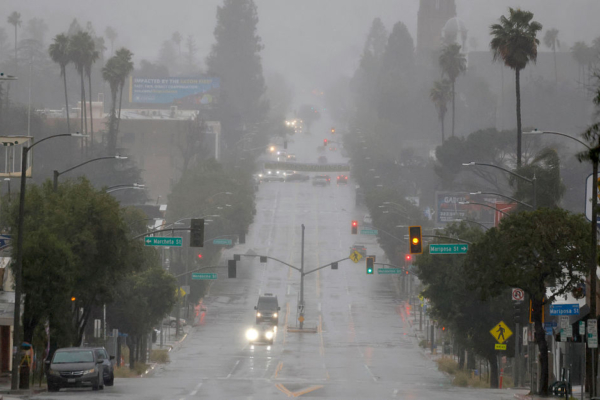
A powerful winter storm has been hitting California since Monday (16th), bringing dangerous weather conditions such as thunderstorms, strong winds, heavy rain, huge waves, and heavy snow in the mountains. The storm is expected to last for several days, with areas like Big Bear Lake experiencing harsh conditions. Multiple important highways and mountain roads leading to popular attractions have been blocked or closed, affecting people’s vacation plans.
The first heavy rain on Monday led to flash flood warnings for millions of residents in Los Angeles County; while in high-altitude areas, the storm brought about 1 to 3 feet of snow. The National Weather Service (NWS) stated that popular vacation spots like Big Bear Lake and San Jacinto have already seen about 1 foot of snow. The winter storm is expected to last until Thursday (19th).
According to the weather forecast for the Big Bear Lake area, gusts could reach speeds of up to 40 miles per hour, with extremely low visibility, making travel very dangerous.
Authorities are urging people to prepare for severe weather. Currently, all mountain roads have implemented R2 restrictions: two-wheel-drive vehicles must use tire chains, and four-wheel-drive vehicles must carry tire chains.
The snow is expected to benefit ski resorts, but due to the intensity of the snowfall and deteriorating road conditions, some tourists may alter their plans or end their trips early. Although the roads are not completely closed, the hazardous conditions have resulted in multiple vehicles getting stranded.
In addition to Big Bear Lake, other attractions have been affected by the storm, such as Six Flags Magic Mountain, which closed on Monday, and Knott’s Berry Farm, which closed early. With the storm expected to continue for several days, people should stay updated on changes to attraction opening hours.
Due to the impact of heavy rain, Los Angeles International Airport (LAX) issued a “ground stop” order on Monday, and flights in the coming days will also be affected by the extreme weather.
Apart from LAX, the Federal Aviation Administration (FAA) stated in an air traffic report released on Tuesday (17th) that strong winds may also cause flight delays at San Francisco International Airport (SFO) and San Diego Airport (SAN).
Facing the looming extreme weather conditions, the California Department of Transportation (Caltrans) has closed several major roads. Officials say that reopening will depend on improvements in weather and road conditions.
As of Tuesday evening, one northbound lane of Porto Marina Way on the Pacific Coast Highway (PCH) was closed due to storm damage; Topanga Canyon Boulevard (SR-27) from PCH to Grand View Drive remains closed.
Furthermore, several mountain roads and sections near the Angeles National Forest, including Aliso Canyon Rd, Glendora Mountain Road, and Angeles Crest Highway, have been closed due to the storm. The reopening time is yet to be determined.
The persistent heavy rainfall has increased the risk of flooding and mudslides in most parts of Los Angeles County, with some residents in areas ravaged by last year’s devastating wildfires receiving evacuation warnings.
Areas like San Gabriel Valley, San Fernando Valley, Whittier, Culver City, Inglewood, and Beverly Hills are also within the flash flood warning range.
The meteorological agency predicts that giant waves will hit coastal waters before Friday. Coastal areas have all issued warnings for giant waves and beach hazards.
At the same time, temperatures are expected to drop sharply this week, with daytime highs in most areas of Los Angeles and Orange County remaining around 50 degrees Fahrenheit (approximately 10 degrees Celsius) and temperatures in the mountains possibly dropping to around 40 degrees Fahrenheit (approximately 4 degrees Celsius).
CAL FIRE is reminding people to prepare for emergencies such as heavy rain, mudslides, or landslides. In addition to staying informed about local weather conditions and emergency alerts, it is necessary to drive slowly, avoid flooded areas, steer clear of downed power lines, and clear house gutters to ensure proper drainage.