
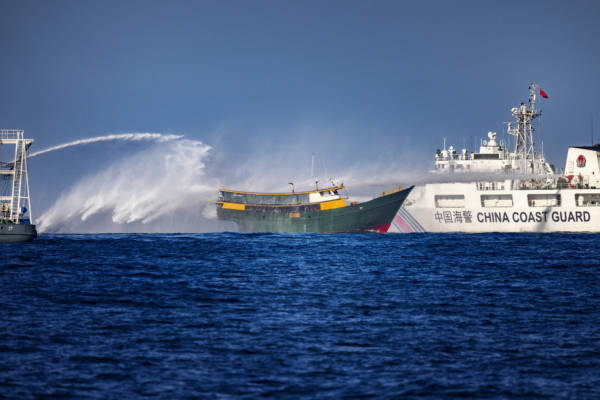
The tension between the Philippines and Beijing in the South China Sea has escalated once again, shifting focus from maritime standoffs to a diplomatic war of words. In response to the warning from the Chinese Embassy in the Philippines that diplomatic conflict could lead to “millions of people losing their jobs,” the Philippine Department of Foreign Affairs (DFA) issued a strong statement on Monday (February 16), condemning the Chinese rhetoric as “coercive” and expressing strong opposition.
The diplomatic row began when some Philippine senators suggested “recalling” the Chinese ambassador to protest against China’s aggressive actions in the South China Sea. In response, a spokesperson for the Chinese Embassy in the Philippines, Ji Linpeng, last week threatened that any deterioration in bilateral relations (such as diplomatic downgrade) would result in “millions of job losses.”
The DFA’s statement on Monday stated, “We strongly oppose the Embassy’s tone, which seems to suggest that economic cooperation could be used as leverage or retaliation. In the current atmosphere, such statements are seen as coercive and undermine constructive bilateral dialogue.”
Despite the Chinese Embassy’s threat of “millions of job losses,” think tanks and economic data in the Philippines show a lack of empirical support for this claim.
According to data from the Bangko Sentral ng Pilipinas (BSP), from January to November 2025, China’s foreign direct investment (FDI) in the Philippines was only around $3.1 million, a significant decrease of 52.43% compared to the same period in 2024, accounting for only 0.27% of the total FDI inflow into the Philippines.
The Stratbase Institute pointed out that China’s claim of “disastrous unemployment” lacks empirical support. Currently, the Philippines is actively promoting economic cooperation with the United States, Japan, the European Union, and Australia to reduce reliance on a single market.
This dispute comes at a time when the Chinese Ambassador to the Philippines, Jing Quan, has been in office for less than three months, facing a serious challenge in his diplomatic work due to the South China Sea stalemate. As China continues to take dangerous actions against Philippine ships, such as firing water cannons and interfering with resupply missions, some Philippine senators, like JV Ejercito and Raffy Tulfo, have called for Jing Quan to be declared “persona non grata.”
In response, the Chinese Embassy has requested the Philippine Department of Foreign Affairs to “restrain certain individuals” from making “slanderous” remarks.
Currently, although Philippine President Ferdinand Marcos Jr. has taken a firm stance on the South China Sea sovereignty issue, he has temporarily rejected the Senate’s proposal and is inclined to maintain diplomatic channels to avoid the situation spiraling out of control. However, the Philippine Department of Foreign Affairs has explicitly demanded that Chinese diplomats adopt a “responsible and restrained tone” in public communications.
(This article is based on reports by Reuters)