
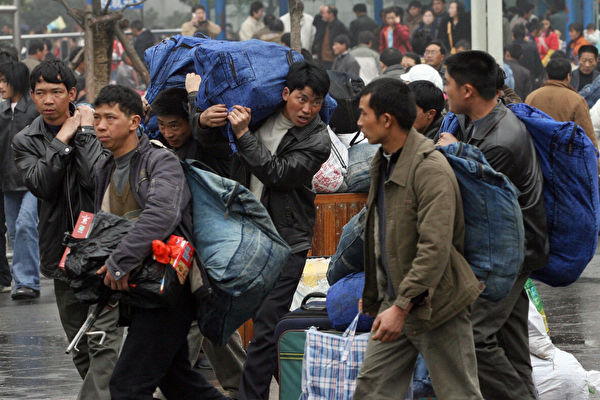
The Year of the Horse has arrived in the midst of political pressure and economic decline in China, with official media promoting the “warmth of the new spring”. However, some people from Henan who have returned home for the Lunar New Year expressed that this year lacks the festive atmosphere compared to previous years. The common people were struggling in 2025 and are feeling lost in 2026, with constant criticism of the authorities, indicating a sense that something big is about to happen.
A man from Henan, Xiao Ming (pseudonym), who works in Zhengzhou but hails from Yuzhou, returned to his hometown a few days ago for the Lunar New Year. Xiao Ming told reporters on February 17th that there is no festive atmosphere this year. He noted the emptiness of the streets, saying that in the past during the New Year, one could see many young and elderly people from the hometown walking on the streets, wishing each other well. Children used to play with firecrackers in groups, but this year, it’s all desolate.
Xiao Ming mentioned that the lack of a festive atmosphere extends beyond his hometown, stating that even his friend from Harbin remarked on the absence of Lunar New Year atmosphere in their city.
He attributed the subdued celebrations to worsened living standards and fewer job opportunities. People are earning less, leading to a less enjoyable Lunar New Year celebration.
According to Xiao Ming, fewer people are returning home for the holidays due to financial constraints. Without enough money, people are reluctant to visit relatives during the Lunar New Year. This trend reflects economic hardships faced by many.
A large number of videos showing unemployed individuals sleeping on the streets have circulated on the Chinese internet. On February 12th, the Cyberspace Administration of China announced a month-long special operation to crack down on information that maliciously incites negative emotions. Critics believe that the authorities are attempting to mask the public’s hardships.
Xiao Ming described 2025 as a year of “struggle,” where people were just trying to get by. In contrast, 2026 seems to be a year of confusion and bewilderment. He noted that many young people lack direction and hope due to limited opportunities compared to previous years when there was a sense of vitality and entrepreneurial spirit among the youth.
Many people in his community work in indoor decoration, but due to the failing real estate industry and fewer buyers, construction sites have halted, leading to many unfinished buildings.
Reports of scams in countries like Myanmar and Cambodia have gained traction, with many individuals in China engaging in unscrupulous activities instead of legitimate work. Xiao Ming mentioned that several individuals from his village were arrested for engaging in telecom fraud within China.
He stated that Chinese society has not progressed in recent years but instead regressed. People are aware of the situation and are constantly criticizing the status quo.
Xiao Ming pointed out the prevalent political corruption within the Chinese Communist Party, where joining the party often involves bribery. He mentioned instances where gifts are given to gain entry to the political organization, emphasizing the widespread corruption corroding the system. He indicated that most individuals seeking party membership are driven by personal gain and status.
As the Year of the Horse unfolds, traditional Chinese culture and historical political terminologies suggest a period filled with turmoil and vigilance.
Xiao Ming expressed a shared sentiment among the common people that something significant might happen in China, although no one can pinpoint exactly what it might be. People are hopeful for change, despite the uncertainty.
While Chinese citizens demonstrate resilience, Xiao Ming believes they are reaching a breaking point and might soon revolt against the oppressive regime. The authorities’ strict control measures, including surveillance in residential areas and the brainwashing tactics employed, have fostered a sense of apathy and compliance among the populace.
He lamented the lack of bravery and righteousness in today’s society, where standing up against wrongdoing could lead to punishment regardless of the justness of the cause. People are less likely to speak up or take action for fear of repercussions, prioritizing personal well-being over societal welfare.
Despite the challenges faced by Chinese people, Xiao Ming remained hopeful that the collective resilience will eventually reach its limits, leading to a potential societal awakening and pushback against the status quo.