
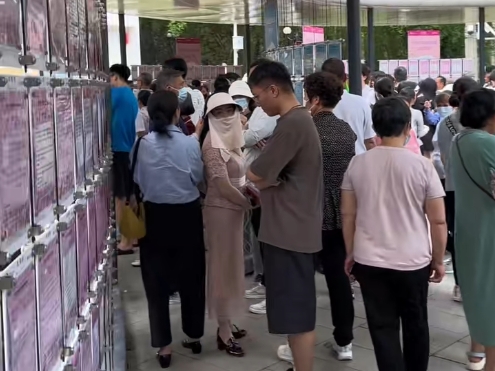
In China, there is a serious gender imbalance between men and women in rural and urban areas. The number of young single men in the countryside is close to 30 million, while there is a large number of “leftover women” in cities who cannot find ideal partners. The number of “leftover women” in Beijing, Shanghai, Guangzhou, and Shenzhen, the four first-tier cities, is around 2 million each. The contrast between “rural male singles” and “urban female singles” is quite unique.
According to the data from the “China Statistical Yearbook 2024,” based on the age for marriage, the number of unmarried women in Beijing is 2.23 million, followed by Shanghai with 2.09 million, Guangzhou and Shenzhen with 1.88 million and 1.79 million respectively. Cities like Nanjing, Hangzhou, Chengdu, and Wuhan also have over 1 million unmarried women.
In the group of “urban leftover women,” many women cannot find the men they idealize, while others are overwhelmed by the pressures of life and choose to “lie flat.”
Fang Fang, who works in matchmaking in Beijing, mentioned that many female clients have high expectations regarding the appearance, education, financial status, and family background of potential partners. However, these women over 30, 35, or even 40 years old often overlook the fact that men with these favorable qualities tend to seek women around the age of 25. If women do not compromise, it is challenging to find a match.
Another typical case is Xiao Wu, a 33-year-old office worker in Beijing. She expressed her reluctancy towards marriage, citing the daily hardships faced by her mother at home while her father does nothing, playing the role of a “hands-off master.” She would rather not have such a marriage. She noted that among the younger generation of Chinese urban women, there are many who share similar thoughts.
In stark contrast, in rural China, there are 30 million young single men who struggle to find brides. This situation is considered an inevitable outcome of the Chinese Communist Party’s implementation of the “family planning” policy for over thirty years. According to the 2020 census data, the gender ratio among city adolescents is 106 males to 100 females, while in rural areas, it reaches 120. If middle-aged populations are included, the gender ratio in rural areas would be even higher.
Moreover, in rural China, there is a tradition of the groom giving a “bride price” (dowry) to the bride’s family. With the prevailing societal emphasis on “money is paramount” after the CCP’s reform and opening up, the bride price has been skyrocketing. Coupled with the imbalance between men and women, in recent years, brides have demanded dowries exceeding 200,000 RMB. For rural residents with monthly incomes of only 3,000 to 5,000 RMB, marriage often means the groom borrowing money to the point of bankruptcy.
As a result, many rural men can only choose to remain single, and in some areas, there are even “single men villages.” For instance, in Xiaoping Village, Yushu Township, Xiushui County, Jiangxi Province, out of around 100 households, there are 30 unmarried men above the age of 40, accounting for one-third of the total households. What’s more alarming is that no one in the village has gotten married for five consecutive years. Villagers describe that in the village’s WeChat group, the majority of profile pictures are male, with less than 20% being female, and most are relatives or family members of male villagers.
A villager named Wu, who makes a living by beekeeping, was asked if he wants to get married, and he wryly smiled, saying that he can only earn 2,000 RMB a year from beekeeping and has to support his elderly parents. “Get married? I dare not even think about it,” he said.