
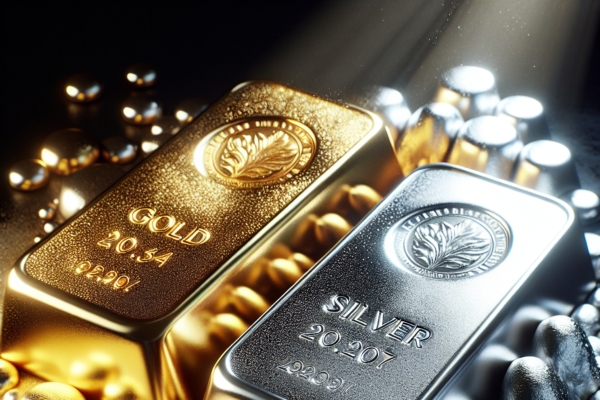
Recently, the international gold price has been fluctuating. In Shuibei Market, a major hub for gold jewelry in China, sales of gold jewelry and investment bars have remained hot. In stark contrast, the Shuibei silver market has fallen into an awkward situation of “short supply but lack of demand” after prices synchronously retraced.
On January 30th, the international gold market experienced a sudden epic plunge, with spot gold plummeting from a historical high of $5,594 per ounce, marking a drop of over 12% at its largest during the trading day, the biggest single-day decline in nearly 40 years. On February 2nd, it dropped by over 10% again in a single day, hitting a key support level at $4,403 per ounce.
As of February 12th, the price of gold bars in Shuibei Market was quoted at 1,163 yuan/gram, significantly lower than the selling price of 1,411 yuan at the end of January. According to a report by “Huaxia Times” on February 17th, just before the Chinese New Year, there was a surge in customer traffic at Shuibei Market, with small weight gold jewelry and investment bars selling well as citizens took advantage of the recent rational pullback in gold prices.
Several gold counters in Shuibei indicated that after the price rollback, there was a significant increase in market traffic, with traditional gold items like necklaces and bracelets continuing to be popular. Moreover, small weight pendants featuring unique designs like dolls and Ultraman have become a new favorite among the younger demographic.
During this consumption wave, the gold commemorative note for the Year of the Horse has become a best-selling item. A citizen who bought it for the holiday season stated that compared to a thousand-yuan red envelope, a gram of the Year of the Horse gold note combines commemorative significance and value-retention attributes, saying it’s a win-win for commemoration and financial management. This view has also become a consensus among many holiday shoppers.
An industry practitioner with eight years of experience in Shuibei sales mentioned that buying gold for the Chinese New Year is a long-standing consumer tradition, with essential needs like weddings, gifts, and symbolically adding accessories for elders and children remaining constant, regardless of gold price fluctuations.
The price drop has become a significant driver for market consumption.
In sharp contrast to the fervor in the gold market, the silver counters present a different picture. The premiums have surged far beyond acceptable levels, with no takers at the silver counter.
At the end of January, the silver market experienced an epic plunge. In early February, the price of silver dropped by over 36% in a single day, causing panic in the market. As of February 12th, the price of silver in Shuibei was quoted at 27.8 yuan/gram, a noticeable decline from the 38.1 yuan price at the end of January.
The industry practitioner with eight years of experience at the Shuibei counter said, “Not a single serious customer all day, occasionally someone stops to inquire about the price, upon hearing it, they turn and leave. ‘It reshapes understanding. They are all precious metals, why such a big difference?'”
She believes that the silver market’s quietness is primarily due to the market logic reconstruction following the gold and silver plunge at the end of January, coupled with various issues within silver itself, leading consumers to lose all willingness to consume and invest. The unexpected surge in premiums is cited as the most direct reason, negating all the positives brought by the price rollback.
She introduced that previously, the market premium for silver was just a few cents per gram, never exceeding one or two yuan. However, starting from November 2025, the premium for silver witnessed a frenzied rise, climbing continuously to 6 yuan, 10 yuan per gram, with some dealers abandoning premium pricing and directly selling at a fixed price. Downstream businesses not only need to compete fiercely for goods but also have to accept the high premiums.
This directly led to a severe disconnect between the actual selling price of silver and consumer expectations. Currently, the market price for silver is only around 20 yuan/gram, but including the premium leads to a terminal selling price of 28 yuan/gram.
She remarked, “The price has dropped, but the actual selling price hasn’t, it’s even more expensive than before,” and businesses are unable to offer a reasonable explanation for this pricing structure, only watching customers drift away.
Furthermore, the chaotic supply system has exacerbated the market’s difficulties. The industry practitioner further pointed out that the Shuibei silver market is currently stuck in a strange cycle of “short supply but no one dares to take” due to dealers holding back on sales.
When silver prices soared to a high of $116 per ounce at the end of January, some dealers had aggressively bought back silver at 34 yuan/gram. The subsequent price plunge led to significant losses, prompting dealers to hold back on sales and raise premiums. Even in the face of tight supply, they are unwilling to sell at lower prices.
This dilemma has put downstream businesses in a bind: buying at high prices makes it difficult to sell at the end, while not raising prices puts them at risk of losses.
“Meanwhile, low-priced silver in channels also presents quality issues like iron and tin impurities, while on the regular route, supply is tight and prices are high, causing consumers to shy away from silver due to concerns about quality,” the industry practitioner said.
The report mentioned that silver’s inherent shortcomings, including the lack of essential retail demand and high price volatility, are the fundamental reasons why it cannot compete with gold.