
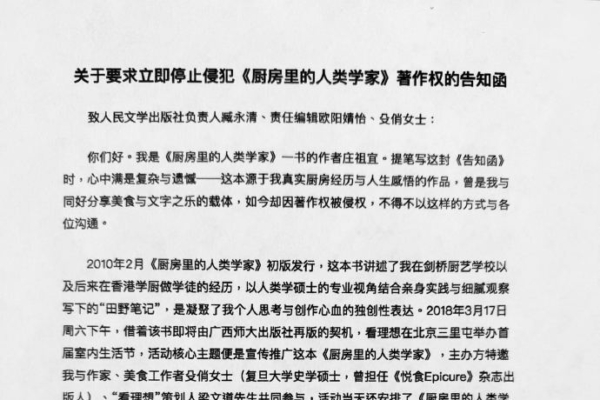
Recently, Taiwanese writer Zhuang Zuyi, living in the United States, has officially issued a copyright infringement notice to well-known mainland Chinese food writer Shu Qiao (female) for systematic plagiarism of her work “The Anthropologist in the Kitchen,” sparking public attention.
Zhuang Zuyi stated on social media that her renowned work “The Anthropologist in the Kitchen” was plagiarized word for word by Shu Qiao, and despite sending a lawyer’s letter to the other party and the publishing house, there has been no response.
She revealed that she personally knows the other party.
Through revelations by the Weibo blogger “The Forest of Lyricism,” Zhuang Zuyi discovered that in Shu Qiao’s 2023 novel “Food Diary,” core chapters (such as “Knife Skills Training” and “Deboning for Chicken”) are 100% identical to her 2010 work “The Anthropologist in the Kitchen,” including personalized metaphors (such as the sound of knife sharpening described as “a master unsheathing a sword”), professional terminology (French cutting technique sequences julienne/allumette/batonnet), and unique expressions like teacher-student dialogue patterns.
The two authors jointly participated in the Beijing “Indoor Living Festival” in 2018 to promote Zhuang Zuyi’s work, and Shu Qiao had a clear understanding of the original writing style. Zhuang Zuyi believes that Shu Qiao’s actions constitute “knowingly committing systematic plagiarism.”
Zhuang Zuyi attempted to communicate through WeChat private messages, but was ignored by the other party who deleted her as a friend. Appeals conveyed through the copyright holder “Ideal Country Publishing House” have also gone unanswered.
On January 26, 2026, Zhuang Zuyi sent a formal lawyer’s letter, accusing Shu Qiao of “verbatim appropriation” of her content, demanding the immediate removal and cessation of sales of the novel “Food Diary” by People’s Literature Publishing House and Shu Qiao herself; public apology and publication of the infringement facts; compensation for economic losses and legal fees.
As of February 11, there has been no response from the parties involved, prompting Zhuang Zuyi to consider legal action and appeal to public opinion.
This incident has been simmering on mainland Chinese social media for several days. Some netizens have juxtaposed screenshots showing the related scenes in “Food Diary” (the protagonist saying “I have a conscience and bottom line”) with the act of plagiarism, creating an ironic contrast.
Some netizens question Shu Qiao and the publishing house for deliberately ignoring intellectual property rights due to Zhuang Zuyi’s lack of discourse power in China, while some voices support Zhuang Zuyi in defending the dignity of original creation.
A netizen with the handle “Arrogance and Hubbub”: If literature wishes to survive, it must start with preserving the dignity of originality.
“Titanium Tantalum”: Zhuang Zuyi, being blocked in mainland China with no way to seek justice, can only uphold righteousness online, while Shu Qiao has even deleted her on WeChat, assuming the other party is helpless. If Zhuang Zuyi were still the American Ambassador’s wife in China today, would this matter have been resolved quickly? No, perhaps no one would dare to plagiarize her work.
Zhuang Zuyi graduated from the English Department of National Taiwan Normal University and the Anthropology Research Institute at Columbia University in the USA. She is well-known in the culinary literary circle in Taiwan and has authored works like “The Human Fields at the Dining Table” and “The Anthropologist in the Kitchen.” Her husband is the former Consul General of the United States in Chengdu, Lin Jiewei, and she has also lived in Chengdu.
Shu Qiao, born in Shanghai in 1980, with ancestral roots in Wuxing, Zhejiang, is an author and founder of the Yue Shi Chinese Culture Project. She also serves as the publisher and editor-in-chief of the “Yue Shi Epicure” magazine and the producer of the documentary “Yue Shi China.”