
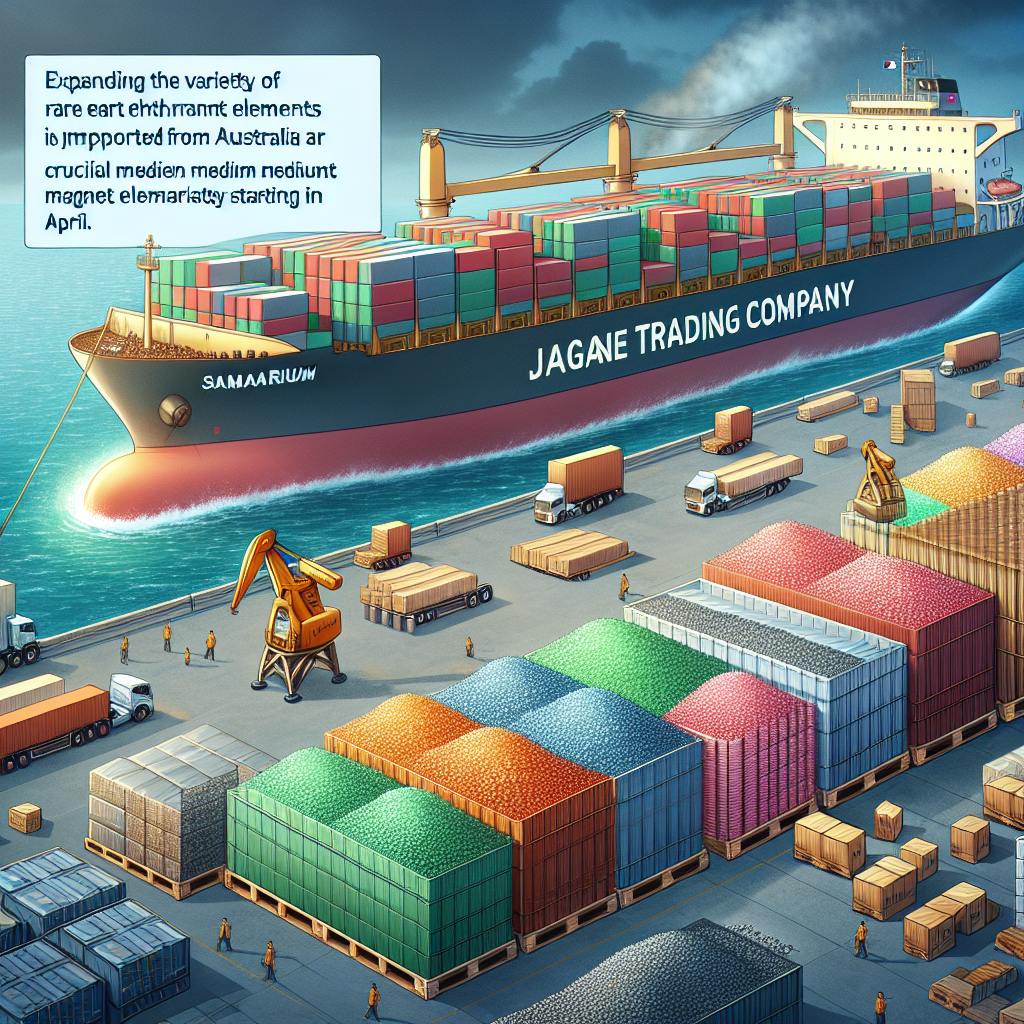
Japan’s trading company, Sojitz, is expanding the variety of rare earth elements imported from Australia. Starting in April, they will be adding the crucial permanent magnet material, samarium, to their imports and plan to increase the types of medium and heavy rare earth elements imported by mid-2027 to as many as six, up from the current two.
According to Nikkei Asia, Japan currently relies almost entirely on China for its supply of medium and heavy rare earth elements. Sojitz’s move signifies a new step for Japan in reducing its dependence on Chinese critical mineral resources, which are vital for high-tech industries.
Samarium is a key material in permanent magnets, which are crucial for the defense and energy sectors, used in manufacturing fighter jets and nuclear reactors among other applications. While Lynas Rare Earths in Malaysia has launched commercial production at a new medium and heavy rare earth separation plant, Sojitz will begin importing samarium. Lynas is the largest rare earth producer in Australia, in which Sojitz holds a partial stake.
Lynas stated that this will be the first commercial production of samarium outside of China. Japan’s annual demand for samarium is around 80 tons; the specific import quantity by Sojitz is yet to be determined.
Lynas also plans to start producing gadolinium at its refining plant in Malaysia. Gadolinium is used for medical imaging diagnosis and control rods in nuclear reactors. Additionally, the company will increase the production capacity of dysprosium and terbium, two heavy rare earth elements that are already being produced at other plants and exported overseas. These elements are crucial for electric vehicle motors and other high-performance applications.
By around mid-2027, Sojitz plans to add two to three more imported raw materials, possibly including gadolinium and yttrium, which are commonly used in medical devices.
Rare earth elements are crucial materials for high-tech industries, with China currently controlling 70% of global rare earth mining and 90% of rare earth processing. In recent years, rare earths have become a significant tool for Beijing in diplomacy. In January this year, China tightened export controls on dual-use rare earths, making diversifying supply chains an urgent priority for the Japanese government.
Japanese Prime Minister Sanae Takii expressed Japan’s intention to cooperate with the United States in developing rare earth deposits near Japan. Given efforts by Japan and the U.S. to construct a supply chain that is not overly reliant on China, this issue could become a key agenda item at the mid-March U.S.-Japan summit between Takii and Trump.
Takii mentioned on a TV program on February 8, “I hope to accelerate this project with full cooperation from the United States.”
Japanese Finance Minister Okatsuki Katsuki stated in an interview with Nikkei Asia on January 9 that Japan should collaborate with the U.S. and Europe to establish a rare earth supply chain to prevent China from turning critical minerals into an economic “weapon.”
She emphasized that the Japanese manufacturing industry should gradually decrease its reliance on Chinese rare earths. Failure to sever China’s monopoly and weaponization of critical minerals could pose a future continuous threat even in non-security-related matters.