
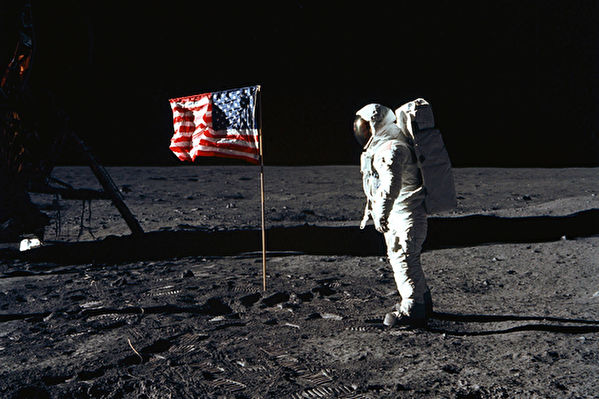
The competition between the United States and China over lunar exploration has spurred two American billionaires to accelerate their lunar projects. Elon Musk’s SpaceX and Jeff Bezos’ Blue Origin are both racing to send humans back to the moon before Beijing’s target of 2030.
According to Reuters, Musk plans to conduct the first public offering (IPO) by the end of this year. He recently stated in a podcast interview and company meetings his ambition to build a lunar base named Alpha, deploy satellite launchers on the moon’s surface, and create a space artificial intelligence computing network composed of one million satellites.
Musk’s increased focus on the moon signifies SpaceX’s shift from its initial Mars colonization mission to conquering the moon. Last summer, Musk even mentioned sending an unmanned Starship spacecraft to Mars as the moon was getting in the way.
In recent weeks, Bezos’ Blue Origin has redirected more resources towards its lunar plans, shutting down its suborbital space tourism business to allocate resources to the Blue Moon lunar lander project in preparation for this year’s planned unmanned lunar mission.
Musk is currently working on convincing investors to maintain confidence in SpaceX’s dominance in the space sector. Post-IPO, SpaceX’s valuation could exceed $1 trillion. Last Friday, SpaceX launched the latest manned mission to the International Space Station for NASA.
On the other hand, Bezos also released a black and white image of a turtle, reminding people of Aesop’s fable of the Tortoise and the Hare. Other aerospace company executives expressed their hope to benefit from the new lunar investments from the U.S. government and the two companies.
SpaceX won NASA’s Artemis moon landing project contract in 2021. Under this $4 billion contract, SpaceX is tasked with adapting its massive Starship rocket into a lunar lander capable of transporting astronauts back and forth from the moon’s surface. SpaceX has committed to preparing the Starship for NASA’s Artemis III mission, marking the first American moon landing in over half a century.
NASA’s Artemis manned lunar program aims to establish the first long-term human outpost on the moon and prepare for future manned missions to Mars. In addition to SpaceX, participants in the Artemis program include Blue Origin, Boeing, Lockheed Martin, and Northrop Grumman.
As NASA strives to relive the glory of the Apollo moon landings, China is devising innovative plans to carry out its own manned lunar mission.
The China National Space Administration has stated its intention to conduct three unmanned lunar missions in the next decade as it aims to compete with the United States in the new era of space exploration.
Richard Fisher, a China military affairs expert at the International Assessment and Strategy Center, said, “The goal is to control low-earth orbit to defeat the United States on Earth.”
This year’s Blue Origin unmanned lunar mission serves as a prelude to manned moon landings and is part of NASA’s Artemis program. Last week, Blue Origin transported the lander to NASA’s Johnson Space Center in Texas for thermal and vacuum testing.
Both Blue Origin and SpaceX are utilizing billions of dollars in NASA funding to construct their respective lunar landers. NASA plans to use these landers for a series of manned lunar missions, with the initial missions being carried out by SpaceX’s Starship. NASA, which first sent humans to the moon in 1969, sees the return to the moon as a rehearsal for future Mars missions and has been urging companies to expedite the development of lunar landers.
Following SpaceX’s acquisition of xAI this month, Musk aims to expand artificial intelligence computing into space. Musk expressed his desire this week to build a “self-growing city” on the moon and launch AI satellites from the lunar surface.
Andrew Chanin, CEO of space-focused investment firm ProcureAM, stated that the moon serves as a critical strategic springboard for SpaceX. If they can reach the moon first and establish infrastructure, they will have a say in how that infrastructure is utilized.
While SpaceX’s Starship rocket has yet to put any objects into orbit, it has launched 11 times since 2023 and is preparing for an upgrade test in a month. As a lunar lander, the development of SpaceX’s Starship involves many steps, including practicing fuel supply processes in orbit using another tanker Starship.
Kathy Lueders, former head of NASA’s Human Spaceflight Operations and head of SpaceX’s Texas Starship development base, mentioned that the competition between SpaceX and Blue Origin is intensifying, with Musk currently focusing more on the lunar project to compete with Beijing.
The competition between Musk and Bezos to embark on lunar missions has also impacted other sectors of the emerging lunar industry in the United States. Justin Cyrus, CEO of Lunar Outpost company, which has already sent a lunar rover to the moon’s surface, revealed that this week 20 investors contacted him. In the past two years, there has been a noticeable shift in the investment community’s perception of lunar surface, with Elon’s statements accelerating this change.
This intense competition and accelerated progress in lunar exploration indicate the exciting advancements ahead in space exploration and colonization.