
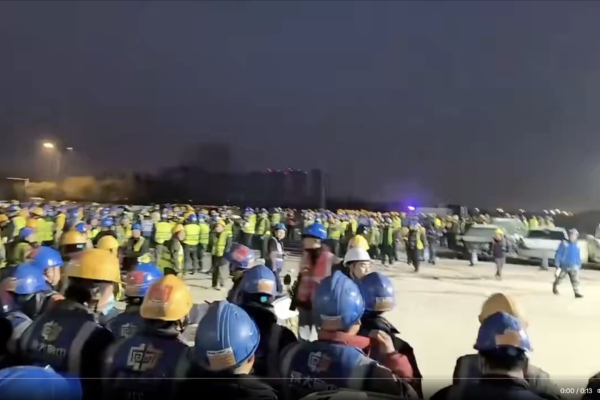
As the year comes to an end, large-scale wage arrears protests have erupted in various parts of China. From workers climbing cranes to threaten with suicide, subcontractors self-immolating, to laborers taking revenge on those who owed them, tragic events continue to unfold. The issue of unpaid wages spans across industries such as construction, manufacturing, healthcare, and public transportation, affecting over ten provinces and cities including Tianjin, Guangdong, and Shaanxi.
In recent days, individuals from different social strata in China have shared their stories in interviews with reporters. The interviewees universally expressed that this year’s wage arrears situation is far more severe than in previous years, leaving them with no recourse and facing desperate circumstances.
At the end and beginning of the year, which should have been the time for migrant workers to receive their earnings and return home, has turned into a time of despair for many.
Videos circulating on the internet show wage protest workers in various parts of China blocking entrances to companies, factories, and construction sites. Emotionally charged workers climbed rooftops or tower cranes, threatening to jump off, trying to exchange their lives for wages owed. Government reception agencies such as labor bureaus, petition offices, and local streets are also flooded with wage claimants seeking justice, presenting chaotic and desperate scenes.
Even more harrowing incidents have come to light. In Shanxi, a farmer who was owed over a thousand yuan in wages reportedly wiped out the entire family of the employer due to unsuccessful wage negotiations. In Fujian’s Quanzhou city, the state-owned Rongqi Group has long delayed project payments and worker wages, leaving workers with no money to return home, leading to a subcontractor setting himself on fire.
On February 13th in Luoyang City, Henan Province, many workers on a construction site threatened to jump off the building due to wage arrears. Writer Cui Chenghao shared a video depicting construction workers engaging in risky maneuvers to claim their wages. As one netizen commented, we should not mock them as the light they fight for will eventually shine on all of us.
Behind these extreme events lies a systemic debt crisis brought about by China’s continued economic downturn, leading to the dire choices faced by millions of ordinary workers when the system fails to protect their rights.
Several interviewees mentioned that they had attempted to seek legal and administrative solutions, but consistently hit a dead end.
A subcontractor from Suzhou, Sun Wenguang, recounted his two-year struggle to recover debts from Nantong Erjian Group Co., Ltd. “All the money goes into the boss’s pocket, how could the project funds reach the hands of the laborers?” He lamented the challenges he faced in trying to recover nearly 350,000 yuan owed to him by the group. Despite seeking assistance from government departments, the group remained reluctant to pay, making it extremely difficult to collect the wages due to his workers.
Liu Songlin, a migrant worker in Xi’an, also failed to receive his earnings this year. He stated that it was not only hard to find work at construction sites, but even when he could, getting paid was a challenge. He expressed the prevailing sentiment in the construction industry where many are giving up due to the difficulty in obtaining wages.
The article continues with more personal accounts of individuals across different industries, such as a bus driver in Shaanxi, a nurse in Shandong, and a government official from Jiangxi shedding light on the underlying financial and administrative challenges leading to the wage arrears crisis in China.
As the Lunar New Year approaches, the journey home for countless grassroots individuals remains uncertain due to the inability to claim their hard-earned wages, highlighting the plight faced by many in the face of growing economic pressures. Videos circulating online depict instances of farmers in Xi’an kneeling to demand their wages, only to be falsely labeled by the Chinese Communist Party as engaging in malicious wage claims. There have also been reports of individuals resorting to drastic measures such as setting fire to the houses of those who failed to pay their wages.
The names of the interviewees have been changed to protect their safety.