
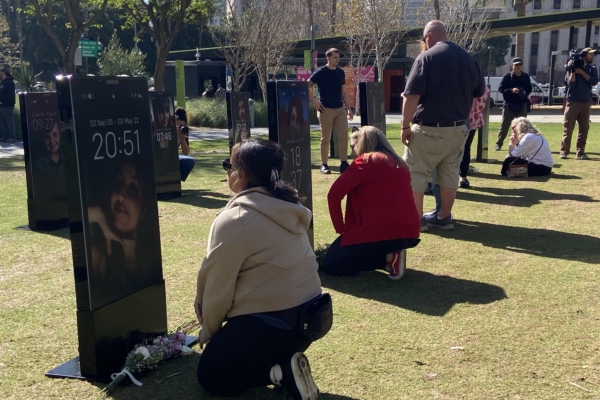
Amid the trial of the highly publicized addiction cases involving Instagram (owned by Meta) and YouTube (owned by Google) in California, 50 “large smartphone tombstones” appeared in downtown Los Angeles, displaying the photos of dozens of teenagers who lost their lives due to internet addiction and the harms of social media.
On Friday, February 13, parents from the United States and the United Kingdom held a press conference at the Gloria Molina Grand Park in Los Angeles, accusing social media platforms’ addictive designs and hidden dangers of taking away children’s lives, urging more parents to be vigilant.
“The Anxious Generation” author and social psychologist Jonathan Haidt stated during the event that for over two decades, major tech companies have ruthlessly treated children worldwide as “guinea pigs,” inducing addiction through constant adjustments of formulas and algorithms.
“They control an entire generation’s attention, they control children’s interpersonal relationships, depriving them of ample sleep, exercise, sunshine, and simple joys of gathering with friends during childhood,” Haidt said, highlighting the numerous damages inflicted upon children by these companies.
On the day of the press conference, an installation named “Lost Screen Memorial” was unveiled. The installation consisted of 50 large glowing smartphones, each displaying a photo of a teenager who tragically lost their life due to internet addiction and social media harms. This installation aims to echo an ongoing “landmark” lawsuit.
On Monday, the California court heard the case accusing major tech platforms Instagram and YouTube of enticing users into addiction. The case was initiated by a 20-year-old woman using the pseudonym KGM, who sued social media companies including Meta, alleging that their intentional addictive platform design led to her developing anxiety, depression, and suicidal thoughts, severely impacting her mental health.
Primary defendants Meta and Google denied the allegations and applied for summary judgment, requesting the judge to dismiss the case for various reasons. According to court documents, the judge rejected Meta and Google’s application on November 5 last year. Other defendants TikTok and Snapchat have reached settlements with KGM before the trial.
In recent years, tragedies of young people losing their lives due to harmful content on social media have become all too common. At the event on Friday, Sarah Gardner, CEO of the “Heat Initiative” organization, stated, “Today, we have 50 children who lost their lives here, but there are hundreds more such tragedies. We cannot let any more children die due to the negligence of tech giants.”
George Nicolaou, a parent of one of the victims, held a photo and told reporters, “This is our lovely son Christopher.”
Nicolaou recalled that in 2022, online criminals found his son and coerced him with threats to the family’s lives, pushing him to complete a series of challenges.
“At first, it was just simple challenges, like finishing a bowl of cereal within 2 and a half minutes and going back upstairs. Eventually, it turned into staying up all night watching horror movies, staying up until dawn, filming himself doing these challenges, and more,” Nicolaou said, explaining how his son reached the end of his life through gradual inducement.
Another young teenager, 12-year-old Erik Robinson, lost his life after attempting a “Blackout Challenge” game where one holds their breath until passing out. Judy Rogg, a relative, told reporters, “Robinson had no idea that what he was about to do could cost him his life.”
Apart from the mentioned dangers, the online world is rife with drug dealers.
Bridgette Norring, a parent of a victim, shared, “When my son Devin was 19, he suffered from fainting spells, migraines, and a cracked molar. In the first week of the lockdown due to the pandemic, as his doctor’s appointment got canceled, he sought immediate relief and turned to Snapchat.” Consequently, a drug dealer sold fake fentanyl pills to Devin through social media. After taking them, he never woke up again.
Rogg sorrowfully expressed, “Our children couldn’t be saved, so we became volunteer parents, hoping to help save other children from harm.”
More and more studies indicate that a significant number of adolescents using phones and social media are no longer driven by interest or leisure but have developed an uncontrollable habit. Some research shows that by the age of 10, children addicted to phones or social media have a suicide risk two to three times higher than their peers.
Currently, multiple countries globally are suing social media platforms for harming children’s mental health. Australia and Spain have already banned users under 16 from accessing social media platforms, and many other countries are considering similar measures.